

Writer: Gerri Detweiler


Editor: Jon McDonald


Reviewer: Ashley Fricker

If you’re struggling to get approved for a credit card because of bad credit, you may be willing to settle for any card you can get. But some credit cards for bad credit (often referred to as “subprime cards”) can be expensive.
Be careful. If the card you get isn’t affordable, you may miss payments, and missed payments can lower your credit scores.
In this guide, you’ll learn how to compare subprime credit card fees and costs so you can make an informed decision about which card is best for you.
Step 1: Learn the Different Types of Fees
Before we get into the costs, though, let’s define subprime. There’s no single definition, as each lender can make that decision individually.
Using VantageScore 4.0, Experian defines subprime as a score of 600 or below, and deep subprime as 500 or below. FICO notes that lenders may consider scores of 580 to 619 subprime, and scores below 580 deep subprime.
Now, for some of the fees subprime cardholders may encounter:
| Type of Fee | Charged when you: |
|---|---|
| Setup or Processing | Get the card |
| Annual | Open the card and each year on the card anniversary |
| Monthly | Keep the card open from month to month, regardless of activity |
| Statement | Request paper statements |
| Cash Advance | Get a cash advance using the card at an ATM or bank |
| Overlimit | Go over your limit (requires you to opt in) |
| Late Payment | Pay after your due date or due date cut-off time |
| Return Payment | Make a payment that “bounces” because you don’t have enough money in your account |
| Balance Transfer | Use a balance transfer to pay off other debt |
Subprime credit scores are seen as riskier, and borrowers who get a loan or credit card with low credit scores are likely to be charged higher interest rates on top of these fees.
Other Common Costs You Need to Know
Fees are just one way issuers make money. You may see additional costs, including:
- Interest Charges: Poor credit often means you’ll be charged a high interest rate for purchases. If your card offers a grace period, you can avoid interest by paying off the statement balance by the due date.
- Penalty Interest Rates: Card issuers (and not just those that offer subprime options) may charge an even higher penalty interest rate (also called a default interest rate). If you are late with a payment, your interest rate may go up to the penalty rate.
- Security Deposits: If you choose a secured card, you’ll place a security deposit with the issuer. It’s not a fee because you’ll get that money back when you pay off your full balance and close your account. But you won’t be able to access that money while the card is open.
What the Law Says About Fees
For many years, there were virtually no limits on the fees issuers could charge. Some people ended up with cards where nearly the entire limit was eaten up by fees.
A federal law, the Credit Card Accountability Responsibility and Disclosure Act of 2009 (Credit CARD Act), changed that by limiting certain credit card fees.
Under that law, initial required fees, such as setup or monthly fees, can’t exceed 25% of the credit limit in the first year. Additional penalty fees, such as late fees, can still be charged on top of that.
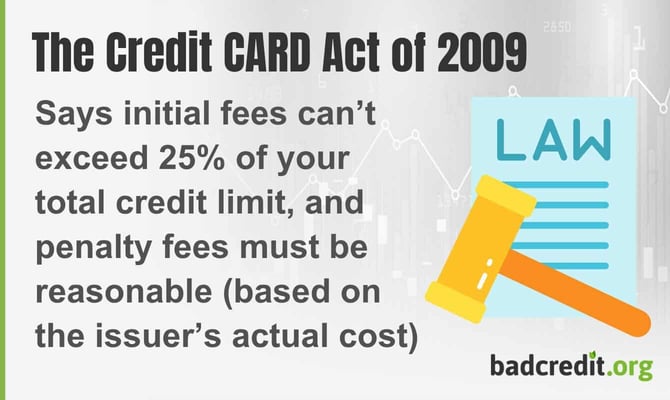
Another section of the law says that the dollar amount charged for penalty fees, like late fees or over-limit fees, must be reasonable based on the issuer’s costs.
The Consumer Financial Protection Bureau (CFPB) tried to place an $8 cap on most penalty fees in 2024, but that proposed rule was struck down in court and rescinded the following year. The cap currently stands at $32 for the first violation and $43 for the second one.
Additionally, over-limit fees can only be charged if the cardholder opts into transactions that will put them over their limit.
Step 2: Read the Fine Print Like a Pro
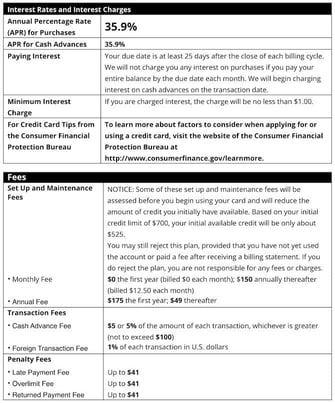
Issuers are required to tell you the essential costs of a card upfront. These are listed in what’s known as the “Schumer Box” after the legislation that required this disclosure.
Review the Schumer Box
The Schumer Box was designed to be easy to read and lay out all of the card’s costs on one simple page. Here’s the key information you’ll find in the Schumer Box:
Annual percentage rates (APR)
- Purchase APR
- Cash advance APR
- How interest is calculated
- Minimum interest charges
Processing or setup fees
- Annual fees
- Monthly fees
Transaction fees
- Cash advance fees
- Foreign transaction fees
Penalty fees
- Late payment fee
- Overlimit fee
- Returned payment fee
So, the next time you are thinking about getting a credit card, you can skip all of the marketing language and go straight to this if you want to see what you’ll actually pay.
What to Look for in the Cardholder Agreement
When you get your card, read the cardholder agreement for answers to these key questions:
- How is interest calculated?
- How are payments calculated?
- When are payments due?
- What happens if you pay late?
- How can the terms of the card change?
- What can trigger these changes in terms?
- What are your options if terms change?
You’ll also see a section describing your rights, including what to do if you have a billing dispute.
It’s not fun reading, but it is a legal contract that can affect your finances, so try to make time to review it.
Step 3: Do the Math to See the Real Price
Just like subscriptions that you forget to cancel, credit card fees and interest charges can creep up on you if you’re not careful. Here are two ways to evaluate the fees of a card you’re considering:
The Credit Limit Test
With this calculation, you compare the upfront fees to your credit limit. This gives you a clearer picture of how much credit you really have available (your spending power, if you will) when you start using your card.
Example:
- Credit limit: $500
- Annual fee: $50
- Other fees (e.g., set-up or processing): $25
- First month’s fee: $5
- Actual spending power: $500 − $50 − $25 − $5 = $420
That means your spending power, even with a $500 credit limit, is instantly reduced by $80. And you’ll need to start paying that back on your first statement, especially if you want to avoid interest.
How to Calculate Your Annual Cost
A $5 monthly fee may not seem like a lot, but over the course of a year, it adds up to $60. Add in other fees, like an annual fee or a paper statement fee, and you may be paying more than you realize.
That’s why you don’t want to look at these fees in isolation. Add all your fees to figure out how much the card will cost in the first year.
Example:
- Annual fee: $100
- Other fees (e.g., set-up or processing): $25 (enter $0 if none apply)
- Monthly fee: $5 ($5 × 12 months = $60/year)
- Total first-year cost: $100 + $25 + $60 = $185
If your card doesn’t charge an annual fee in the first year, but starts charging one in the second year, you may want to extend this formula out for two years and average the results. That will give you a better picture of the true annual cost.
Alternative Options for Building Your Credit
If a fee-heavy subprime card isn’t a fit, you can explore other options for building credit.
Secured Credit Cards
With a secured card, you place a security deposit with the card issuer, and your starting credit limit is often equal to your deposit.
When you close the account and pay off your balances, you’ll get your deposit back. Some cards will raise your credit limit as you build your credit history, without requiring you to add to your deposit.
If you want to see exactly how a secured credit card could fit your situation, we developed this tool to help you build a strategy:
Secured card issuers can also charge annual fees and penalty fees, and interest rates can be high. As with any card, read the fine print.
Credit-Builder Loans
A credit-builder loan can help you build a savings account and a credit history at the same time. With one of these accounts, you save money each month toward a specific savings goal and those payments are reported to credit bureaus.
You get your money back, minus any fees, when you either reach your goal or close your account.
Don’t Get Surprised by Fees on Subprime Credit Cards
A credit card can be helpful if you’re trying to build or rebuild your credit, or if you want a safer way to make online purchases. If you’re having trouble qualifying for one, you may be tempted to get any card you can.
Before you apply, shop around. A variety of credit cards may be available if you have bad credit, and shopping around can help you find one that’s best for your situation.
As your credit improves, don’t be afraid to shop around again. Stronger credit scores can give you access to new options.


