
Writer: Erica Sandberg


Editor: Lillian Guevara-Castro


Reviewer: Ashley Fricker

Credit scores aren’t numbers that rate consumers by superficial characteristics or traits, such as age or home location. Unbiased at its core, credit scoring rates borrowers based on their actions, not their character.
Existing disparities can, however, give the opposite impression. Studies indicate significant variations in credit scores across the racial divide, making us ponder what external factors are at play, influencing these differences.
So, how do credit scores vary by race? And what are the primary reasons behind these substantial differences? We’ll explore that below.
Asian Americans Have the Highest Average Credit Scores: 745
FICO reports that the average credit score in the U.S. was 717 in 2024, which lands in the “good” range.1
According to Moneyzine, Asian Americans hold the highest average credit scores, with an average score of 745. A number like this falls into the “very good” classification on the credit score meter.
Here is how every race compared in credit scores in 2023, according to Moneyzine2:
| Race | Median Credit Score |
|---|---|
| Asian | 745 |
| White | 734 |
| Black Non-Hispanic | 677 |
| Hispanic | 701 |
You can view a credit score as a barometer measuring a borrower’s credit activity. Credit scores use credit and debt information that appears on credit reports to generate a number (from 300 to 850) that lenders can use to rate creditworthiness and set terms.
Like an atmospheric barometer, credit scoring models, such as FICO Scores and VantageScores, can sense shifts in your credit activity and either increase or decrease your score depending on that new information.
In credit scoring, the higher the number, the better. Higher numbers represent greater creditworthiness and indicate less lending risk, meaning access to better credit terms, e.g., lower interest rates.
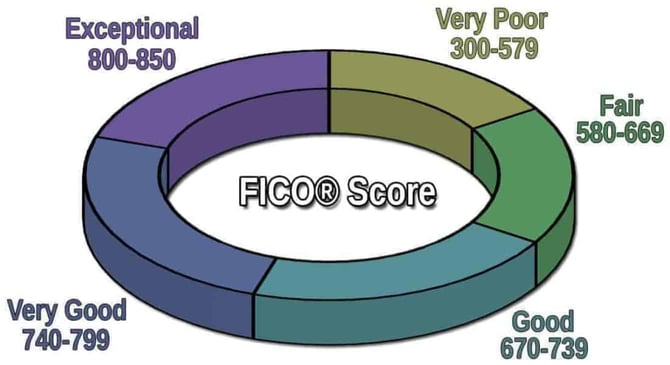
According to FICO, the distribution of credit scores by what is considered poor to exceptional is as follows:
| FICO Score Categories | Score Range |
|---|---|
| Exceptional | 800-850 |
| Very Good | 740-799 |
| Good | 670-739 |
| Fair | 580-669 |
| Poor | Below 580 |
If you have a score of 745, your number would fit within the very good range. Not many people reach this status, with only 28% of Americans having a score of 740 or higher. Even a smaller percentage has an exceptional credit score. According to Experian, only 22% of Americans have scores in the exceptional range.4
But don’t worry if you don’t fall into either of these categories. More attractive credit options are available to those with higher scores. But raising your score isn’t beyond reach. Implementing practical tips can help you get onto the right path.
High credit scores are a result of maintaining a record of long-term positive borrowing and repayment activity. That means having and using a variety of credit products, such as loans and credit cards, responsibly for many years.
A person with a good credit score pays their bills on time and keeps their revolving credit debt levels low relative to the amount they can borrow with the credit line. Avoiding negative mistakes or fraud can also prevent any infractions that could decrease your score.
Native Americans Have the Lowest Average Credit Scores: 612
According to the Urban Institute’s data, Native Americans have the lowest average credit scores in the United States, at 612.5 These scores are in the fair range.
Though securing credit products is possible with such scores, your credit terms won’t be as appealing as those of someone with higher numbers. Conditions such as interest rates, perks, and rewards won’t be as attractive because of the level of risk associated with a lower credit score.
Studies also found that Native Americans are more likely to have “thin credit,” meaning little to no credit history, than those of other racial backgrounds.
The National Community Reinvestment Coalition reported that Native Americans tend to have limited access to banks and other financial institutions, making it difficult to establish credit and build a positive credit history.6
Someone with no accounts listed on their credit reports will have no credit scores at all. And the only way to shift the tides is to gain access to credit opportunities.
For those seeking to build credit, there are plenty of avenues available to start your journey. You can apply for a myriad of things that can contribute to your credit score, including a credit card, a car loan, a mortgage, and a personal loan.
But beware: A person’s credit scores will be lower if there is negative information on their credit reports, such as a history of late payments, accounts in collections, defaults, bankruptcies, and high debt relative to revolving credit limits (credit cards, usually).
Applying for many new credit products in a short period will also cause scores to be lower, especially when a person has a thin credit file or already has scores at the lower end of the scale.
Remember, good things take time. You can’t build a great credit score overnight. It takes time to create a good credit score, as well as time (and money if people want to pay professionals) to rectify problems that bring scores down.
Reasons Credit Scores Vary Among Races
Credit scores were designed to be neutral algorithms built with fairness in mind.
Their purpose is to create an objective system where borrowers are not judged based on irrelevant factors such as race, sex, marital status, religion, or any other discriminatory considerations, but solely on their actions and spending behavior.
In fact, credit scores do not include income in the calculations either (though lenders will ask for that information on the application) to avoid discriminatory practices.
Credit scores are strictly based on a borrower’s history of behavior, such as how often a person takes out credit products and then uses them.
So why do credit scores vary so much according to race? There are a few main drivers:
- Income. The more a person earns, the greater the likelihood they will have higher credit scores. Consumers with higher incomes are more likely to use loans and open credit cards to purchase the things they need and can afford to repay. Data shows that income disparities based on race exist. According to the U.S. Census Bureau, the average incomes by race are7:
- Asian – $112,800
- White – $89,050
- Black – $56,490
- Hispanic – $65,540
- Access to conventional financial products. People from underserved communities don’t always have access to conventional credit sources and often seek out alternative lending options to fill in the void. For example, payday loans are disproportionately used by Black and Hispanic communities.8 Not only are these products absent from credit reports, but they are expensive relative to conventional loans and credit lines, making them more difficult to pay back. This can lead to a cycle of debt for borrowers.
- Trust in banks. To become an active borrower, maintaining a deposit account with a bank is key. But USA Facts reported that Black Americans have the highest unbanked rate — at 14% — of any demographic group.9
- Wealth gap. The wealth gap related to income is the amount of money a person keeps, which creates stability. In the event of a financial emergency, such as job loss or a large unexpected expense, a person who has substantial savings and investments won’t have to rely on credit products and loans and then fall behind on payments, causing credit scores to decline. Black and Hispanic families hold a lower distribution of wealth on average compared to White families, according to the St. Louis Federal Reserve.10
There are various factors that contribute to why racial disparities exist in credit scores, and most of these factors point to a broader problem: a lack of access to financial services.
But significant progress is underway. The rise of fintech solutions could help bridge the gap between financial institutions and underserved demographics.
And notable credit scoring models, like FICO, are making moves to integrate alternative data, including Buy Now, Pay Later data, into credit reports to create more precise risk assessments and help with consumer access.
Still, being proactive is important. Learning how to build credit is one of the first steps to getting on the right track, despite these challenges. Check out these tips for how to improve your credit score here.
Key Takeaways
Creating a good or better credit score has a lot to do with using credit products the right way. Credit scores are based on a borrower’s behavior, so how well you steward your credit responsibilities will determine your score and creditworthiness.
But we can’t ignore the impact external factors can have on credit scores. Elements, including income, accessibility, and wealth gaps, can make it more challenging for people to build or even establish good credit histories.
Additionally, if problems arise, you would need to address them swiftly. That requires catching and remedying issues such as mistakes and fraud by paying attention to credit reports and filing disputes. This process can take considerable time out of one’s day, which can be a hardship for people who are financially struggling.
So while it is possible for everyone to develop high credit scores, racial disadvantages and discrepancies remain.
Further Reading:
- Average Credit Score by Age
- Average Credit Score by State
- Average Credit Score by Income
- Average Credit Score in America
Data Sources:
1. https://www.fico.com/blogs/average-u-s-fico-score-stays-717-even-consumers-are-faced-economic-uncertainty https://apps.urban.org/features/credit-health-during-pandemic/
2. https://moneyzine.com/credit/credit-score-statistics/
3. https://www.myfico.com/credit-education/what-is-a-fico-score
4. https://www.experian.com/blogs/ask-experian/how-many-americans-have-800-credit-score/
5. https://apps.urban.org/features/credit-health-during-pandemic/
6. https://ncrc.org/native-americans-struggle-to-obtain-credit-a-close-analysis-of-native-american-mortgage-lending-from-2018-2021/
7. https://www.census.gov/library/stories/2024/09/household-income-race-hispanic.html
8. https://www.researchgate.net/figure/Disproportionate-use-of-payday-loans-by-African-Americans-and-Latinos_tbl1_228292240
9. https://usafacts.org/articles/who-is-unbanked-in-the-us/
10. https://www.stlouisfed.org/institute-for-economic-equity/the-state-of-us-wealth-inequality