

Writer: Andrew Allen


Editor: Ashley Fricker


Reviewer: Catherine McNally

Key Takeaways
- A new BadCredit.org survey found that 45% of pet owners have skipped or delayed their own medical, dental, or prescription care to pay for their pet’s care.
- Close to 4 in 10 have cut back on their own groceries or meals to afford care for their pet, and 1 in 3 have scaled back their savings.
- Almost as many people would go into debt for their pet’s medical care (48%) as for their own (50%).
- If they could afford only one emergency bill of $2,000, more than 2 in 5 (42%) would opt to pay their pet’s bill first.
- Approximately half of pet owners who don’t have health insurance for themselves have pet insurance.
Pets are a pretty big deal in America these days. In an era when many people feel more disconnected from one another than ever before, some may find themselves relying on the companionship of a furry friend rather than that of another human.
A recent report shone a light on the bond many pet owners in the U.S. have with their pets, revealing that 83% of them said their animal “feels like their own child.”
Many pet owners value their domestic animal so much that they pay for its care at the expense of their own health. Some even sacrifice money they would otherwise use to buy groceries or fund their savings. That may sound slightly unusual to a certain segment of the population, but if you’ve ever referred to your pet as your “fur baby,” you probably get it.
A new survey from BadCredit.org found that a surprising share of pet owners have skipped their own visits to the doctor so they could afford to pay for their pet’s care. Though younger generations may be more likely to go that route, putting one’s own health needs aside for those of their pet isn’t something that only younger adults have done.
45% Have Put Their Own Health Care on Hold for Their Pet
Surprisingly, nearly half of Americans (45%) surveyed said they’d put their health care to the side to prioritize their pet’s care. That is, they’ve skipped or postponed their own dental, medical, or prescription care so they could pay for their pet’s treatment.
Respondents who were members of Gen Z, or those aged 18 to 28, at the time of the survey were the most likely to say they have skipped or delayed their own care in lieu of treatment for their pet, with 56% indicating they had done so.
Millennials, those aged 29 to 44, and members of Gen X, those aged 45 to 60, were much less likely to say they’d made that move, at 43% and 42%, respectively.
Overall, 48% of women respondents with pets indicated they had put their own health care on the back burner for their pets. Only 40% of men said they’d done the same.
Pet Expenses Are Cutting Into Groceries and Savings
Some people are reluctant to visit the doctor even when all signs suggest they should. So they may be slightly more motivated than others to put aside their own health care for that of their pet. But choosing to give up food or opportunities to build a more stable financial future to afford pet care is a different level of sacrifice altogether.
Almost 9 in 10 (87%) survey respondents with pets said they’ve cut back on at least one thing to afford care for their pet. And the most common item they’ve cut down on, at 39%, is groceries or meals for themselves.
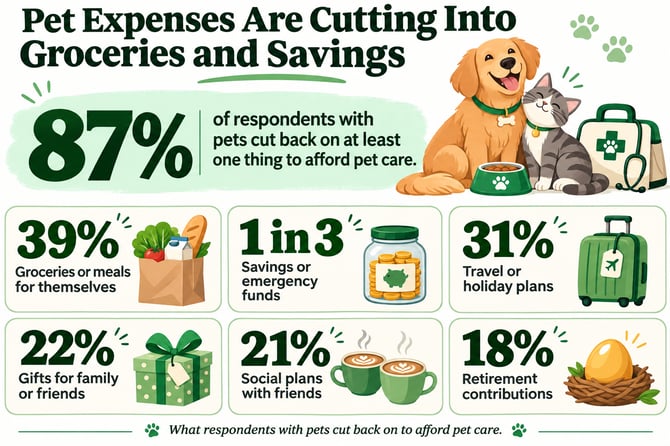
Meanwhile, one-third say they’ve put less into savings or emergency funds to afford the cost of pet care. Along those lines, nearly 1 in 5 (18%) said they’ve decreased contributions to a retirement account to afford treatment for a pet.
But it’s not just food or financial goals that people have put on the back burner for the sake of their pets’ health. Many have chosen to forgo fun activities, including 31% who said they’d scaled back on travel or holiday plans and 21% who indicated they’d trimmed social plans with pals.
Did a close friend give you a half-used candle or stale candy for your last birthday? Before you start scheming about how to out-cheap them on a present for their upcoming birthday, consider whether they had cut down on their gift budget to afford care for Fido or Fluffy. More than 1 in 5 (22%) survey respondents said they’d slashed spending on gifts for family or friends to afford pet care.
48% Would Take On Debt for Their Pet’s Medical Care
Some financial experts hold fast to the theory that all debt is bad. Whether those so-called experts ever had to choose between going into debt and getting care for a sick puppy is another matter.
Our survey revealed that nearly as many pet owners say they would take on debt for their own medical care (50%) as they would for their pet’s care (48%). And slightly more than one-third (34%) say they would not borrow money for their own care but would for that of their pet.
Financial gurus who espouse a no-debt philosophy shouldn’t feel that their message has been entirely lost on pet owners, as 15% of respondents said they wouldn’t borrow funds for their own or their pet’s medical care.
“Borrowing money is one way pet owners are managing the costs when they don’t have the spare cash. If you don’t have the funds upfront, a loan or credit card can definitely come to your and your animal’s rescue,” said Erica Sandberg, consumer finance expert at BadCredit.org.
42% Would Pay Their Pet’s Emergency Bill Before Their Own
Many people are struggling to make ends meet in the current economy. Financial challenges can cause people to face tough decisions on which expenses to cover and which to avoid.
We presented respondents with the following hypothetical situation to learn how they’d react: If you could only pay one emergency medical bill of $2,000 this month, would you pay for your own or your pet’s?
Nearly 6 in 10 (58%) said they’d pay their own bill, while the remaining 42% said they’d put the money toward their pet’s medical bill. Members of Gen X were the most likely to say they’d opt to pay their pet’s bill. Almost half (49%) of Gen X respondents said they’d prioritize their pet’s medical bill, while only 39% of Gen Zers and 37% of millennials said the same.
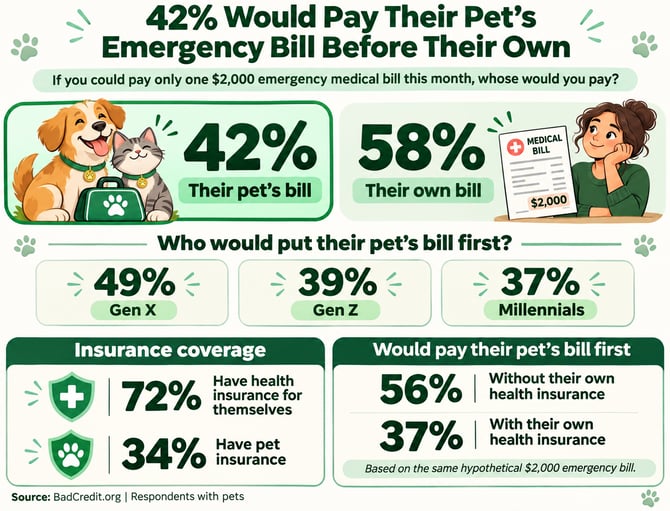
For some pet owners, their animal’s health is important enough that they’re willing to buy pet insurance. While 72% of respondents with pets said they had health insurance for themselves, 34% said they had pet insurance.
Among those who indicated that they don’t have health insurance for themselves, roughly 50% said they do pay for pet insurance. And respondents in that group were much more likely to pay their pet’s health bill first.
More than half (56%) of uninsured pet-owning respondents said they’d pay a $2,000 bill for their pet before making a payment on one for themselves, compared with just 37% of pet owners who do have health insurance.
Sandberg adds, “The good news is that, compared to medical insurance for humans, pet insurance is relatively affordable. I’m not surprised that our study found that of those who don’t have health insurance for themselves, roughly half do pay for pet insurance.”
The Sacrifices People Make for Their Pets
A pet can bring a lot of happiness to its owner’s life. And with many people considering their pet to be a member of their family, it’s no surprise that pet owners are willing to make sacrifices when it comes to their pet’s health and paying for its care.
“My advice to prospective pet owners is to be realistic about upcoming costs and build them into your budget. Eventually you’ll probably need to take your animal to the veterinarian, so anticipate those bills. Even a little extra savings can help reduce the burden. I recommend looking into pet insurance too,” suggests Sandberg.
After all, for many pet owners, the well-being of their furry friend is one thing they’re simply not willing to put on paws.
Methodology:
BadCredit.org surveyed 1,001 U.S. adults ages 18–61 from October 27 to November 5, 2026. Pet-care findings are based on 716 current pet owners. Contradictory responses were excluded from individual multiselect questions, resulting in bases of 704 for debt willingness, 712 for spending cutbacks, and 713 for insurance coverage. The data are raw and unweighted.
Assuming simple random sampling, the approximate margin of error is ±3.1 percentage points for the full sample and ±3.7 percentage points for the pet-owner question bases at the 95% confidence level. Margins are larger for demographic subgroups. Percentages may not total 100% due to rounding, or may exceed 100% when multiple selections were allowed.
For media inquiries, please email catherine@badcredit.org.


