

Writer: Andrew Allen


Editor: Ashley Fricker


Reviewer: Catherine McNally

Key Takeaways
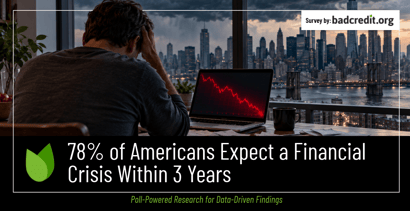
- A new BadCredit.org survey found that 78% of Americans believe that the U.S. will experience a financial crisis sometime within the next 1 to 3 years.
- Coming in at the top of the list of feared losses among those expecting a financial crisis is health insurance, with 27% selecting it over the loss of their job (22%) or home (18%).
- Though the majority of survey respondents say they expect a financial crisis to occur in the U.S. over the next 1 to 3 years, nearly 32% aren’t doing anything to prepare financially for it.
- Expectations of a crisis are similar across income levels, but preparation differs: 46% of those with household incomes below $50,000 aren’t taking any steps to prepare, while only 13% of those with household incomes of $100,000 or greater are taking the same approach.
Fall is a crucial time for many people in the U.S. who are looking to make changes to their health insurance coverage for the coming year. The annual period for Medicare open enrollment began on October 15 and runs to December 7. And open enrollment on Healthcare.gov for coverage in 2027 is set to start on November 1.
Selecting a health insurance plan that you think will suit your needs in the year ahead can be a tall task. But it may take on extra importance for consumers this year as healthcare costs climb. According to health policy organization KFF, workers now pay 9% more annually, on average, toward their families’ health insurance premiums than they did the prior year.
As Americans take a look at their healthcare needs to get ready for open enrollment, decisions about benefits and premiums may come with an even bigger concern: What could people end up losing in the event that their finances take a serious hit?
A new survey from BadCredit.org found that 78% of Americans anticipate a financial crisis taking place in the U.S. in the next 1 to 3 years. Among those who see a crisis on the horizon, health insurance is what they most fear losing. Nevertheless, 1 in 3 said they weren’t taking any action to financially prepare for a potential crisis.
81% of Women Expect a Financial Crisis
Whether or not a financial crisis will materialize over the next 1 to 3 years is anyone’s guess. After all, if the future state of the nation’s economy were easy to predict, then it would be a much simpler task for Americans to financially prepare for the years to come.
Although exactly what lies ahead isn’t clear, men and women are largely on the same page in their expectations of a pending financial crisis. But women feel a bit more convinced about the matter, according to the survey results.
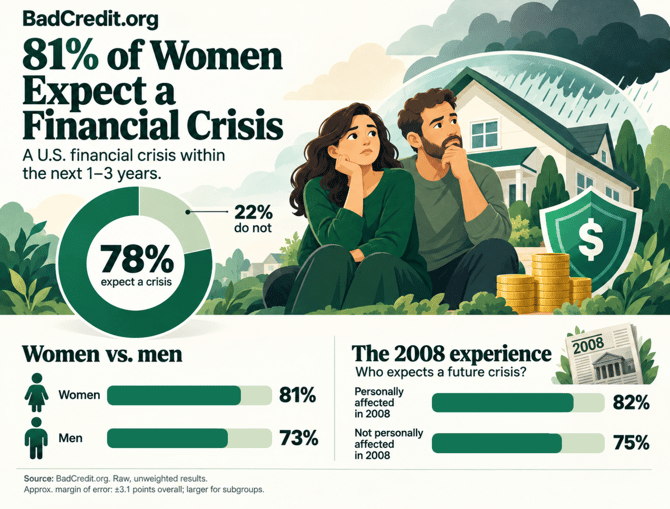
More than 4 in 5 women (81%) who participated in the survey said they expect a financial crisis to occur in 1 to 3 years, compared with 73% of men.
Someone’s experience of living through an economic collapse in the past can influence how likely they are to expect a financial crisis in the future. The survey’s results indicate that those who personally felt the effects of the 2008 financial crisis are somewhat more likely to expect a severe economic downturn in the future.
Of respondents who said the Great Recession personally affected them, 82% foresee a financial crisis in the future. Meanwhile, only 75% of those who said the 2008 economic turmoil didn’t affect them personally expect a financial crisis to unfold within the next three years.
Note that these responses measure expectations of a crisis as opposed to predictions of whether one will take place.
27% of Those Expecting a Crisis Fear Losing Their Health Insurance Most
Studying the impact that a financially catastrophic time such as the Great Depression had on the United States can seem more like an academic exercise than anything else. But it feels a lot less distant when you read about families losing their homes and people struggling just to afford the most basic necessities of life. Suddenly, the statistics transform into more relatable stories.
While today’s economic anxieties may not resemble the ones many people had in the 1930s, the underlying concerns appear similar: how to protect the things that can keep a family secure.
Among survey respondents who expect a financial crisis in the U.S. in the next 1 to 3 years, health insurance is their number-one feared loss. More than 1 in 4 (27%) of those who anticipate a crisis are most afraid of that outcome.
The second most feared outcome among 22% of respondents anticipating a crisis is losing their job. While investment income and financial support from family members can bolster a person’s financial position, many people rely most heavily on the paycheck from their job to supply them with the funds they need to afford their lifestyle.
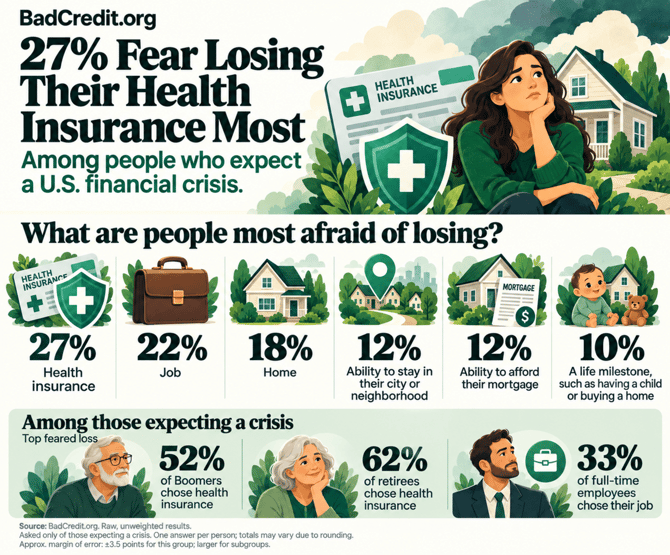
The loss of their home was the most-feared loss among 18% of respondents who expect a financial crisis to hit the U.S. relatively soon. Closely related to that fear, 12% of this group said they most feared the loss of their ability to stay in their current city or neighborhood. And another 12% most fear losing the ability to make their mortgage payments.
Rounding out the losses people fear the most is missing out on one of life’s milestones, such as purchasing a home or having a child. Ten percent of respondents expecting a crisis are most afraid of this outcome.
The fact that Americans are in the midst of open enrollment season may mean that healthcare is more on people’s minds these days.
That, combined with the number of politicians who are campaigning ahead of the upcoming election and talking about their ideas to make healthcare more affordable, may cause certain groups to worry more about health insurance at this time than they normally would. But for some groups, healthcare may always be near the top of their minds, or at least close to it.
While 27% of applicable respondents pointed to health insurance as their most-feared loss, a whopping 52% of baby boomers who are expecting a financial crisis indicated that health insurance is at the top of their feared-losses list. That figure jumped all the way up to 62% among respondents who are retired and anticipating a crisis.
Respondents from younger generations may not have healthcare on their minds as much as baby boomers, but they have concerns of their own. Among full-time workers who expect a crisis in the coming years, 1 in 3 (33%) fear losing their jobs most.
1 in 3 of Those Expecting a Crisis Aren’t Taking Steps to Prepare
A person’s expectations of a financial crisis striking soon could cause them a great deal of stress. But anticipating trouble before it arrives on their doorstep could also allow them to take steps to lessen the blows they expect the crisis to deliver.
Among respondents who expect a financial crisis to impact the U.S., more than two-thirds (68%) are taking steps to prepare financially for it. That leaves 32% who aren’t making any moves to get ready.
The strongest finding from the BadCredit.org survey is that while respondents of varying levels of household income say they expect a crisis at similar rates, they report significant differences when it comes to preparing for it.
Approximately 46% of respondents with a household income of less than $50,000 said they are expecting a crisis but aren’t taking any steps to prepare for it. Just 13% of those who have a household income of $100,000 or greater are in the same boat. The difference in reported lack of action between these two income groups is 33 percentage points.
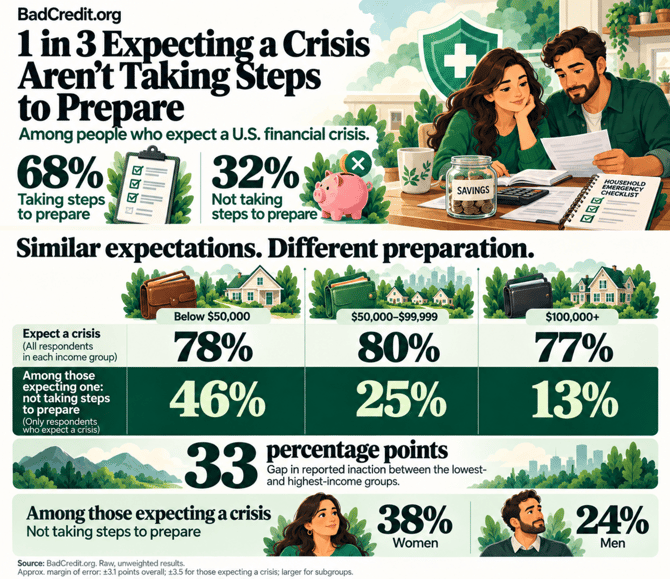
And 1 in 4 respondents with a household income of at least $50,000 but not more than $99,999 say they expect a financial crisis but aren’t making moves to prepare for it.
The survey results also highlighted a difference between male and female respondents regarding whether they’re preparing for expected financial difficulties. Among those who are anticipating a crisis, 38% of women said they aren’t taking any action to get ready for it, while only 24% of men reported the same.
“By adding even a small amount of money consistently into an emergency fund, you can plan for unexpected expenses. This is a great time to assess consumer debt too. Carrying over high-interest credit card balances robs you of much-needed cash. If you have it already, develop a payoff plan,” says Erica Sandberg, consumer finance expert at BadCredit.org.
Sandberg adds, “As for healthcare costs, you can’t stop political or company policy changes, but you can be aware of the policy you do have. Dive into what is and isn’t covered. If you have access to a Health Savings Account or Flexible Spending Account, take advantage of them by adding to your fund.”
“They allow you to save pre-tax dollars, and your savings earn interest and investment returns. It’s a huge relief to know that you have money already set aside for your uncovered medical expenses.”
Seeing a Crisis Coming Doesn’t Mean You’re Ready For It
Depending on your stage of life, the prospect of a financial crisis in the near future may raise different concerns for you, from losing your health insurance or a job to worrying about whether you’ll be able to afford to have a child or make your mortgage payments.
But the findings from BadCredit.org’s survey suggest that just because a person expects a financial crisis to unfold in the U.S. within the next couple of years, it doesn’t mean they’ll actually do anything to prepare for it.
Methodology
BadCredit.org surveyed 1,000 U.S. adults based in the U.S. in 2026. Findings about feared losses and financial preparation are based on the 781 respondents who expect a U.S. financial crisis within the next one to three years. The data are raw and unweighted.
Assuming simple random sampling, the approximate margin of error is ±3.1 percentage points for the full sample and ±3.5 percentage points for the subgroup at the 95% confidence level. Margins are larger for demographic subgroups. Percentages may not total 100% because of rounding.
For media inquiries, please email catherine@badcredit.org.


