Eric Bank has been covering business and financial topics since 1985, transforming complex subject matter into clear, accessible insights for consumer audiences. His work regularly appears on Credible.com, eHow, WiseBread, The Nest, Get.com, Zacks, Chron, and several other respected outlets. A former software engineer, Eric holds an M.B.A. from New York University and an M.S. in finance from DePaul University, and brings a rare blend of technical expertise and financial acumen to his writing.
Lillian brings more than 30 years of editing and journalism experience, having written and edited for major news organizations, including The Atlanta Journal-Constitution and the New York Times. A former business writer and business desk editor, Lillian ensures all BadCredit.org content equips readers with financial literacy.
Ashley has managed content strategy for BadCredit since 2015, partnering with major banks, financial institutions, and media outlets to deliver authoritative personal finance content. Her expert credit card commentary has appeared in top national publications, including CNBC, MarketWatch, Investopedia, Yahoo Finance, and Reader's Digest, establishing her as a trusted voice in the industry.
Second-chance bank accounts can help consumers with bad credit or past banking issues open an account with fewer barriers. The options below offer simple applications, everyday banking features, and minimal signup requirements. Here are the best bank accounts for bad credit in 2026, according to our experts.
Disclosure: When you apply through links on our site, we often earn referral fees from partners. For more info, see our ad disclosure and review policy.
BadCredit.org’s bank account ratings are based on our experts’ evaluation of fees, deposit requirements, and account features. We also consider accessibility, customer service, and account flexibility. Our ratings are unbiased and regularly updated.
Overdraft protection up to $300 with opt-in and eligible direct deposit*
No monthly fees with eligible direct deposit, otherwise $5 per month
Earn up to 7% cash back when you buy eGift Cards in the app
Get your pay up to 2 days early - Get your government benefits up to 4 days early.*
High-yield savings account, 4.50% APY paid quarterly on savings up to $5,000.*
*Terms and conditions apply. GO2bank™ cards are issued by Green Dot Bank, Member FDIC, pursuant to a license from Visa U.S.A., Inc. Visa is a registered trademark of Visa International Service Association. Overdraft fees may apply. Click Apply Now to learn more.
BadCredit.org’s bank account ratings are based on our experts’ evaluation of fees, deposit requirements, and account features. We also consider accessibility, customer service, and account flexibility. Our ratings are unbiased and regularly updated.
BadCredit.org’s bank account ratings are based on our experts’ evaluation of fees, deposit requirements, and account features. We also consider accessibility, customer service, and account flexibility. Our ratings are unbiased and regularly updated.
BadCredit.org is a free online resource that offers valuable content and comparison services to users. To keep this resource 100% free for users, we receive advertising compensation from the financial products listed on this page. Along with key review factors, this compensation may impact how and where products appear on the page (including, for example, the order in which they appear). BadCredit.org does not include listings for all financial products.
Our Editorial Review Policy
Our site is committed to publishing independent, accurate content guided by strict editorial guidelines. Before articles and reviews are published on our site, they undergo a thorough review process performed by a team of independent editors and subject-matter experts to ensure the content’s accuracy, timeliness, and impartiality. Our editorial team is separate and independent of our site’s advertisers, and the opinions they express on our site are their own. To read more about our team members and their editorial backgrounds, please visit our site’s About page.
Review Breakdown: Bad Credit Bank Accounts
The following chart summarizes our experts' ratings of bad credit bank accounts. To apply for an account, click on the name of the service provider to visit its website and online application. These companies provide easy access to checking and savings accounts as well as user-friendly websites and mobile apps to manage your money.
BadCredit.org’s bank account ratings are based on our experts’ evaluation of fees, deposit requirements, and account features. We also consider accessibility, customer service, and account flexibility. Our ratings are unbiased and regularly updated.
BadCredit.org’s bank account ratings are based on our experts’ evaluation of fees, deposit requirements, and account features. We also consider accessibility, customer service, and account flexibility. Our ratings are unbiased and regularly updated.
BadCredit.org’s bank account ratings are based on our experts’ evaluation of fees, deposit requirements, and account features. We also consider accessibility, customer service, and account flexibility. Our ratings are unbiased and regularly updated.
Bank accounts for bad credit exist because financial setbacks can take different forms. You may have missed payments that hurt your credit score, or your bank may have closed your checking account because of bounced checks or unpaid negative balances. Whatever the cause, you may need a practical way to get back on track.
You may want to rebuild your credit and reopen a checking or savings account with a provider that offers more flexible approval standards. To help, we’ve assembled a list of banks and financial companies that offer second-chance account options.
We also answer some frequently asked questions about second-chance bank accounts to help you compare your options and move forward.
1. What Is Bad Credit?
Your credit is bad when you have trouble getting a credit card, cash advance, loan, or personal or business bank account because of previous financial challenges. Creditors classify consumers according to their creditworthiness, expressed as credit scores that range from excellent to very poor.
FICO, the leading credit scoring system, deems scores below 580 on their 300 to 850 scale as bad credit.
VantageScore, the second most-used scoring system, designates scores below 600 as poor and those under 499 as very poor.
FICO scores predict the degree of probability that you’ll default on a debt within the next two years. A low score reduces access to credit and makes it more expensive. It may also cause banks to reject your applications for a new account.
Even seriously derogatory items on credit reports (e.g., defaults, collections, bankruptcies, etc.), which are the basis for credit scores, disappear within seven to 10 years. The good news is that your credit score will immediately begin to respond to positive credit habits, such as consistently paying your bills on time and keeping your debt levels in check.
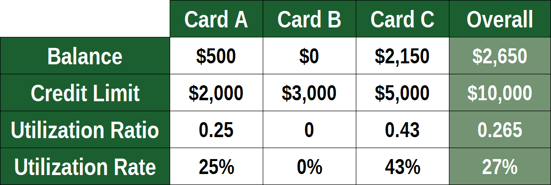
FICO uses the credit utilization ratio to quantify credit card debt. CUR is the amount you owe to your credit cards divided by the credit available.
You can get a fast credit boost by reducing your overall CUR below 30%. Timely bill paying takes up to a year to increase your score, but it is the surest path to good credit. It is never too late to improve your credit.
2. What Is a Bank Account For Bad Credit?
So-called second-chance banks provide checking and savings accounts to consumers with bad credit. Many of these accounts are available online and offer essential banking services.
Opening a second-chance account can help you rebuild your banking history, provided you avoid overdrafts, bounced checks, and unpaid negative balances. Poor credit may not prevent you from opening a second-chance checking or savings account because some providers use more flexible approval standards and may not rely as heavily on traditional credit or banking history reviews.
3. How Does a Bank Account For Bad Credit Work?
There’s nothing remarkable about the workings of a second chance personal or business account other than the bank’s lack of physical branches. You can deposit money by mailing in checks, making direct deposits, or using a cellphone app that scans and transmits checks.
Some of these accounts offer paper checks, but others require you to rely on your debit card instead.
You can also arrange online bill payments and money transfers. ATMs let you access funds, but the network of machines that don’t charge transaction fees may be relatively small. Consider choosing a second-chance bank with a nearby no-fee ATM.
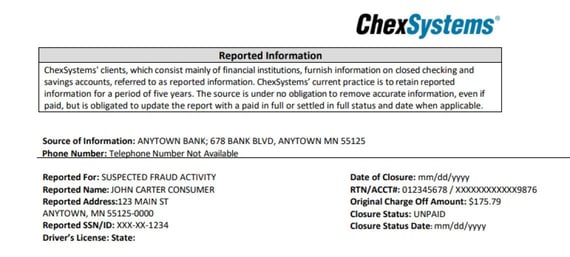
Specifically, ChexSystems collects demand account (i.e., checking and savings) information and sells it to its customers, including banks, credit unions, and thrifts. The collected data includes:
Traditional banks usually reject new account applications from consumers with negative ChexSystems reports. These reports contain only derogatory information — you get no recognition for being a responsible customer. Data remains in the ChexSystems files until purged after five years.
You have the right to review your ChexSystems report and dispute incorrect items. You can do so online at the company’s webpage.
Example ChexSystems Report
ChexSystems is not the only company that provides consumer banking information. TeleCheck maintains records of bounced and returned checks. A consortium of banks owns Early Warning Services (EWS), which records incidents of account misconduct.
5. Will I Have to Pay a Deposit?
Nearly all American bank and credit union accounts require an initial deposit, although the amount may be as little as $5.
Some second chance checking accounts require a sizable security deposit (for example, $200). The bank usually holds the security deposit in a savings account under its control, where it may generate interest. Your security deposit remains in a separate account until the bank is satisfied with your account usage and returns the money to your checking account.
Security deposits do not provide overdraft protection. If you write a check for more than your balance, the bank will return the check (and probably charge a whopping overdraft fee) instead of tapping into your security deposit to cover the shortfall.
If you close the account with a negative balance due to unpaid fees and penalties, the bank will use the security account to pay the amount due and refund the remainder.
6. How Is a Bank Account For Bad Credit Different From Any Other Bank Account?
Second chance and conventional checking accounts share many features. Both offer the ability to pay bills, accept direct deposits, and deposit, transfer, and withdraw money.
But second chance accounts have a few significant differences, including:
Many are online only with no personal service at a physical branch
Some do not offer paper checks
May give you faster access to direct deposits
May charge extra fees
May not offer a credit card. If it does, it likely won’t be among the best credit cards available nor offer a high credit limit.
May not provide overdraft protection
Almost all second-chance accounts work with a mobile banking app. You can use the app to scan and deposit checks remotely.
7. What Should I Look For In a Bank For Bad Credit?
Competition among second chance accounts is fierce, so it pays to look for the best deal you can find. Points of comparison include:
Fees: Ideally, you’d prefer the account waive or minimize monthly charges. Read the bank’s entire fee schedule before deciding.
Requirements: Some second-chance accounts impose minimum balances and/or require direct deposits.
Branches: Most of these banks are online only, but several traditional banks and credit unions offer second-chance accounts. This may be important if you want to establish a personal relationship with your banker.
ATMs: The quality of ATM access varies widely. Look for banks or online account providers with large networks that have convenient locations and don’t charge fees.
Services: Make sure the account offers the services you prefer. For example, you may want paper checks or overdraft fee protection.
Reward cards: Debit cards for some accounts provide purchase rewards.
Apps: Some mobile apps offer superior functionality and are easier to use. Look for features such as mobile check deposit and digital wallet integration.
Several reviewed accounts offer extra services that may help sway your decision. For example, you may prefer an account that provides brokerage services or high-yield savings. One last consideration: FDIC or NCUA insurance is a must.
8. Can I Open a Bank Account If I Owe Another Bank Money?
The answer depends on whether the new bank reviews your banking history through ChexSystems or a similar consumer reporting agency. If it does, an unpaid negative balance or account closure at another bank could make approval more difficult.
Repaying old account debts may improve your chances of opening a new account, and you can ask the previous bank to update ChexSystems once the debt is resolved. In some cases, paying what you owe may also help you qualify for better account options over time.
9. What Do I Do If I Get Refused For a Bank Account?
Involuntary closure of your bank account because of an unpaid negative balance, overdrafts, or bounced checks
Suspicions of fraudulent behavior
Opening multiple accounts within a short period
Abusing your ATM or debit card privileges
An error on your ChexSystems credit report is a more innocent explanation for a rejected account application. For example, the report may conflate your identity with another’s.
Banks may go beyond ChexSystems and review your credit history and score from one or more major credit bureaus. A low credit score may be enough to doom your account application. If you have trouble opening a community, regional, or national bank account, consider the following steps:
Review your ChexSystems reports and address any derogatory items you find. You can dispute any invalid items in your report. If your dispute succeeds, ChexSystems will remove the incorrect item. Otherwise, the derogatory item will drop off your report after five years have passed.
Perform the same procedure on your credit reports, which you can get for free from AnnualCreditReport.com. If you can remove derogatory errors, the credit bureau will inform recent report recipients of the correction, and your credit score may increase.
Apply for a second chance bank account. You should be able to open one regardless of your previous mistakes. Alternatively, consider opening a secured checking account if it offers more benefits than a second chance account.
Once you open a bank account, take the opportunity to demonstrate responsible behavior by avoiding overdrafts and similar problems.
10. Can I Get a Bank Account Despite Previous Bank Problems?
You may be able to open a second-chance bank account even if your banking record is less than perfect. If you want to qualify for more traditional banking options later, it can help to repay any money you owe to previous banks and confirm that any resolved issues have been updated with ChexSystems.
If your credit history leaves something to be desired, take steps to nudge your score higher. At the very least, pay your credit card and other bills on time.
You may consider getting a credit-builder account from a credit union or online source. With this type of account, you borrow money that the lender deposits into escrow. You then pay off the loan in monthly installments that the lender reports to the credit bureaus.
The lender refunds your money when the loan is repaid. It’s an excellent way to both rebuild credit and save up a small emergency fund.
You Can Open a Bank Account Despite Having Bad Credit
If you’ve had trouble opening a bank account because of bad credit or past banking problems, second-chance accounts may give you a path forward. These accounts may come with more fees or fewer features than traditional accounts, but they can help you manage your money and rebuild your banking history.
Compare costs, account features, and eligibility requirements to find the option that best fits your needs.
About The Author
Eric BankFinance Writer
Eric Bank has been covering business and financial topics since 1985, specializing in taking complex subject matters and explaining them in simple terms for consumer audiences. Eric's writing appears on Credible.com, eHow, WiseBread, The Nest, Get.com, Zacks, Chron, and dozens of other outlets. A former software engineer, Eric holds an M.B.A. from New York University and an M.S. in finance from DePaul University.
Information Warranty & Disclosure: Great efforts are made to maintain reliable data on all offers presented. However, users should check each provider’s official website for updated terms, details and conditions for each offer before applying or signing up. Our site maintains strict terms of service and may accept compensation for paid ads or sponsored placements in accordance with these terms. Users must be at least 18 years of age to be eligible for financial offers as per the terms presented on provider websites.
* FICO scores/credit scores are used to represent the creditworthiness of a person and may be one indicator to the credit type you are eligible for. However, credit score alone does not guarantee or imply approval for any financial product.