My Comprehensive Review of Current: A Great Account for Restoring Financial Health
I love how Current helps you stay out of debt, rather than tempting you into overspending.
By: Jon McDonald
Jon McDonald
With more than 15 years of journalism expertise, Jon stays apprised of finance trends, influential companies, and financial literacy resources for subprime consumers. He is most knowledgeable in the areas of budgeting, loans, and responsible credit use, and his articles have appeared in publications produced by The New York Times.
Lillian brings more than 30 years of editing and journalism experience, having written and edited for major news organizations, including The Atlanta Journal-Constitution and the New York Times. A former business writer and business desk editor, Lillian ensures all BadCredit.org content equips readers with financial literacy.
Ashley has managed content strategy for BadCredit since 2015, partnering with major banks, financial institutions, and media outlets to deliver authoritative personal finance content. Her expert credit card commentary has appeared in top national publications, including CNBC, MarketWatch, Investopedia, Yahoo Finance, and Reader's Digest, establishing her as a trusted voice in the industry.
Disclosure: When you apply through links on our site, we often earn referral fees from partners. For more info, see our ad disclosure
Advertiser Disclosure
BadCredit.org is a free online resource that offers valuable content and comparison services to users. To keep this resource 100% free for users, we receive advertising compensation from the financial products listed on this page. Along with key review factors, this compensation may impact how and where products appear on the page (including, for example, the order in which they appear). BadCredit.org does not include listings for all financial products.
and review policy
Our Editorial Review Policy
Our site is committed to publishing independent, accurate content guided by strict editorial guidelines. Before articles and reviews are published on our site, they undergo a thorough review process performed by a team of independent editors and subject-matter experts to ensure the content’s accuracy, timeliness, and impartiality. Our editorial team is separate and independent of our site’s advertisers, and the opinions they express on our site are their own. To read more about our team members and their editorial backgrounds, please visit our site’s About page.
.
When I was in college, I had to visit a bank branch to find out how much money was left in my account. On one visit, I realized I had miscalculated how much money I had left.
Two swipes for coffee put me about $3 over (I miss those pre-inflation coffee prices), and the bank planned to charge me around $40 in overdraft fees. That was a fortune for me at the time.
A kind manager eventually waived the fees after some pleading, but this experience stuck with me. Today, I could avoid that situation entirely by choosing an option like Current.
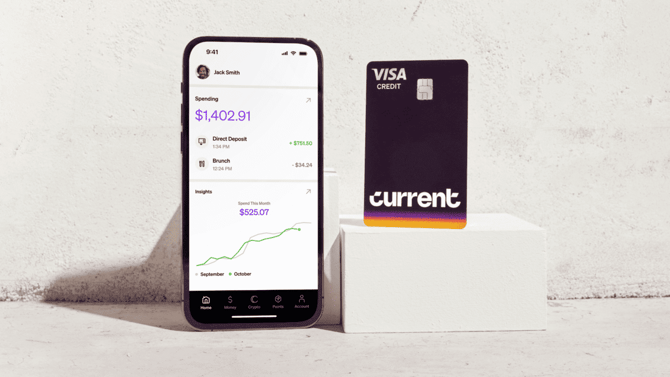
It isn’t technically a bank, but it is a fintech that lets you access and manage your checking account from anywhere on your mobile device. It also provides more flexibility with optional overdraft coverage and early access to your direct deposits.
Current also has long-term finances in mind. Its Savings Pods help accountholders save for future goals or passion projects, and the Build Card can help improve your credit score.
Now, these are just a few benefits of Current, and they certainly would have helped me avoid overdrafts in college (without any begging). But during my deep dive into the company and its account, I was surprised by just how impactful its tools can be — especially for the underbanked.
What to Expect With a Current Account
Even though Current isn’t technically a bank, you can expect a similar digital banking experience. Like many other so-called neobanks, Current partners with banks that are members of the Federal Deposit Insurance Corporation (FDIC) to provide underlying banking services that are still federally insured.
Specifically, Current works with Choice Financial Group and Cross River Bank as its FDIC partners. But if you were a Current customer, you would just interact with Current through its app or customer service channels.
BadCredit.org’s bank account ratings are based on our experts’ evaluation of fees, deposit requirements, and account features. We also consider accessibility, customer service, and account flexibility. Our ratings are unbiased and regularly updated.
★★★★★
4.9
Monthly Fee
Minimum Deposit
Minimum Balance
Reputation Score
$0
$0
$0
7.5/10
Through Current, you can open a deposit account that has no monthly fees, which is essentially a combined checking and savings account. Within a Current account, you have access to a Spending balance, which is like the checking account side.
If you swipe your debit card or pay a bill online using your account number, for instance, the money comes from your Spending balance first.
Current also offers optional Savings Pods. There, you can set aside money, just like in a savings account, to potentially earn up to a 4% annual bonus on up to $6,000 (I’ll talk much more about this later).
However, the Savings Pods function as sub-accounts (think folders within your checking account) rather than acting as separate accounts.
That said, if you try to overdraw your Spending balance, Current won’t automatically pull from your Savings Pods, so there is some separation in that sense. And if a transaction overdraws your account, Current doesn’t charge any overdraft fees as long as you meet its minimum direct deposit requirements (which is $200 every 35 days).
While Current doesn’t have any physical branches, like many other neobanks, you can access cash from your Spending balance fee-free through over 55,000 worldwide Allpoint® ATMs. You can also deposit cash for a $3.50 fee at major stores like Walmart, CVS, Walgreens, and other stores through the Green Dot Network.
To withdraw cash, you can use either your Current debit card, which runs on the Visa network, or you can opt in to use the Current Build Card, which is a secured Visa credit card.
The secured Build Card is a good option for those rebuilding or trying to establish credit. First, you don’t need a credit check, and because it is secured, you have guardrails in place to help you avoid debt (more on that in the Build Card section below).
A Look at the Costs and Fees
Current is one of the most affordable options of any bank or neobank, both for its main deposit account and for other products like its secured Build Card.
That said, you shouldn’t assume using Current — or any bank — is free. There are still some small potential costs to be aware of, as we’ll examine here.
No Upfront or Account Maintenance Costs
One of the biggest advantages of choosing Current is that you’ll avoid many of the fees that often come with digital banking accounts. Current doesn’t charge monthly maintenance fees, account opening fees, or overdraft fees (if you qualify), and there are no minimum balance requirements.
While there are amounts required to maximize the Savings Pods bonus, you can use Current as a checking/savings account without any baseline fees or minimums.
Even with the Build Card, there’s no annual fee or minimum security deposit — your spending limit depends on how much is in your Spending balance.
ATM, Deposit, and Other Fees
While there are no regular monthly fees for Current accounts or cards, you could still face a few costs, depending on your usage. Some common examples include:
Cash deposit: $3.50 per transaction if depositing cash into your account at eligible retailers
Out-of-network ATM: $2.50 per transaction from Current, plus whatever that ATM might charge for out-of-network transactions
Foreign transactions: 3% of the transaction amount for purchases, and $3 plus 3% for foreign cash withdrawals
Replacement card: $5 plus $30 for expedited delivery
Most of these fees can be avoided by a little planning. For example, if you know where the fee-free ATMs are located near you, that can eliminate ATM fees from the equation entirely.
But if you make a lot of cash deposits or plan to frequently use the Build Card while traveling abroad, you could end up paying a good chunk of change in fees.
Total Cost Analysis
For the most part, Current accounts and cards are free to use, especially if you’re mindful about how you use them. But life is unpredictable, so it’s safer to plan for scenarios where you’ll incur fees.
So, let’s assume you make six cash deposits and six out-of-network ATM withdrawals per year (once every two months for each). That adds up to $36. Then, assume the out-of-network ATM charges the average of $3.22 per transaction. That brings your total to $55.32.
That might sound high, but it’s also relatively easy to avoid. In particular, if you rarely deal with cash, it can be easy to go a full year without incurring any fees from Current.
Benefits and Money-Saving Features
Not charging a monthly maintenance fee is quickly becoming the industry standard, so Current doesn’t necessarily stand out in that regard.
Still, the main deposit account has some distinct features that can help you save money, and its integration with a secured credit card is particularly helpful for those trying to improve their credit.
Savings Pods
Current Savings Pods give you a way to earn interest on your savings at a competitive rate, though technically, Current classifies this as a bonus, not a traditional annual percentage yield (APY).
Semantics aside, you can earn a maximum of 4% per year on up to $6,000, meaning you can earn an extra $240 total. Qualifying requires some hoops to jump through, though.
One is that the base rate for these pods is 0.25%, but you can earn a Boost that brings the rate to 4% if you have a qualifying direct deposit. You need to maintain at least one eligible direct deposit every 35 days to keep the Boost going.
If you’re getting regular paychecks, this is a pretty easy bar to clear, but still worth keeping in mind.
The other big caveat is that the bonus applies to up to $2,000 per pod, but you can have up to three pods. Anything over $2,000 in one pod or $6,000 total doesn’t earn any interest.
So, while the 4% bonus is relatively high, it loses its appeal if you have significant savings. And, note that Current could change the bonus rate at any time.
The Build Card
As I mentioned, the Build Card is a secured credit card tied to your Current deposit account. Your payments get reported to all three major credit bureaus, so making on-time payments can help you build your score.
Meanwhile, you don’t need a security deposit or a credit check, as your spending limit is simply set by your Spend account balance (plus any eligible overdraft protection).
The card doesn’t have any annual fees or interest charges, though you’re expected to pay off your balance in full each monthly cycle. And if your balance becomes past due for two or more payment cycles, you’ll face a 3% late fee.
The Current Build Card links to your account and can help you build credit.
In general, though, Current makes it easy to avoid trouble. As you spend on the card, Current sets aside money from your main spending account into Reserved Funds.
So, you’ll see your Spending balance decrease as your card balance goes up. And if you have autopay set up, Current will automatically apply the Reserved Funds to your card balance, so you can stay on track.
And while the credit-building aspects are probably the most important part of the Build Card, another perk is that you earn 1X points on dining and groceries, which can then be redeemed for cash back. The point value is subject to change, though.
Overdraft Coverage
Another Current perk is its fee-free overdraft coverage, which works for both debit and credit purchases. To qualify, you need at least $200 in direct deposits within the past 35 days. To start, you can get at least $25 in overdraft coverage, with the amount potentially increasing over time, depending on your situation.
You still have to pay back any negative balance due to overdrafts, but you won’t be charged a fee for the act of overdrafting. Future deposits would go toward the negative balance first, but if you can’t pay it off within 60 days, Current can close your account.
Similar terms apply to overdrafting with your Build Card. Normally, you can only charge up to the amount in your deposit account, but if you qualify for Build Fee-Free Overdraft — with at least $200 in direct deposits within the past 35 days — then you can avoid overdraft fees altogether.
The main difference, though, is that you still owe any overdraft based on your normal card payment schedule, so if you can’t pay off the balance in time, that could hurt your credit.
Paycheck Advance
If you ever find yourself a little short before payday, Current can help you avoid high-interest payday lenders or putting expenses on credit cards. Its Paycheck Advance feature can put up to $750 from your paycheck into your pocket early.
To qualify, you need to set up recurring direct deposits of at least $200 per month. And it could take a while to work your way up to that $750 maximum, as Current will likely cap your advances (think $50 to $100) until you show consistent deposits.
If you can wait up to three business days for the money to hit your bank account, Current doesn’t charge any fees. You can also choose the Instant Access option, which will deposit the advance immediately for a fee of $4.99.
Current automatically takes the advance amount out of your next qualifying deposit, so you don’t have to keep track of anything. And while this feature can come as a relief if you really need it, you definitely don’t want to rely on it.
If you find yourself taking advances like this regularly, you need to reevaluate your finances before you get caught in a digital version of the payday loan debt cycle.
Who Qualifies for Current
Qualifying for a Current account is pretty straightforward. The main requirements are:
Being a U.S. citizen, legal resident, or non-resident lawfully-admitted alien
Having a valid Social Security number
Having a valid U.S. address
Being at least 18 years old — though parents can also open Teen Accounts for minors ages 13-17
Having a valid email and agreeing to only receive electronic communications
These basic requirements mean most people should qualify for a Current account, even if you have bad or no credit. That said, not everyone is automatically guaranteed an account.
It’s possible that Current‘s risk management team would flag your account during the opening process if your information seems to be fraudulent, for example.
How to Sign Up for Current (Step-by-Step)
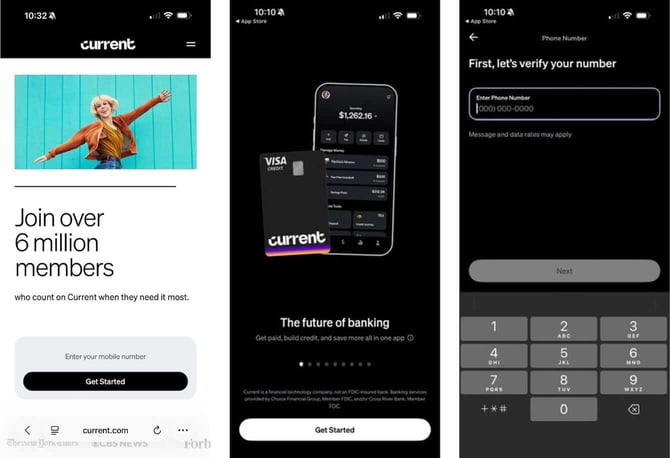
The first step to sign up for Current is to download its mobile app. Even when I tried to open the account on its website, it directed me to download the app.
But from there, the process is quick and easy.
Step 1: Download the App
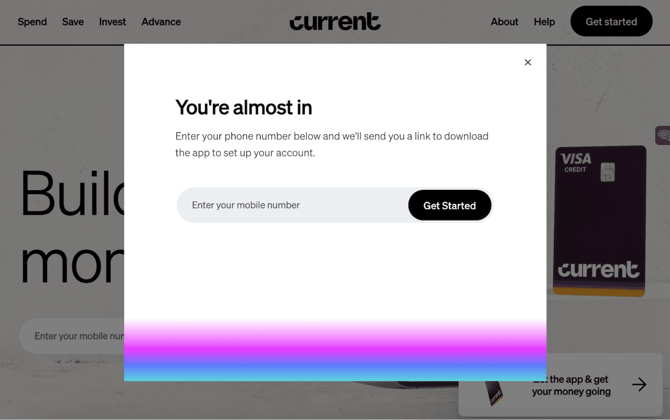
On both desktop and mobile, Current asked for my phone number to begin the application process. When I click “Get Started,” Current sends me a link to download the app.
You may also see a screen with a QR code to download the app, depending on your text message settings.
Step 2: Enter Your Phone Number
After downloading the app, you’ll click “Get Started” again and officially start the application. Here, you’ll add your phone number again.
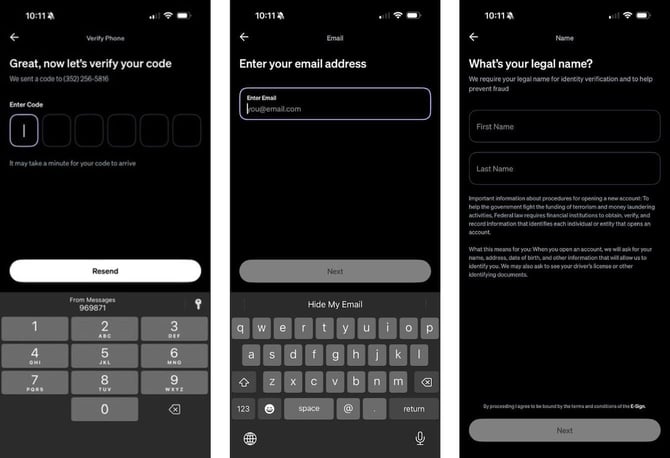
Steps 3-5: Verify Phone Number, Email, and Name
Next, Current verifies my phone number by texting a code, which I enter to continue the application. Then I enter my email address and legal first and last name.
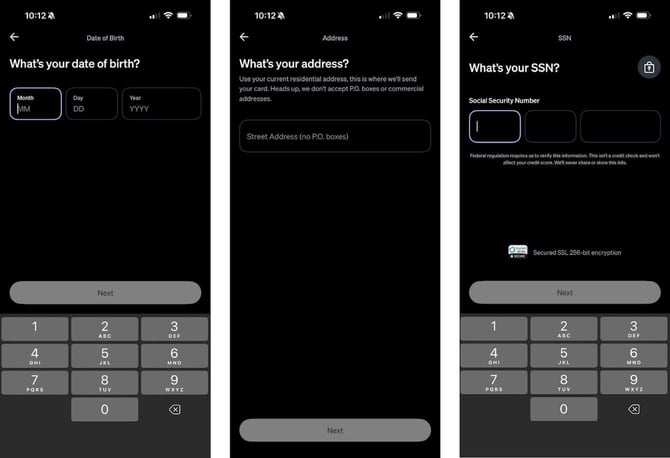
Steps 6-8: Birth Date, Address, and Social Security Number
The next step asks for my date of birth, address, and then my Social Security number.
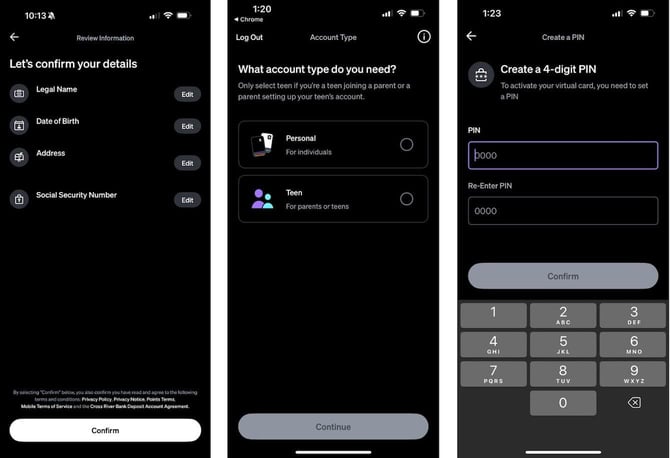
Steps 9-11: Confirm Details, Account Type, and Create PIN
Current asks me to confirm my details before submitting the application. After that, it asks whether I’m opening up a personal account or a teen account.
I also set up a PIN to activate a virtual card I’ll receive after I open the account.
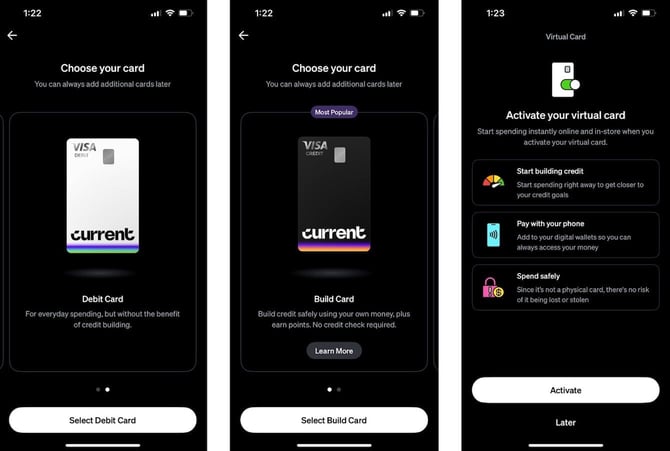
Steps 12-14: Select a Card and Virtual Card Activation
At this stage, I get to select a Current debit card and/or the Build Card, which is a secured credit card linked to the account.
There’s also an option to set up a virtual card if I want to use the card before Current mails out a physical one. In that case, the application asks me to activate the virtual card with the PIN I set earlier.
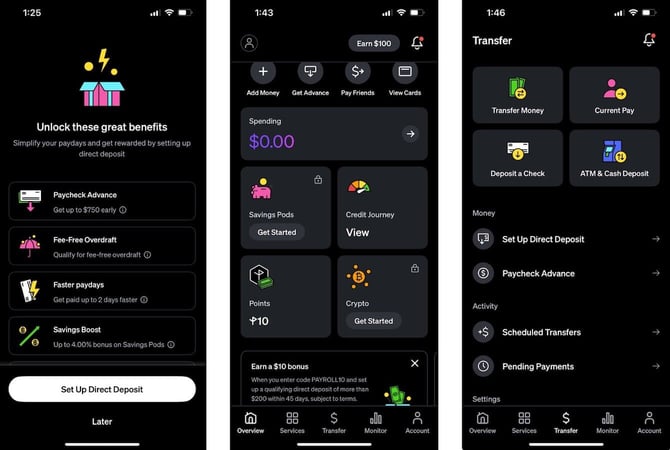
Steps 15-17: Direct Deposit Details and Account Setup
From there, Current offers me the option to set up direct deposit, and it helpfully points out how I can unlock additional benefits, like a higher savings rate, if I do so. However, it’s not required. I can click “Later” if I just want to establish my account first.
Once the account is set up, I can easily see my spending balance, and there are options to set up additional features, like Savings Pods.
I can also click on the Transfer tab to go back to setting up direct deposit if needed, as well as accessing different options like transferring money from an external account or depositing a check.
That’s pretty much all there is to it. It’s possible Current will ask for additional verification, like a photo of your driver’s license, if something suspicious gets flagged after submitting your application. This could happen if you’ve been a victim of identity theft before.
Still, the application is largely fast and simple, and you can get started with an account in just a few minutes.
Who Should (and Shouldn’t) Consider Current
The ideal Current user is someone who’s new to banking or someone who has made financial mistakes in the past and wants a fresh start. Current is a place where they can deposit and access their money while having access to savings, digital management, and credit-building tools.
Some other banks make it hard to avoid fees if you have a low balance, but Current doesn’t have any minimum balance requirements, even for its secured Build Card.
And because the Current Build Card automatically sets money aside from your Spending balance, that can help you reduce the risk of overspending, while starting to build up your credit.
Should Consider Current
May Not Benefit from Current
People who are just getting started with a bank account.
People with a solid financial history and good overall financial health.
Those who have had negative banking experiences in the past and want a fresh, simple start.
Those who have more than $6,000 in savings, as Current stops paying a bonus rate on balances above that amount.
Anyone worried about needing to keep a high balance, since Current has no minimum balance fees (even for its secured credit card).
Individuals looking for credit cards with higher spending limits.
Granted, you may be able to access fee-free overdrafts with the Build Card, but you still want to be mindful about going into debt or missing payments and having that affect your credit score.
However, Current may not be right for everyone. Those with a more established financial history and good financial health could benefit from a different type of account.
Current isn’t necessarily a bad account for these people, but they could be leaving money on the table. For Example, if someone has more than $6,000 in savings, they wouldn’t see interest on anything over $6,000, since Current stops paying a bonus rate on savings above that.
Also, if you have a solid financial situation, you may want access to credit cards with higher spending limits or products like mortgages, and you may prefer to get all of those from the same financial institution, such as a traditional bank or credit union.
Pros and Cons
Current has plenty of attractive features, particularly for those who are getting their finances in order or who prioritize a simple, mobile experience.
That said, it may not be for everyone, including those with substantial savings.
Pros
No monthly maintenance fees or minimum balance requirements
Option to earn up to 4% extra on up to $6,000 in savings
Secured card has no annual fees and encourages healthy credit building
Cons
No interest on savings above $6,000
No physical branches and cash deposits incur fees
If you’re strategic about how you use Current, like maximizing the 4% bonus but not leaving extra savings in your account, while also only using in-network ATMs, it can be a great choice.
But if you deal with cash a lot, especially for deposits, you might want to look at other options that charge fewer fees.
Other Accounts Worth Considering
Several other fintech companies share some similarities with Current, and you might want to consider them if you’re looking for an online-only account with no monthly maintenance fees.
Chime®
There’s a lot of overlap between Chime® and Current, as both feature fee-free overdraft coverage and a secured credit card tied directly to your available balance. Chime® also offers fee-free cash deposits at Walgreens and Duane Reade locations, though other retail partner networks typically charge a fee.
Your Chime® Checking Account comes with a Visa® Debit Card, no monthly fees or minimum balance fees.
Over 47,000 fee-free ATMs¹ — more than the top 3 national banks combined!
Get paid up to 2 days early with direct deposit, terms apply.²
Chime will spot you up to $200 on debit card purchases and cash withdrawals with no overdraft fees. Eligibility requirements and limits apply.³
Chime is a financial technology company, not a bank. Banking services and debit card provided by The Bancorp Bank, N.A. or Stride Bank, N.A.; Members FDIC.
¹Out-of-network ATM withdrawal and over the counter advance fees may apply.
²Early access to direct deposit funds depends on the timing of the submission of the payment file from the payer. We generally make these funds available on the day the payment file is received, which may be up to 2 days earlier than the scheduled payment date.
³Chime SpotMe is an optional service that requires a single deposit of $200 or more in qualifying direct deposits to the Chime Checking Account at least once every 34 days. All qualifying members will be allowed to overdraw their account up to $20 on debit card purchases and cash withdrawals initially, but may be later eligible for a higher limit of up to $200 or more based on member’s Chime Account history, direct deposit frequency and amount, spending activity and other risk-based factors. Your limit will be displayed to you within the Chime mobile app. You will receive notice of any changes to your limit. Your limit may change at any time, at Chime’s discretion. Although there are no overdraft fees, there may be out-of-network or third-party fees associated with ATM transactions. SpotMe won’t cover non-debit card transactions, including ACH transfers, Pay Anyone transfers, or Chime Checkbook transactions. See Terms and Conditions.
While Chime® doesn’t cap your balance that can earn interest, its highest yield of 3.75% APY is gated behind its top-tier status, which requires a steep $3,000+ in monthly direct deposits. So, if you have modest direct deposits and balances under $6,000, Current‘s straightforward framework remains a stronger tool for your savings.
GO2bank™
GO2bank™ features a competitive 4.5% APY on balances up to $5,000 when placed into its in-app savings vaults. It also offers an integrated secured Visa credit card to help users build credit.
Overdraft protection up to $300 with opt-in and eligible direct deposit*
No monthly fees with eligible direct deposit, otherwise $5 per month
Earn up to 7% cash back when you buy eGift Cards in the app
Get your pay up to 2 days early – Get your government benefits up to 4 days early.*
High-yield savings account, 4.50% APY paid quarterly on savings up to $5,000.*
*Terms and conditions apply. GO2bank™ cards are issued by Green Dot Bank, Member FDIC, pursuant to a license from Visa U.S.A., Inc. Visa is a registered trademark of Visa International Service Association. Overdraft fees may apply. Click Apply Now to learn more.
But Current still holds the clear upper hand for everyday flexibility and affordability. That’s because GO2bank™ charges a $5 monthly maintenance fee if you don’t receive a qualifying direct deposit each month. Also, you need to put down a minimum $100 deposit to use GO2bank™’s secured card.
Would I Recommend Current?
In a world where traditional banks often nickel-and-dime you, it’s nice to see a modern, low-fee option like Current emerge. As long as you don’t use cash often, which is increasingly becoming the case for many people, I’d recommend Current as a great pick for starting or restarting your financial journey.
Even those who just need a way to deposit and spend their paychecks, without cash, typically don’t need all the features and fees that can come with brick-and-mortar banks.
And while other digital-only banks or fintechs offer accounts with no monthly maintenance fees and no overdraft fees, a big reason to pick Current is for easy access to its secured Build Card. Current doesn’t charge an annual fee for this card, so it can be an affordable way to start building or repairing your credit.
However, I wouldn’t recommend Current to everyone. If you have substantially more than $6,000 in savings, you’d be better off banking elsewhere so you can earn interest on the entire balance. Also, if you frequently need cash or get paid in cash, there are better options to avoid fees.
But for everyone else, Current is a viable option that is easy to set up and provides a lot of value for charging so few fees.
Current
★★★★★ 4.9/5.0
Current
4.9/5.0
About this rating
BadCredit.org’s bank account ratings are based on our experts’ evaluation of fees, deposit requirements, and account features. We also consider accessibility, customer service, and account flexibility. Our ratings are unbiased and regularly updated.
Information Warranty & Disclosure: Great efforts are made to maintain reliable data on all offers presented. However, users should check each provider’s official website for updated terms, details and conditions for each offer before applying or signing up. Our site maintains strict terms of service and may accept compensation for paid ads or sponsored placements in accordance with these terms. Users must be at least 18 years of age to be eligible for financial offers as per the terms presented on provider websites.
* FICO scores/credit scores are used to represent the creditworthiness of a person and may be one indicator to the credit type you are eligible for. However, credit score alone does not guarantee or imply approval for any financial product.