


Writer: Eric Bank


Editor: Lillian Guevara-Castro


Reviewer: Adam West

Key Takeaways
The August 2025 Personal Consumption Expenditures report signals rising economic danger.
U.S. consumer spending rose 0.6%, outpacing income gains of 0.4%, driving the personal savings rate to just 4.6% — one of the lowest since the pandemic.
With spending outstripping income, Americans are increasingly relying on credit, leaving subprime lenders with almost no margin for error.
The result is a fast-disappearing safety cushion. Almost 70% of American families live paycheck to paycheck, and average liquid savings have dropped 10% in just over a year to under $10,000.
For the most vulnerable 25% of households, the typical cushion is only $2,300. One in 4 families reported they couldn’t pay all their bills in August.
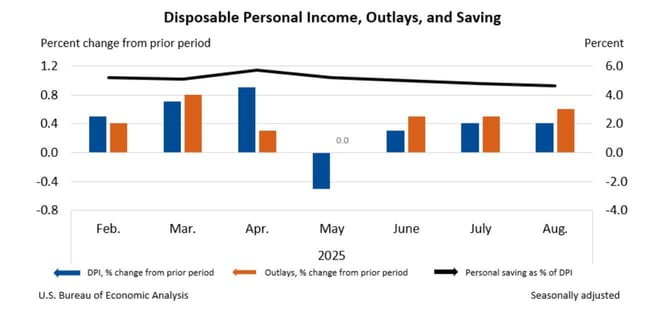
Despite modest wage and income gains, Americans’ ability to manage debt remains constrained. In August, disposable personal income rose $86.1 billion, but real disposable income grew just 0.1% month over month and 1.9% year over year — trailing the 2.7% increase in real spending.
Even small income gains give consumers a limited, though real, capacity to service credit. For subprime lenders, this creates both opportunity and risk.
Stronger consumer spending can boost demand for credit cards, personal loans, and buy-now, pay-later products, particularly among higher-risk borrowers seeking to cover the gap between income and expenses.
But with savings depleted, even minor emergencies or job losses can quickly overwhelm budgets.
Credit Demand and Risk
The rise in consumer spending underscores why lenders monitor macroeconomic data closely. In August, Personal Consumption Expenditures (PCE) climbed $129.2 billion across both goods and services. At the same time, wage growth slowed to 0.3%, and real disposable income rose only 0.1%.
The gap suggests households are increasingly relying on credit to maintain spending. For subprime lenders, this could drive loan growth — but also raises the risk of higher delinquencies as more borrowers stretch their finances to the limit.
Inflation and Fed Policy
Inflation continues to complicate the picture. Although price growth has eased from earlier highs, the PCE price index still rose 2.7% year over year, with core inflation at 2.9%, eroding both purchasing power and real earnings.
In response to slowing job growth, the Federal Reserve cut rates in September despite ongoing inflation risks, highlighting the delicate balance policymakers face. For lenders, this environment of higher and more volatile funding costs affects both the cost of credit and their willingness to lend.
Strategic Considerations for Subprime Originators
Subprime lenders can glean several lessons from the current environment. First, demand for credit remains strong as consumers continue to spend beyond their means.
Second, declining savings rates make careful underwriting and stress testing more challenging. Third, ongoing inflation and interest-rate uncertainty call for selective pricing strategies.
Some lenders may respond by tightening repayment terms or targeting borrower segments with more stable incomes.
Paycheck-to-paycheck borrowers, for example, might face shorter loan terms with higher APRs, while near-prime applicants could be offered products designed to support gradual credit improvement.
For service workers and other low-income groups, alternative data can help lenders assess repayment capacity even when traditional credit files are thin.
Consumers are spending — but without the financial buffers they had just a year ago. For lenders, this creates a larger market but also a narrower margin for error if unemployment rises or inflation spikes again.


