

Writer: Erica Sandberg


Editor: Jon McDonald


Reviewer: Ashley Fricker

When it comes to credit, I think I’ve heard all the rumors and partial truths by now. This myth is among them:
“The only way to have a high credit score is to keep a balance – credit card companies want me in debt!”
And if you believe it, you’ll end up hurting the very thing you want to improve.
Your credit utilization ratio is an important part of a credit score. It’s the amount of money you owe compared to the credit line expressed as a percentage. Not just on one credit card, but on all combined.
A high utilization ratio can make lenders nervous because you seem overextended or are having financial problems.
Since credit scores are developed so these businesses can make swift, objective lending decisions, your debt-to-credit limit ratio is essential.
So credit card companies don’t want you to be drowning in debt, but want to know that you can handle revolving credit products! You can achieve this by reaching and staying in a healthy credit utilization zone. How? By following these steps.
Step 1: Check Your Overall Utilization
Don’t fret if you’re not a math person. Your credit utilization ratio is a basic calculation.
Find out what the credit limit is for each of your credit cards. You’ll see it on your monthly statement and when you log into your account online or the app.
Then find your current balance. Divide your balance by the credit limit to get your credit utilization ratio.
Imagine you have the following three accounts:
- Card A: $1,000 balance, $5,000 limit = 20% credit utilization.
- Card B: $950 balance, $1,000 limit = 95% credit utilization.
- Card C: $3,400 balance, $10,000 limit = 34% credit utilization.
Now review your overall utilization. Again, super easy.
- Add up all of your credit limits.
- Tally your balances.
- Divide the total of your balances by the total of your credit limits.
For the example above, the total credit limit is $16,000, and the combined balance is $5,350. That puts the overall credit utilization ratio at 33.44%.
So what do all these percentages mean to you? Well, credit scoring companies such as FICO and VantageScore use them (both per card and overall) as part of your credit score.
Regularly using your card but paying the bill in full is ideal. It’s not only great for your credit score, but for your finances too, because you’ll avoid interest.
Outside of that, it’s best to have at least 70% of the credit line available to you (which means a 30% credit utilization ratio). It shows you’re not relying too heavily on credit products to make ends meet. If your utilization ratios start to get too high, it can indicate financial trouble.
The two major credit scores are the FICO Score and VantageScore, and each weighs credit utilization differently.
At 30%, FICO Scores rank amounts owed, which includes credit utilization, as the second most important scoring factor (payment history is just above, at 35%).
| FICO Score 8 Factors | VantageScore 4.0 Factors |
|---|---|
| Payment History: 35% | Payment History: 41% |
| Amounts Owed: 30% | Utilization: 20% |
| Credit History: 15% | Age/Credit Mix: 20% |
| Credit Mix: 10% | New Credit: 11% |
| New Credit: 10% | Balance: 6% |
| Only uses five factors | Available Credit: 2% |
VantageScore treats credit utilization a little differently. For its 3.0 version, credit utilization is 20% of your score, after payment history at 40%, and depth of credit (age and mix of credit accounts) at 21%.
The VantageScore 4.0 model ties credit utilization with depth of credit, so both are 20% of your score, while payment history is 41%.
Important: even if your overall utilization ratio is low, maxing out even one card can hurt your credit score.
Step 2: Find Your Scoring Zone
Maintaining a high credit utilization ratio acts as a warning signal to your credit card issuers that you’re in over your head.
It can also lead to late payments, so even if you aren’t behind now, lenders may fear delinquencies are on the horizon.
Since FICO Scores are most commonly used, I’ll focus on what this company considers positive and negative credit utilization.
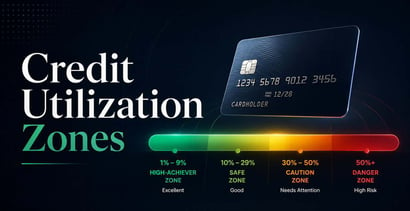
The FICO High-Achiever Zone (1% to 9%)
Reach for the stars! If you carry over between 1% and 9% of your credit card limits you’re in a preferred position.
As long as you use your credit cards regularly, and either pay the bills off in full or keep the revolving debt to no more than 9% of your limits, you look like you are managing your financial affairs without difficulty.
Pair it with a steady stream of on-time payments and a credit utilization ratio like this will help you achieve excellent credit scores.
The Safe Zone (10% to 29%)
Want to buy something expensive and then pay it off over time? That's part of the beauty of a credit card.
Maybe your credit card has a $10,000 limit, and you used it to buy a MacBook Pro, costing around $2,000. That purchase takes up 20% of your limit, so you’re still in the safe zone.
With a few big payments, though, you can take the balance down, and you'll be in an even better position as time passes.
Revolving 10% to 29% of your account’s credit limit and managing the card’s payments responsibly should keep you in decent scoring shape.
The Caution Zone (30% to 50%)
OK, here is where lenders start to get nervous. When you owe between 30% to 50% of your credit lines, it can be an indication that you are borrowing for the things you need and want. You start to look risky, which makes your credit scores go down.
Now, you may know that everything is fine and that you can and will pay off what you owe quickly, but your intentions won’t matter to a credit scoring model.
If you want to hike up your score and get out of the caution zone, make a few big payments. When your account is back under 30% utilization, you can breathe a sigh of relief. The next time your score is calculated, it will be with the new ratio.
The Danger Zone (Above 50%)
Crossing the 50% credit utilization threshold is most definitely a bad sign, and will have alarm bells going off with potential creditors.
It shows that something is amiss, especially if you begin to max out your accounts entirely.
Once you’ve used up more than half of your credit limits, it’s not a one-off situation but a pattern.
Your credit scores will take a dive even if you make your payments by the due dates.
Step 3: Understand the Timing of Balance Reporting
To ensure that your credit utilization is in the best place possible when you are charging expenses, know a bit more about the reporting process.
When you use your credit card, your credit card issuer will submit information about your activity to the three credit bureaus. That data will go into your credit scores.
So when it comes to reporting, there are two dates to know: the statement closing date and the due date.
The statement closing date is when your credit card issuer records your balance for that billing period. If the issuer reported that you owed $1,000 and your credit limit is $2,000, it will show that your credit utilization for that card is 50%.
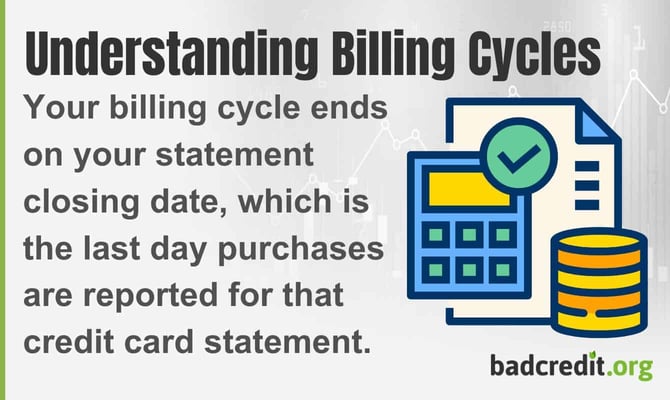
The due date, of course, is the day your credit card issuer expects at least the minimum payment. The due date is usually a couple of weeks after the statement closing date, though, so even if you paid the bill in full by the due date, that high credit utilization ratio may have already been factored in to your score.
Thankfully, there is an easy solution to this problem. Pay before the statement closing date instead of the due date.
Not only will you always have a steady stream of timely payments kicking your credit score up, but you can guarantee that the big purchases you made won't result in points being deducted from your score because it seems like you have a high credit utilization ratio.
Step 4: Create a Strategy to Move Between Zones
Before you start to believe getting (and staying) in the right utilization zone is far too complicated, take my advice. I assure you it's not hard.
- Start with a new account (or one that doesn't have a balance on it) and make a note of the limit.
- Identify a small and steady sum that you can charge that is significantly less than the limit. So if the card’s limit is $1,000, keep the charge to well under $300. A $20 streaming service bill is perfect. That way, you can still use the card for other affordable expenses without pushing the average daily balance too high.
- Pay the bill in full by the due date, and the utilization ratio will be in the safe zone, despite the statement closing date.
- Pay the balance to zero or very close to it before the statement closing date you will be in the high achiever zone.
So what should you do if you have accounts with lingering debt now? Here are three simple steps:
- Review all of your cards and pinpoint the one that has the highest utilization ratio.
- Work that debt down so you have at least 70% of the line available to you, while making at least the minimum payments on the others.
- Keep doing this until all of your cards are in this same ratio.
Once done, your overall credit utilization ratio will also be in good shape, causing your credit scores to rise.
I strongly recommend enrolling in autopay with your credit card issuer, too. It’s free and only takes a moment. Choose the “pay in full” option. You’ll still be able to use your card, but the debt will never get too high.
This doesn’t mean you can’t charge something expensive that will tap out your credit line. You can, just by adjusting the autopay tool for fixed payments instead.
For example, you add $800 to a card with a $1,000 limit and commit $200 instead of paying it off all at once. After the third payment, you’ll be back in the safe zone because the utilization ratio will be 20%.
Note: Your credit score may dip in the first couple of months when you owe a lot compared to your card’s limit, but scores aren’t static. They change with your activity and also assess patterns.
Paying off a high debt incrementally every once in a while is very different from a consistent history of doing so.
Oh, one more tip: if you feel that your credit limits are too tight for comfort, you can request a higher limit. When you've developed high credit scores and have a good history with that issuer, they may increase the line.
There’s no need to constantly struggle to charge less than you can afford!
Take Control of Your Scoring Potential
As you can see, credit scoring models do not reward you for carrying over high debt from one month to the next, but instead for being an active and responsible credit card user.
So yes, break out your plastic and charge what makes sense for your budget. When you do, either pay the bill off entirely or at least enough so your revolving balance is far below the account’s limit.
Do so on a regular basis, and you will establish exactly what financial institutions want to see: that you are an active but low-risk borrower. And that’s the truth.

