

Writer: Eric Bank


Editor: Lillian Guevara-Castro


Reviewer: Adam West

Key Takeaways
- A federal judge dismissed an antitrust case alleging Apple, Visa, and Mastercard worked together to keep high merchant fees on Apple Pay.
- No clear evidence of a conspiracy was discovered, and the court emphasized the difficulty in proving antitrust collusion on circumstantial charges.
- The ruling gives subprime card issuers and embedded fintechs leeway to grow without fear of regulatory blowback against partnership strategies.
An Illinois federal judge threw out a high-profile antitrust case that alleged Apple, Visa, and Mastercard conspired to keep high transaction fees for merchants using Apple Pay. The verdict is a win for mobile payment leaders and solidifies the high threshold for proving anticompetitive conduct in court.
The class-action lawsuit was filed in the name of a class of merchants, led by Mirage Wine & Spirits. The plaintiffs alleged Apple was receiving hundreds of millions of dollars annually from Visa and Mastercard not to offer an alternative payment network to rival that of Mastercard and Visa.
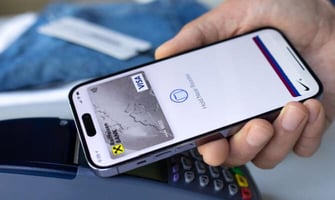
The merchants said that the supposed agreement stifled innovation and forced firms to continue paying high interchange fees each time an Apple Pay customer made a purchase.
But U.S. District Judge David Dugan ruled that plaintiffs could not offer hard evidence of a conspiracy. Instead, he noted that Apple’s card network contracts explicitly preserved Apple’s right to compete, and there was no indication Apple ever intended meaningful steps toward building a competing network.
Court Needs Real Evidence, Not Concurrent Conduct
Dugan’s decision illustrates just how hard it is to win an antitrust case without a smoking gun. Although the merchants mentioned enormous compensation payments Apple was receiving from the networks, the court was not convinced.
The judge emphasized that such revenue-sharing arrangements, on their own, do not prove an illicit understanding to quell competition.
The merchants also cited Apple’s exclusive control of the iPhone’s NFC (near-field communication) chip, which inhibits other wallets from competing on equal footing. However, the court was not satisfied that this was clearly a coordinated effort by Visa and Mastercard.
Since no clear communications and other direct evidence of collusion could be shown, the judge dismissed the case but provided the plaintiffs 30 days in which to revise their complaint.
The decision comes amid a broader regulatory climate where antitrust enforcement is building momentum.
The Department of Justice suggested that it was interested in investigating Apple Pay’s NFC restrictions, and the Consumer Financial Protection Bureau was worried about competition in mobile payments as part of its most recent market monitoring exercises.
What This Means for Subprime-Focused Players
The ruling also has ramifications across the broader credit and fintech world, especially for subprime card issuers and embedded finance firms. The latter, in particular, frequently rely on cooperation between Apple Pay and the card networks to reach end users without having to develop costly infrastructure.
Mercury Financial, Avant, and Petal can continue without undue concern that their arrangements will face antitrust scrutiny solely based on either exclusivity or revenue sharing.
If the case had gone further, it would have engendered legal ambiguity surrounding normal fintech partnerships. The judge’s dismissal gives such firms a sense of relief, as cooperation in and of itself likely would not attract antitrust scrutiny unless supported by explicit anticompetitive intent.
The ruling also reflects a jurisprudential mentality that views large payment systems as legally problematic but not automatically suspect. That’s a good thing for new market entrants who plug into such systems to access underserved segments.
Big Tech and Payment Networks Remain in the Crosshairs
Apple, Visa, and Mastercard prevailed on this front, but antitrust scrutiny is hardly finished.
The Consumer Financial Protection Bureau and Department of Justice are still in investigative mode on fees, routing choice, and competitive issues in card- and mobile-based payments. Apple’s control over iPhone’s tap-to-pay is still in court, thanks to a new lawsuit brought by payment processor Block.
Meanwhile, antitrust authorities are on the lookout for anticompetitive behavior under the guise of cooperation. Although this ruling determines the legality of cooperation, firms must still be careful about their access and pricing arrangements.
The Illinois ruling offers clarity: strategic partnerships involving payment processing and mobile wallets are not illegal in and of themselves. However, companies that operate in such areas must be cautious about the structure and documentation for those relationships.


