


Writer: Lynn Cadet


Editor: Lillian Guevara-Castro


Reviewer: Ashley Fricker

Key Takeaways
As property prices soar and traditional mortgage loans become increasingly unattainable, a new mortgage proposal has emerged as a possible solution to the American housing crisis: a 50-year loan.
Backed by the Trump administration, the proposed 50-year mortgage loan has already drawn national attention. But how do Americans view this controversial idea? According to a recent BadCredit.org study, 45% of Americans say they would consider the ultra-long loan term.
While national sentiment may indicate that many are willing to consider a 50-year term, not all states share the same view on the matter. Variances in cultural norms and economic factors among regions have created gaps in how people from different states perceive the idea.
This divide paints a vivid picture of how differently Americans experience the housing crisis depending on where they live.
The 10 States Most Open to a 50-Year Mortgage
The path toward homeownership is now more challenging than ever before. And Americans across all 50 states are feeling the pressure. Yet, there is a split in how people view Trump’s proposal of a 50-year mortgage.
Residents in some states have shown a higher willingness to consider the idea of a longer mortgage term than others. According to our study, these 10 states were the most open to the proposal:
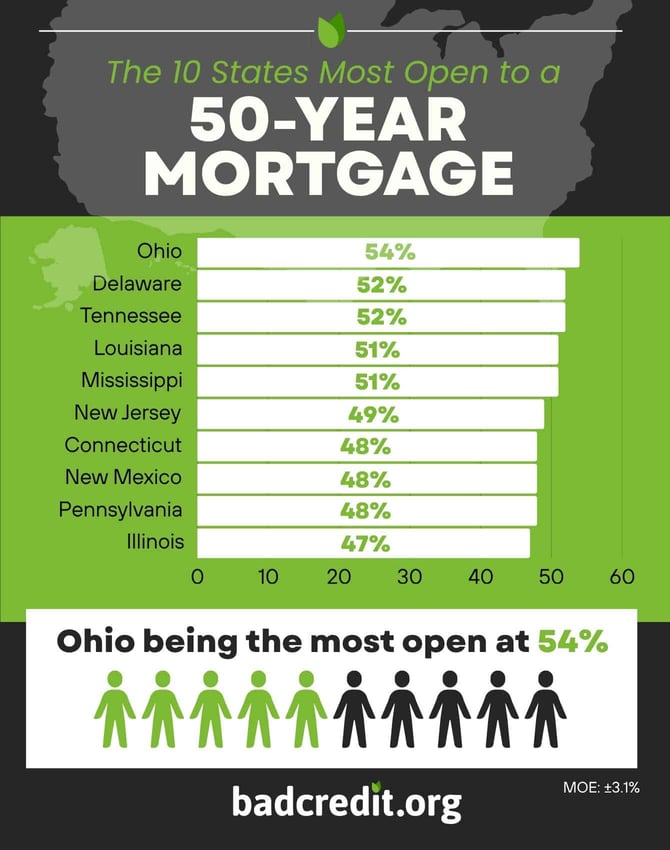
In times of desperation, people are more willing to take risks. Currently, Americans are juggling more than they can afford financially, between balancing student loans, societal pressures, and other financial obligations.
For instance, interest clusters were found in the Midwest and certain parts of the South, where affordability pressures have increased but homeownership remains a primary financial goal. To these people, a longer mortgage cycle may have its shortcomings, but it would provide a practical path to homeownership.
This suggests that a mix of factors, including tightening affordability, rising demand, and homeownership norms, could play a role in making extended-term financing more appealing to residents in some states.
The long-term debt may be overlooked in favor of more manageable monthly payments, as rising prices push more people out of the housing market.
The 10 States Least Open to a 50-Year Mortgage
While residents in some states appear more ready to cast doubt aside and embrace an extended loan as a path to homeownership, others remain skeptical about the proposal.
Residents in these states showed the least interest in adopting a 50-year mortgage loan (in ascending order):
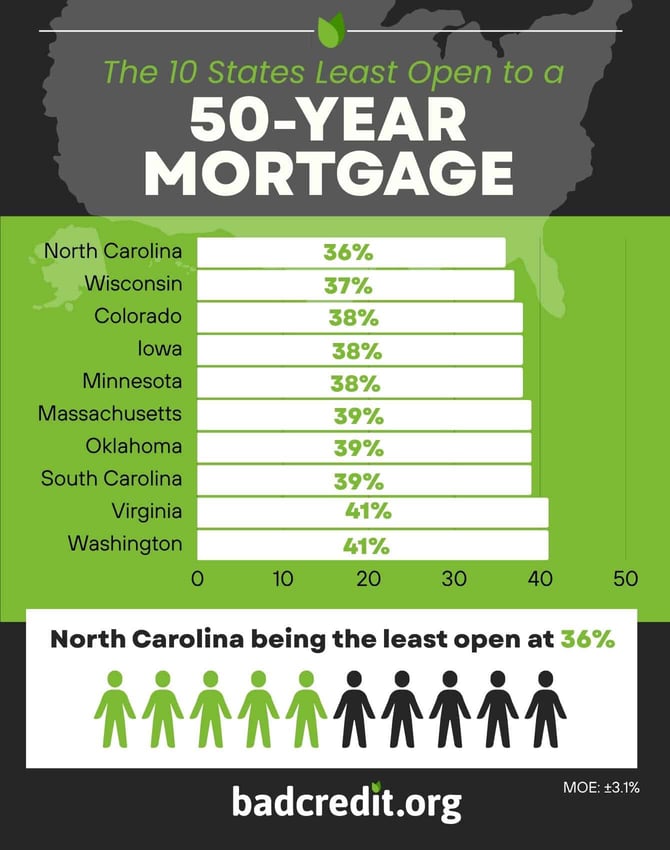
It’s no surprise that people in some states are showing more resistance to the idea. Common concerns about long-term debt, risky terms, and financial freedom could influence why people from these states are hesitant to adopt half-century-long loan terms.
Yet, attitudes toward this matter are more varied than they are uniform. The states we listed above all represent a diverse set of regions, indicating that no single demographic or economic explanation can account for skepticism.
While those in the Midwest may resist due to a historically conservative financial culture, individuals in high-cost states, such as Massachusetts and Washington, may fear that longer loan terms could drive prices even higher, showing how location can influence perception even among those with the same sentiment.
Why States View 50-Year Mortgages So Differently
Disparities in income, cost of living, and varying cultural norms among states may all contribute to the regional differences we observed in our study.
There were no uniform responses among regions; instead, a mixed sentiment that could have more to do with a state’s specific circumstances than its location. For example, South Carolina and Louisiana are both located in the South, yet they were on opposite ends of the spectrum in terms of support.
However, we can’t ignore the fact that states with similar economic and cultural backgrounds also scored similarly. Our study shows that states under the highest affordability pressure aren’t always the most supportive. California, for example, sits near the national average.
Some of the states that showed the most support, including Louisiana, New Mexico, Tennessee, and Mississippi, also have some of the lowest income averages in the U.S. In their eyes, a 50-year mortgage could be viewed as a practical way to make monthly housing payments more affordable.
How Support for 50-Year Mortgages Varies Across the U.S.
“Expanding the array of mortgage options isn’t inherently negative,” said Erica Sandberg, consumer finance expert at BadCredit.org. “In rare circumstances, a mortgage with a 50-year term could be a practical decision. The monthly payments would likely be slightly lower than those for a 30-year loan, so if price is the only hurdle to homeownership, it might work.”
Sandberg adds, “However, the downsides can’t be overstated. Stretching a mortgage to five decades means extremely high total interest, and someone who buys at 40 would pay until age 90, long past typical retirement, when income drops. Interest rates would also likely be higher than on shorter-term mortgages. If this idea comes to fruition, I would urge caution.”
Amid a persistent housing crisis, homebuyers are weighing riskier mortgages in their search for affordability. While a 50-year loan could expand access and provide short-term savings, it also comes with glaring risks, including extended long-term debt. And where people live could matter more in this conversation than most think.
Methodology
This survey was conducted in November 2025 among 1,000 U.S. adults via an online opt-in panel. State-level estimates are based on the subset of respondents from each state. All responses were single-selection, and each question received 1,000 completes. Results reflect the responses of this survey sample.
The margin of error for the full sample is approximately ±3.1 percentage points at the 95% confidence level (as a reference for a simple random sample of 1,000 respondents).
To account for varying state sample sizes and to reduce volatility in states with very few respondents, an empirical Bayes shrinkage adjustment was applied, which blends each state’s observed percentage with the national average.
For media inquiries, please contact catherine@badcredit.org


