


Writer: Andrew Allen


Editor: Ashley Fricker


Reviewer: Catherine McNally

Key Takeaways
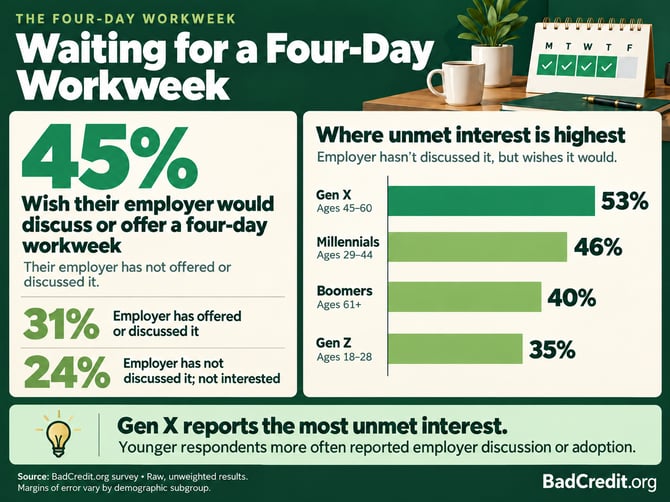
- A new BadCredit.org survey found that 45% of respondents said their employer hadn’t offered or discussed a four-day workweek with them, but they wished it would, a view shared by 53% of Gen X respondents.
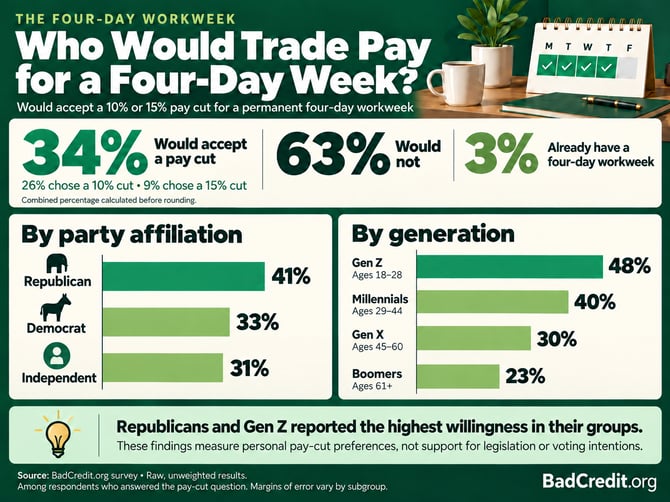
- While 41% of Republican respondents said they would take a pay cut, only 33% of Democrats and 31% of independents said the same.
- Among all demographics, 34% said they would accept a pay cut of either 10% or 15% to secure a permanent four-day workweek.
- If accepting a reduction in pay led to financial strain, 24% of respondents said they would repay debt more slowly and 18% said they’d opt to cut back on the amount they contribute to retirement savings.
As people enter adulthood, many leave behind the passions and hobbies they pursued in their youth. Faced with mounting bills and an overall increase in responsibilities — including potentially having more mouths to feed — most adults join the labor force and earn a steady paycheck.
Oftentimes, that can mean working 40 hours per week. But if Senator Bernie Sanders (I-VT) and Representative Mark Takano (D-CA) have their way, Americans may soon have a little more time to pursue their hobbies.
The duo has introduced a new bill that could lead to a 32-hour workweek in the near future. The bill would also aim to block employers from reducing benefits or pay in response to a shorter workweek.
BadCredit.org conducted a survey to gauge people’s interest in working four days a week and to find out exactly what people would give up to have one fewer day in the office each week. The research takes a look at a hypothetical workweek arrangement rather than reactions to the bill from Sanders and Takano.
45% Wish Their Employer Would Discuss a Four-Day Workweek With Them
While a four-day workweek may interest many workers, their employers may feel quite differently about the idea. Honest conversations about the topic, allowing workers and their bosses to express their opinions and desires concerning the appropriate length of the working week, could help the concept gain more traction.
But according to respondents, some employers haven’t addressed the topic at the time of the survey:
- 45% of respondents said that their employer hadn’t offered or discussed a four-day workweek with them even though they wished their employer would take that step.
- 31% said their employer had offered or discussed it.
- 24% said their employer hadn’t discussed it, but they weren’t interested in a four-day workweek anyway.
Across generations, respondents who are members of Gen X — or those aged 45 to 60 at the time of the survey — reported having the greatest unmet interest when it comes to a four-day workweek.
Interestingly, Gen Zers, those aged 18 to 28 when they took part in the survey, reported having the lowest level of unmet interest of all age groups, at just 35%. This could be because more businesses that employ members of Gen Z are open to allowing them to work a four-day week.
However, it could also be due to the possibility that Gen Zers, an age group relatively new to full-time employment, haven’t fully embraced the idea of a shorter workweek just yet.
41% of Republicans Would Accept a Pay Cut for a Four-Day Workweek
Although the bill from Sanders and Takano would seek to prevent an employer from reducing a worker’s pay if a 32-hour workweek were implemented, more than 1 in 3 survey respondents indicated that they would be willing to give up income to work four days per week.
“That truncated workdays are part of the political discourse is fascinating. One of the more interesting results of our study is the difference between party voters. It might not be what people expect, with republicans being most apt to say they would accept a pay cut to enjoy a regular three-day weekend,” said Erica Sandberg, consumer finance expert at BadCredit.org.
Among all respondents:
- 34% indicated they would accept a pay cut, with 26% selecting a cut of 10% and 9% opting for a 15% reduction in pay.
- 63% said they would not accept a pay cut.
- 3% said they already had a four-day workweek.
The legislation to move to a four-day workweek comes from a member of the Democratic Party and an Independent. But it was respondents who indicated they supported the Republican Party who were more likely to say they’d accept a reduction in pay if it meant their workweek was just four days long.
Here’s how survey participants responded to the question of pay cuts, by party affiliation:
- More than 4 out of 10 (41%) Republican respondents would accept a pay cut.
- One-third of Democratic respondents would do the same.
- Just 31% of Independent respondents would accept a reduction in pay.
And Gen Z, the youngest group of respondents in the survey, was the group that said they’d be most willing to take a pay cut in exchange for a four-day workweek. Among generations, 48% of Gen Z respondents said they would accept lower pay, compared with 40% of millennials, 30% of Generation X, and 23% of baby boomers.
Of particular note in these findings is that the share of respondents saying they’d take a pay cut decreased with each successive generation, from Gen Z to millennials to Gen X to baby boomers.
One explanation for this could be that older generations may have accumulated more debt — and may have more people they’d like to support financially — than younger generations, making them less willing to accept lower pay.
Sandberg notes, “Perhaps least surprising is that, out of all the other generations, Gen Zers are most willing to take a pay cut in exchange for a four-day workweek. Almost half would be willing to accept lower pay so they could have more time to play!”
The survey findings do not establish support for the bill from Sanders or Takano, nor do they suggest any voting intentions.
24% Would Pay Down Debt More Slowly for a Four-Day Workweek
Answering a question about what sacrifices you’d hypothetically make to get a four-day workweek is one thing, but actually adapting to lower pay is another. Those who said they’d take a smaller paycheck in exchange for a four-day workweek could face some tough financial decisions down the line should their pay actually decrease.
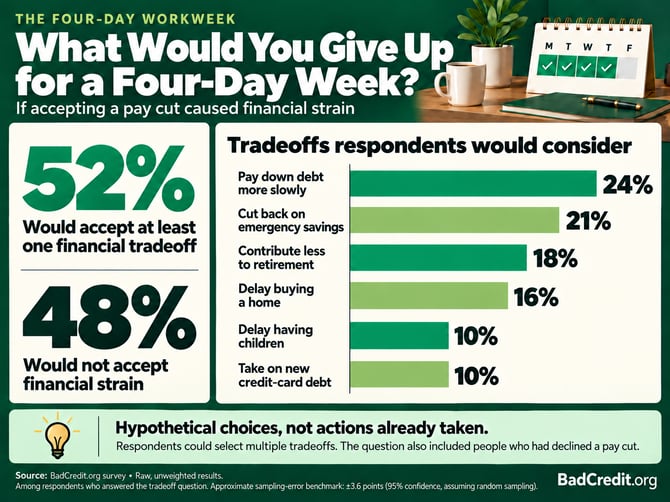
When asked what they would sacrifice if accepting a pay cut led to financial strain, the most common response from survey participants was that they’d take a slower approach to paying down debt. Here is the full list of possible actions people would take, along with the share of respondents who selected them:
- Pay down debt more slowly: 24%
- Cut back on emergency savings: 21%
- Contribute less money to retirement: 18%
- Delay buying a home: 16%
- Put off having children: 10%
- Take on new credit card debt: 10%
And while the majority of respondents (52%) selected at least one of these actions, nearly half (48%) said they wouldn’t accept any financial strain at all.
According to Sandberg, “Though a shorter work week can look awfully appealing at first glance. But when it will result in a tighter budget, not being able to meet goals in their desired timeframe, lead to excess consumer debt, and having trouble making credit card payments, it suddenly starts to become a lot less exciting.”
The responses to this question include those from people who said they wouldn’t take a pay cut in a previous question. The responses are hypothetical, and survey participants were permitted to select multiple actions.
Considering Whether a Shorter Workweek Is Worth It
In and of itself, a shorter workweek may sound like a dream come true. After all, who wouldn’t want more time to pursue their passions, spend time with their family, or even just relax?
But people who are wishing for a four-day workweek may want to ask themselves how much that extra day away from the office is worth to them.
For some respondents, a smaller paycheck is an acceptable tradeoff to make. But that may necessitate a slower approach to paying down debt or building their emergency savings.
Before signing up to trade a day of work for a day of freedom, workers would be wise to consider whether the added flexibility is worth the potential cost to their financial security.
Methodology
BadCredit.org surveyed 1,000 U.S. adults in late spring 2026. Findings about pay cuts and financial tradeoffs are based on 760 respondents. The data are raw and unweighted.
Assuming simple random sampling, the approximate margin of error is ±3.1 percentage points for the full sample and ±3.6 percentage points for the subgroup at the 95% confidence level. Margins are larger for demographic subgroups. Percentages may not total 100% because of rounding or multiple selections.
For media inquiries, please email catherine@badcredit.org.


