

Writer: Chris Taylor


Editor: Lillian Guevara-Castro


Reviewer: Adam West

When you’re a government agency tasked with overseeing huge swaths of the payments and lending world, and your budget is being chopped in half, what do you do?
Well, here’s one solution: You mandate yourself less work.
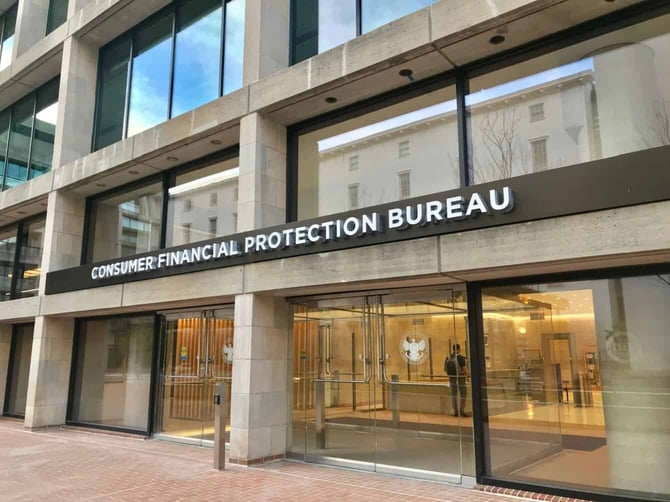
That would be one result of the Consumer Financial Protection Bureau’s proposed rule changes, which were announced on Aug. 8.
By essentially limiting its supervision to only larger players in the industry — in areas like debt collection, international money transfers, consumer reporting, and auto financing — the bureau could vastly reduce the number of companies it oversees.
This could feel like a welcome reprieve for many firms, releasing them from previous regulatory burdens and compliance work. For the government agency, which is trying to make do with fewer resources, it certainly takes a lot off their plate.
For both sides, it’s an easy solution. It’s also the wrong solution.
The Clock Is Ticking on Getting This Right
Of course, nothing is written in stone yet. We are currently in a period of public comment, until Sept. 22, as interested parties weigh in on what a renovated industry would look like.
But the time is short. And there is plenty of reason to worry about what might result, if these proposed changes go through.
For example, in auto financing, if the size threshold for oversight was raised to 1 million annual transactions, the number of companies under the Bureau’s supervisory authority would go from 63 (or 94% of the market) to just five (42% of the market). In consumer reporting, the number of larger participants would drop from 30 to six.
In other words, these are not small tweaks. These are significant changes that could reverberate in harmful ways.
First, it would mean two different realities for companies in these industries. The largest entities would be closely watched for regulatory compliance, while those falling below that supervisory threshold would not face similar oversight.
That’s hardly a level playing field: If there are multiple standards at work, then there is no standard at all.
Second, there is the question of consumer protections — which is the bureau’s stated goal, after all. This is an especially pressing question in the subprime lending space, where borrowers are more vulnerable than most. Released from supervision, you can imagine the kind of predatory practices that bad actors would be tempted to adopt.
Third, there is the larger question of the integrity of capital markets. Any financial system relies inherently on trust — that proper standards are being followed, that the numbers are solid, that consumers are not being taken advantage of. If oversight is erased for large chunks of the industry, some of that trust inevitably goes away.
And when trust is questioned, it doesn’t take much for confidence in a sector to fall apart. Just one bad actor, rightly or wrongly, can raise doubts about every other operator in the space.
As we saw in the housing crisis of 2008-2009, investor panic and contagion can take down some of the most storied financial firms in the country in the blink of an eye.
Saving the Industry From Itself
In other words, the CFPB and its oversight are helping save the payments and lending world from itself. It’s a classic short-term versus long-term dilemma: Sure, freed of oversight, you could juice near-term returns and push the boundaries of acceptable practices. But the deeper costs, both reputational and legal, just aren’t worth it.
Having the government peeking over your shoulder may be annoying, and it may be occasionally onerous. But it’s a system that helps ensure the foundations of the entire structure are solid.
Chipping away at those foundations is not a game you want to play.
One potential outcome, for instance, is that the new system could be gamed. If smaller operators are free from oversight, and big ones are not, then larger participants might be incentivized to break themselves into pieces to fall under that reporting threshold.
Nothing is written in stone yet. We are in a period of public comment, until Sept. 22, as interested parties weigh in on what a renovated industry would look like.
There are a couple of paths forward here. One is that, rather than the CFPB slashing its responsibilities because of a lack of money and manpower, responsible lawmakers should work toward a restoration of that budget so they can actually do their work. After all, a sound financial system benefits all of us, top to bottom.
Another is that, if the administration is determined to scrap the existing framework, there could at least be some middle ground to be found.
While the raised thresholds proposed by the CFPB would result in much less supervision, they could be seen as the first salvo in a negotiation — an opening bid, so to speak. More moderate changes in those thresholds would mean a less dramatic shakeup of multiple industries.
The point is that the notion of two segments of the industry, operating under wildly different standards, is not really fair to anybody. Not to the companies that are trying to play by the rules — and not to consumers, who will ultimately be affected most.
