


Writer: Lynn Cadet


Editor: Ashley Fricker


Reviewer: Adam West

Key Takeaways
- Just 7% of respondents say women’s financial mistakes are framed as strategic risks or learning experiences, compared to 22% for men.
- 33% say women’s financial mistakes are described as reckless or irresponsible, vs. 21% for men.
- 23% of respondents believe women are judged more harshly for financial mistakes, while only 13% say the same about men.
When men make financial mistakes, they’re seen as strategic three times more often than women, who are more likely to be called reckless, according to a recent national survey from BadCredit.org.
The survey reveals how Americans perceive and describe financial missteps differently depending on gender, with insights into why that narrative split may matter more than we think.
Gender bias in the financial sphere has long existed. Outdated views, rooted in traditional norms where men managed finances, continue to reverberate throughout our society today, influencing how financial behaviors and roles are framed.
These aren’t just semantic differences. The way we frame mistakes based on bias can impact how people are trusted, promoted, or given a second chance, especially in financial or leadership roles. Our survey explores the biases and double standards that influence how culture frames finance and gender below.
“Strategic” for Him, “Reckless” for Her
Gender inequality in finance is a long-standing issue. For years, most women lived with limited financial autonomy. Even when they gained the freedom to earn their own wages, they were paid significantly less than their male counterparts.
These double standards continue to persist in 2025. Our data depicts a clear difference in how women are judged financially compared to men, with the perception of competence often skewed toward men.
When asked how financial mistakes are portrayed in the media, only 7% of respondents said women’s financial mistakes are portrayed as strategic, compared to 22% who said the same about men.
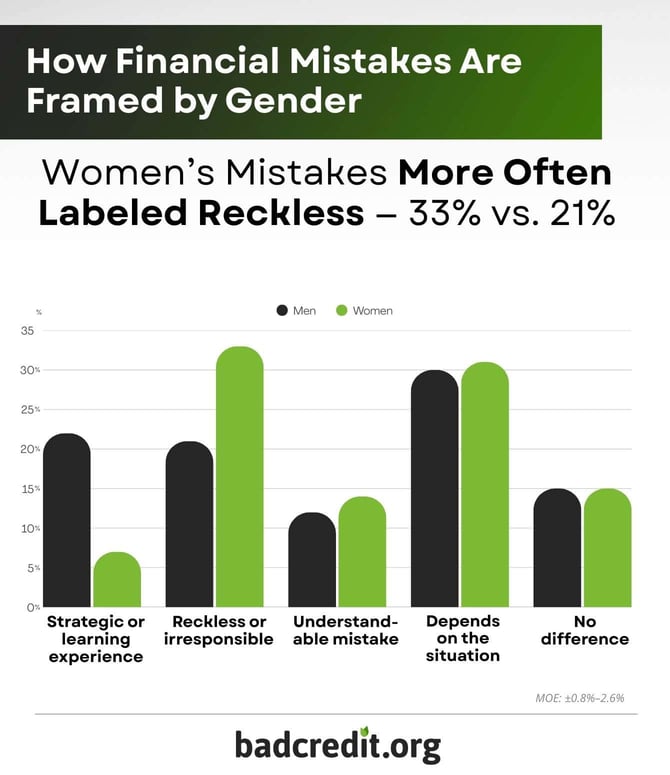
Instead, our study found that women were more likely to be portrayed as “reckless” with their financial decision-making. In fact, 33% of respondents described women’s mistakes as “reckless or irresponsible,” compared with 21% for men.
These results point to a narrative disparity, in which men’s financial failures are perceived as strategic, while women’s mistakes are interpreted as flaws in judgment.
The stereotype that women are bad with money may be to blame for this skewed viewpoint. Stemming from societal expectations and historical disadvantages, many people still believe, even if subconsciously, the myth that women can’t responsibly manage their money, let alone understand finances.
The facts tell a different story. Several studies indicate that women are less likely to splurge than men and have outperformed men in investing.
But women often have less money to save and invest because of the wage gap. That may be a more accurate reason why women often end up with less savings in their bank accounts and are slower to reach major financial milestones.
Do Women Receive Different Financial Advice?
We’ve all made financial decisions that we wish we could erase, not only from our wallets but also brains. New data shows nearly 1 in 4 Americans think women are not only judged more harshly but also receive different financial advice, and that perception could carry real reputational weight and financial implications.
While 23% of surveyed Americans say women receive different advice and are judged more harshly for financial mistakes, only 13% say men face more judgment and are advised differently.
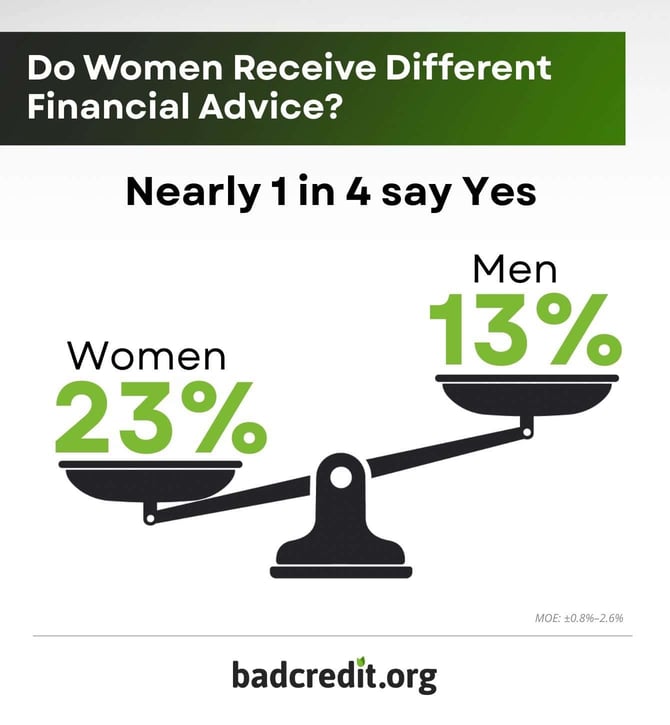
Often unfairly depicted as reckless with money, many women have personally encountered gender bias in financial discussions, more so than their male counterparts.
According to our study, while 3 in 5 (60%) men say they have never experienced or witnessed gender bias in financial discussions, only 47% of women could say the same. Women were also more likely to respond with “yes” or “unsure” when asked about experiencing gender bias in financial advice conversations.
These findings highlight a widespread perception of unequal judgment and bias for financial mistakes when it comes to gender. They also show a correlation between how women are portrayed in culture, e.g. reckless, and how they are judged more harshly in reality.
Where missteps by men may be perceived with more understanding, women are expected to take the safe route with their decisions. This sets up a disparity in not just how mistakes are described, but in how severely they’re judged.
Why Perception Matters & What it Could Mean
These viewpoints, unfortunately, have an impact. Research in behavioral finance and leadership shows that perceived reputational risk can influence decision-making, meaning how society or an individual perceives themselves can directly affect their next steps.
A person’s environment heavily influences and informs their perception of themselves. When women expect to be judged more harshly, that perception may shape how they lead, take risks, or recover from failure.
As it happens, framing language plays a significant role in influencing how women view themselves. Negative framing language, such as “reckless,” can contribute to unfavorable financial behavior among women, including:
- Hesitation to take calculated risks: Women may take fewer risks due to the fear of making a mistake that could be wrongly judged.
- Self-censorship in leadership or decision-making settings: Confidence starts with self-belief. When women think they lack financial competence, it can be challenging for them to be self-assured in the decisions they make.
- Lower trust in recovery after failure: Women may internalize these narratives, leading to lower risk tolerance, fewer leadership bids, and slower recovery after failure, not because they’re less capable, but because they’re less forgiven.
“The findings in this study confirm that perception informs reality when it comes to how we judge financial decisions,” said Bobbi Rebell, CFP® & Personal Finance Expert. “The results are frustrating at a time when more progress should have been made in how we work to elevate women’s financial wellbeing throughout their life stages.
Rebell adds, “This will hopefully be a call to action for all genders to push past outdated stereotypes and work toward better framing of financial behavior.”
Mistakes are a part of progress, but how they’re judged can determine how we move past them.
Whether we make a bad investment or regret an impulse buy, how that decision is judged shouldn’t be predicated on gender, especially since data shows social labels can carry lasting consequences.
We don’t just judge mistakes differently. We remember them differently, and that shapes who gets to move forward.
Methodology
This survey was conducted among 1,500 U.S. adults to explore perceptions around financial decision-making, emotional drivers of spending, and generational attitudes toward money.
Questions included topics such as financial regret, budgeting behavior, impulse purchases, and, relevant to this study, perceptions of how financial mistakes are judged and framed by gender.
The sample included 1,000 nationally representative respondents and an oversample of 500 Gen Z adults, with data weighted to ensure balanced representation across age, gender, race, and region.
The survey aimed to capture a broad and demographically diverse view of how financial behavior and narratives are experienced across generations, with an emphasis on younger consumers. Fieldwork for the survey took place between February 21- February 27, 2025.
The margin of error for proportions ranges from ±0.8% to ±2.6%, depending on the specific question and subgroup. All results reflect a 95% confidence level.
For media inquiries, please reach out to catherine@badcredit.org.
