

Writer: Lynn Cadet


Editor: Lillian Guevara-Castro


Reviewer: Adam West

Key Takeaways
- Nearly half of Americans (48%) say their credit score has stopped them from living the life they want — but that number jumps to 73% among expecting parents, the highest of any demographic surveyed.
- Cars are the most commonly blocked purchase (54%) because of bad credit, slightly surpassing homeownership (51%), reported by survey respondents.
- 3 in 4 expecting parents (74%) say bad credit has stopped them from buying or leasing a new car.
While bad credit has long been a deterrent to long-term financial goals such as home ownership, for millions of people, it’s now blocking the purchase of something that was previously more readily available: car ownership.
As average new car prices reach record highs and monthly loan payments exceed $800, lower-cost car options are slowly disappearing. And in a market that leans heavily on credit for financing, poor credit scores are only making car ownership harder to access.
A new BadCredit.org study reveals that nearly half of Americans (48%) say their credit score has stopped them from living the life they want, including achieving major life events such as planning a wedding or having a child.
This reveals an economic reality where financial strain and bad credit collide, forcing millions of Americans to put both financial and life-stage milestones on hold.
Parents, Especially Expecting Parents, Feel the Impact of Bad Credit Most
As for who’s hit the hardest by bad credit, parents are feeling the impact the most.
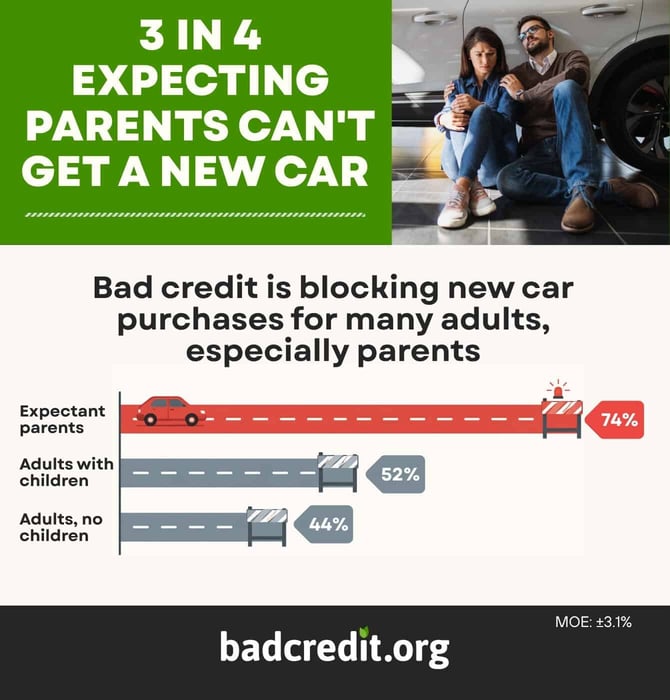
According to our study, this is how Americans responded when asked whether a poor credit score has held them back from living the life they want (by child status):
- Expectant parents: 73%
- Adults with children: 52%
- No children: 44%
Families are increasingly feeling the burden of bad credit, and the experience is even more pronounced among expecting parents.
These are the top three things parents who are expecting a child say they were held back from obtaining due to bad credit:
- Buying or leasing a new car: 74%
- Moving to a better apartment or neighborhood: 37%
- Refinancing existing debt: 37%
- Traveling more: 26%
Our results found that 74% of expecting parents can’t buy or lease a new car because of their credit score, a 20-point leap from the nationwide average, making them the most affected group. This reveals a significant gap that could impact transportation for millions of people.
That gap matters because a car isn’t optional for most families. It’s how parents get to prenatal appointments, bring a newborn home from the hospital, and get to work once parental leave ends. For many families, it’s not a purchase — it’s a prerequisite.
“Bad credit is hitting expectant parents right when the stakes are highest, said Bobbi Rebell, consumer finance expert at BadCredit.org. “Parents are stretched for both time and money, and getting where they need to go in the easiest way possible, often with a child in tow, should be a given.”
Yet bad credit is making that prerequisite out of reach at exactly the wrong time. Parents-to-be are already planning and adjusting their lifestyles to welcome a new life. Oftentimes, this means budgeting and paying for the various expenses associated with growing a family, including transportation.
Rebell adds, “The bar is getting higher and higher. First it was housing, now transportation. This is a big wake-up call that improving your credit profile is one of the best things you can do for your family, and taking proactive steps to do so is non-negotiable.”
With rising day-to-day needs, credit challenges make meeting these needs more difficult, arriving as a financial obstacle at a moment when families have the least flexibility to absorb one.
Cars and Homes Are Now Nearly Equally Out of Reach
For decades, car ownership has been seen as a universally attainable goal. Compared to buying a home, purchasing a car requires less red tape, a smaller price tag, and is more readily accessible.
But that seems to be changing due to one major culprit: bad credit. While homeownership remains a prominent financial hurdle for Americans, a poor credit score now blocks nearly as many people from buying a car as it does a home.
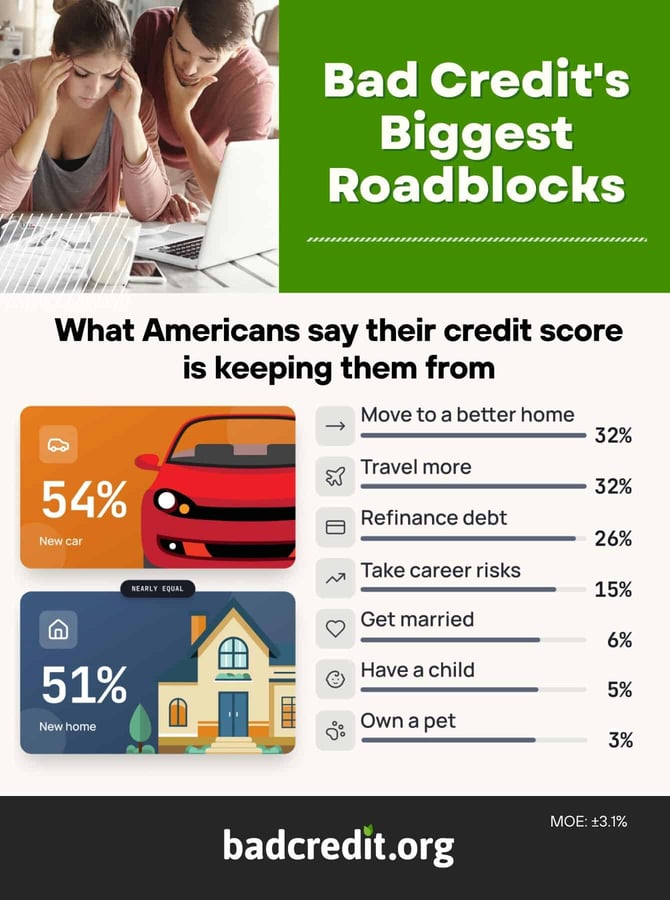
According to our study, these are the most commonly blocked purchases due to bad credit:
- Buy or lease a car: 54%
- Buy a house: 51%
- Move to a better home: 32%
- Travel more: 32%
- Refinance debt: 26%
- Take career risks: 15%
- Get married: 6%
- Have a child: 5%
- Own a pet: 3%
The near-tie between cars and homes represents a meaningful shift. Buying or leasing a car slightly edges out buying a house as the most commonly blocked purchase, most likely due to cars being a more immediate need.
Unlike buying a home, purchasing a car can’t exactly be delayed. The need for a car is typically more essential, as most Americans rely on cars not only for mobility but also for their daily commute to work.
Rebell notes, “I remember when a car was something that teenagers bought when they got their driver’s license. It might have been a used car or a lower-cost model, but in general, a teenager with a job could become a car owner. Now, car ownership is becoming another tough-to-reach adulting milestone that is aspirational rather than a rite of passage.”
“Not having a strong enough credit score has become a ball and chain that is impacting young families in ways that can derail their upward mobility. This is an affordability crisis playing out in real time.”
Bad Credit Is a Symptom of a Bigger Economic Squeeze
Bad credit isn’t just a symptom of poor financial decision-making either. It’s also a sign of growing economic pressure and strain. Americans are currently facing a major affordability crisis that’s straining their wallets and, in turn, impacting their credit and path to everyday necessities.
For expecting parents, that reality is especially stark: the same economic pressure that damages their credit is also blocking the car their growing family will need from day one.
Today, improving credit isn’t just for unlocking long-term financial goals; it may also determine whether basic needs remain in reach for families.
Methodology
This survey was conducted among 1,000 U.S. adults via an online panel. The overall margin of error is approximately ±3.1% at 95% confidence.
All questions were single-selection, and each received 1,000 completes. Crosstabs by demographic group (gender, generation, U.S. region, etc.) are available upon request.
For media inquiries, please contact catherine@badcredit.org.

