

Writer: Eric Bank


Editor: Lillian Guevara-Castro


Reviewer: Adam West

Key Takeaways
Five major auto loan providers are being asked to justify how they can charge military personnel higher interest rates than their civilian counterparts in certain situations.
“The CFPB’s actions to halt enforcement of consumer protection laws have made a mockery of its promise to continue fighting on behalf of service members and their families,” said U.S. Senator Elizabeth Warren in her letter announcing the probe.
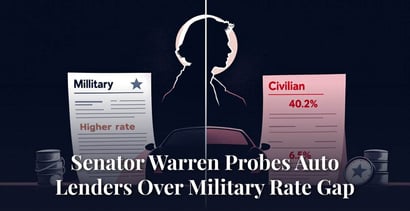
“Service members paid interest rates that were on average 0.35 percentage points higher than similarly situated civilians at one large lender, and 0.28 percentage points higher at another,” she said.
Automobile lenders are currently operating within a gap in federal law as repossessions are increasing, and an growing number of consumers are experiencing late payments.
The current loophole permits automobile lenders to charge interest rates higher than the MLA cap on automobile loans (even those made to military personnel), and rising delinquency rates indicate that subprime borrowers are increasingly stressed.
Repossessions are increasing as oversight has relaxed with decreased enforcement activities at the Consumer Financial Protection Bureau (CFPB). Warren attributed the reduction in oversight activity to actions taken under the Trump administration.
Due to their high rate of relocation and base assignments, military families rely heavily on auto loans, and the pricing gap will be felt immediately.
The Military Lending Act Loophole
Many of the products subject to the Military Lending Act are capped at a 36% APR. But the Military Lending Act does not include vehicle loans, which is what Warren is investigating.
The loophole allows lenders to bypass the 36% cap by issuing vehicle-secured loans, the type many military families rely on. The impact goes beyond higher payments.
“If a service member has more debt than they can afford, it can jeopardize their financial stability and even result in the loss of a security clearance, putting their military career at risk,” Warren said.
Warren Targets Major Auto Lenders
Warren wrote to Ally, Capital One, Santander, Wells Fargo, and JPMorgan Chase. She wants to know the prices these lenders charge and whether they have different loan terms for civilians. The focus of her inquiry is on how lending institutions establish interest rates and loan terms when specific rate caps aren’t applicable.
An industry trade group disagrees. The American Financial Services Association, a U.S. trade group for consumer credit companies, has said, ”Some Military Lending Act regulations limit the availability of some forms of credit to servicemembers… forcing them to search elsewhere to find the credit they need.”
Repossession Surge Raises Broader Risk
Vehicle repossession rates have approached levels not seen since 2008, according to recent data. Typically, this occurs after months of missed payments.
In addition to higher vehicle prices, longer loan terms also increase monthly payment amounts. Subprime borrowers often find themselves operating under a very thin margin of error. Military families may experience an additional burden from relocation costs as well as changes in household expenses.
Why This Matters for the Subprime Credit Ecosystem
There is a loophole that permits lenders to exceed the capped rate of interest. Enforcement against lenders has been lighter, which lessens their potential exposure. The large number of stressed borrowers significantly raises the risk of loan defaults.
As the number of repos continue to rise, lenders may tighten lending standards to limit the amount of loans available to the poorer credit class of borrowers. As lenders become subject to greater scrutiny, they may be forced to either close the loophole or lower the price at which they lend.


