


Writer: John Ulzheimer


Editor: Austin Lang


Reviewer: Jon McDonald

Disclosure: When you apply through links on our site, we may earn a referral fee from our partners. For more, see our ad disclosure and review policy.
Whether you have your heart set on a new rewards credit card, a mortgage loan, or some other type of financing, your credit score or scores will come into play when you fill out your application. Lenders use credit scores as a way to measure the risk of doing business with you and to determine if loaning you money is a smart investment or simply too risky.
Because credit scores matter so much to lenders, it’s always a wise move to pay attention to your own three-digit numbers. Knowing how your credit measures up relative to that of others can also be helpful. To that end, you’ll find this list of 10 surprising credit score statistics that you don’t want to ignore.
1. 65% of the Points in Your FICO Score Have Nothing To Do With Whether You Pay Your Bills on Time
Full disclosure, this statistic is the hardest one for my father to grasp. He comes from an era where all you had to do was pay your bills on time, and you were golden. Times have certainly changed.
Don’t get me wrong. Paying your bills on time is a great habit where credit scores are concerned, and you’ll need to do well in the payment-related categories to max out your FICO and VantageScore credit scores.
Yet, payment history is only worth around 35% of the points in your FICO scores.1
Approximately 65% of your credit score points come from other categories.
| FICO Score Factor | Percentage of Your Score |
|---|---|
| Payment History | 35% |
| Amounts Owed | 30% |
| Credit History | 15% |
| Credit Mix | 10% |
| New Credit | 10% |
In reality, many factors influence FICO and VantageScore credit scores. These credit-scoring factors fall neatly into the following five categories:
Your credit utilization ratio, for example, is one part of the Amounts Owed category from your credit reports. If your credit report indicates that you’re using a large percentage of your credit card limits, it could hurt your credit scores.
The length of your credit history is another example of information that impacts your FICO and VantageScore credit scores. Having older accounts on your credit reports will benefit you.
2. 64% of Americans Have a Good Credit Score
It does take some effort to earn and maintain good credit scores. But, according to the credit score developer FICO, many Americans are actually quite good at doing so.
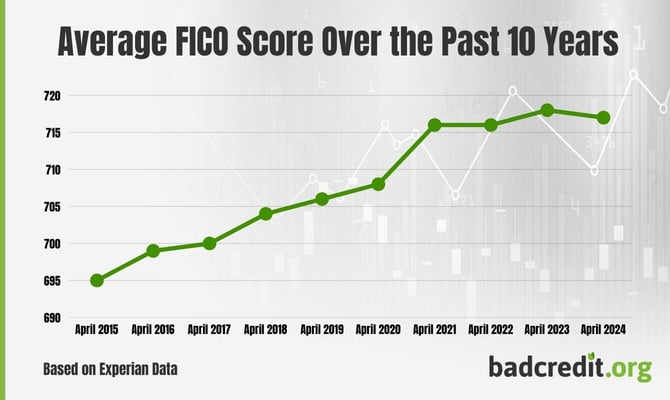
FICO reports that 64% of consumers in the United States have a good credit score as of April 2024.2 The number of consumers with good credit has been on the rise as well. In fact, for the better part of the last 20 years, the average FICO score has gone up. In 2005, the average FICO score was only 688.
The definition of good credit can vary from one lender to the next. In general, a FICO score of 700 or higher is considered to be a good (or better) credit score range. Keep in mind, however, that what a lender considers to be good isn’t the same as where you rank nationally.
The average FICO credit score was 717 in April 2024, which is one point off the all-time high of 718 from April 2023.
Good credit comes with many benefits. A good credit score may give you a better chance of qualifying when you apply for loans, credit cards, and more. Plus, you can often leverage a good credit score to secure lower interest rates, better borrowing terms, and more affordable insurance premiums.
3. The Average FICO Score Hit a Record High in April 2023
Despite the obvious challenges in and since 2020, the average FICO score in the United States has been on the rise. In April 2023, FICO reported that the average U.S. FICO score had climbed to an all-time high of 718, as previously mentioned.2
But, FICO scores don’t predict the future of the economy. A FICO score simply predicts the likelihood that an individual consumer will make a late payment (90 days late or worse) on a credit obligation in the next 24 months. That’s all credit scores are designed to do — nothing more, nothing less.
Of course, you can fully avoid negative information from hitting your credit reports by making at least your minimum payments each month. That way, negative information will never become an issue for you, and the average FICO score would continue to trend upward.
You should check your own credit reports to ensure they are void of negative information, which you can do for free each week at AnnualCreditReport.com.
4. An Estimated 45 Million Credit Files Don’t Qualify for a Credit Score
You may not have known this, but not everyone has a credit report that will qualify for a FICO or VantageScore credit score. Credit scores are based on information found in your credit reports with Experian, TransUnion, or Equifax.
But simply having those reports isn’t enough to guarantee that you’ll qualify for a credit score. If you’re new to credit, or you haven’t had any active credit accounts for years, you may not receive a score.
To have a FICO score, your credit reports must meet FICO’s minimum credit-scoring criteria. Specifically, your credit reports must:
- Not indicate that you’re deceased.
- Have at least one undisputed account that’s at least six months old.
- Have at least one undisputed account that’s been updated by a creditor in the last six months.
Most credit files qualify for FICO scores. But 45 million consumers have credit reports that cannot meet the minimum credit score criteria, according to the Government Accountability Office.3 FICO refers to this demographic as the unscoreables. The CFPB calls these people the credit invisible.
Not having a score can be problematic because your credit applications are likely to have to be manually underwritten.
You cannot have a FICO score of zero, as some people may have you believe. There is no numeric credit score zero — it doesn’t exist. Almost all FICO and VantageScore credit scores fall between 300 and 850. There are some exceptions for variants of the FICO score.
5. Roughly 36% of Consumers Have Below Average Credit
When you have below-average credit, it can be difficult and expensive to borrow money. But in 2024, the percentage of Americans with below-average credit scores was over one-third of the scoreable population.
Below-average credit is a term that means that your credit score will not be high enough to qualify for the best or even near the best interest rates. The actual score threshold where you cross over into the “subprime” region, somewhere below average, is a moving target, as each lender sets its own cutoff point between what it considers to be prime and subprime credit scores. The average score, however, is more cut and dried.
| FICO Score Categories | Score Range |
|---|---|
| Exceptional | 800-850 |
| Very Good | 740-799 |
| Good | 670-739 |
| Fair | 580-669 |
| Poor | Below 580 |
For example, some lenders may consider anything below 700 to be subprime, while others consider scores that fall below 600 to be subprime. Generally speaking, however, a FICO score that falls below 670 is considered a subprime credit score.
In 2024, the average FICO score was 717. That means everything below 717 is considered to be below average.2
Still, if you have bad credit, you are by no means alone in your struggles. More than one-third of Americans have below-average credit scores. That represents millions of people when you consider that the three credit bureaus have credit data on more than 220 million consumers each.
6. Over 50% of Americans Check Their Credit Score Monthly
Keeping an eye on your credit reports and credit scores may help you earn or protect a good credit rating. So it’s a good thing that many Americans do, in fact, check their credit score frequently.
According to TransUnion, 59% U.S. consumers check their credit score at least once a month.4 Most of those consumers — 87% to be exact — access their credit scores free of charge.
The Fair Credit Reporting Act (FCRA) gives you the right to claim a free credit report from all three major credit bureaus once every 12 months. But these free reports don’t include your credit scores.
Still, there are many ways to check your credit scores for free.
- Your credit card issuer may give you free FICO or VantageScore credit score access as a cardholder benefit. Check your monthly statement or log in to your cardmember account online to confirm.
- Discover offers free FICO scores to anyone — whether or not you’re a cardmember.
- Numerous websites offer free credit score access in exchange for letting the company market financial services to you.
NOTE: The credit bureaus allow free weekly credit reports, although they are not required to do so by law. Those free weekly reports are available only at AnnualCreditReport.com.
7. People Who Are 77 and Older Have the Highest Average FICO Scores
Generally, the average FICO score has increased across the board for consumers over the age of 18. Experian refers to these consumers as credit active.
Consumers over the age of 77, known as the silent generation, currently have the highest average FICO score of any credit-active generation. The average credit score for these consumers is 760.5
| Age Group | Average Credit Score |
|---|---|
| Generation Z (18-25) | 680 |
| Millennials (26-41) | 690 |
| Generation X (42-57) | 709 |
| Baby Boomers (58-76) | 745 |
| Silent Generation (77+) | 760 |
Gen Z has the lowest average FICO scores, only 680. These consumers, between the ages of 18 and 25 years old, have a harder time scoring extremely high because their credit reports are going to be younger than credit reports belonging to older consumers. The age of your credit report is an important factor in credit scoring systems.
8. The Average FICO Score Increased 3% From 2014 to 2024
Between 2014 and 2024, the average FICO score in the United States has been on a steady rise. FICO reports that during that time, the average score increased from 692 to 717 (25 points).2
Twenty-five points may not sound like much, but depending on your personal scores, it certainly indicates better credit risk to lenders. Many lenders calibrate credit scores such that every 20- to 40-point score increase indicates a 50% reduction in your odds of making a late payment.
The technical term for this is Points to Double the Odds (PDO). The point is that an increase of 25 points can be a big deal for consumers.
Not only has the average credit score been improving, but much of that improvement occurred during a global pandemic. From 2019 to 2022, the average FICO score increased by 10 points from 706 to 716.
Of course, some of the score improvement has to be attributed to the CARES Act restrictions on credit reporting consumers delinquent while they were in payment accommodations. Also, student loans had a five-year collection hiatus, until May 2025.6
Only time will tell if the recent credit score surge holds. Several factors may be helping to boost consumer credit scores at this time.
Temporarily increased unemployment benefits in 2020, for example, may have made it easier for out-of-work consumers to stay current on their bills. Government-mandated relief options for student loans and federally backed mortgages also helped millions of Americans avoid late payments (at least temporarily) on certain credit obligations. As relief measures continue to expire, consumer credit score trends may adjust.
9. Less Than 2% of Consumers Have a Perfect Credit Score
Most FICO scores are scaled with a range that starts at 300 on the low end and is capped at 850 on the high end, although there are some exceptions. The higher your credit score climbs in that range, the lower your credit risk. A higher score means that you’re less likely to pay your credit obligations 90 days late, or worse.
For some, the idea of chasing the perfect 850 FICO score is enticing. However, earning a perfect credit score is no easy task. According to Experian, only 1.54% of consumers currently hold this honor.7
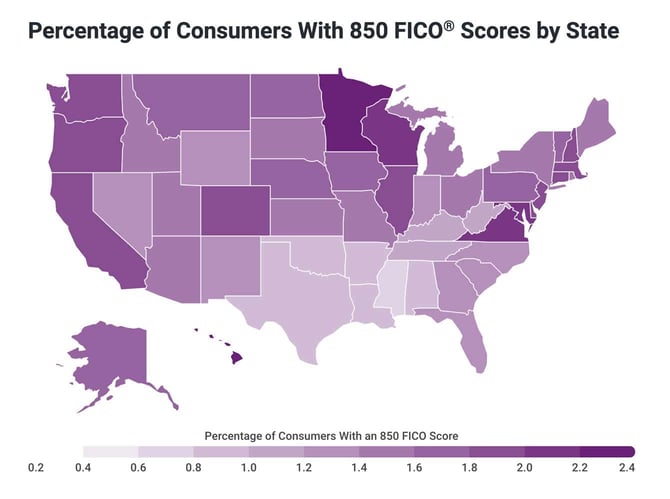
But just because you have 850 today doesn’t mean you’ll have 850 tomorrow, or even later today. As the data on your credit reports change, it’s likely your scores will change as well. And, if you’re close to 850, maybe a few points shy, you could end up with an 850 the next time your score is calculated.
An excellent credit score can work in your favor, of course. It will help you qualify for attractive credit card offers, loans, and competitive interest rates. But you don’t need perfect credit to unlock these types of benefits. In fact, you don’t even have to be close to perfect to score the best deals from lenders.
In general, a consumer with a FICO score of 760 or higher will qualify for the most attractive financing offers available from lenders. The best-published interest rates for mortgages are for those with a credit score of 760 or higher. The best published interest rates for auto loans are for those with a credit score of 720 or higher.
So, while working toward a brag-worthy 850 score may feel exciting, it’s not really necessary.
Improving Your Credit Scores
It’s in your best interest to keep your credit scores in the best shape possible. Good credit comes with too many perks and savings opportunities to ignore.
Start by checking your credit reports often and keeping an eye on your information. When you review your credit frequently, you can more easily spot problems — like identity theft — and track your credit-improvement progress at the same time.
Next, make sure you’re following best practices where your credit is concerned. On-time payments and low credit card utilization are both a must.
Finally, if you don’t have any credit, opening a credit card and using it responsibly may help you as well. You may also want to consider some out-of-the-box strategies like asking card issuers for a credit limit increase or having a loved one add you as an authorized user on an existing credit card.
Data Sources:
1 https://www.myfico.com/credit-education/whats-in-your-credit-score
2 https://www.fico.com/blogs/average-u-s-ficor-score-stays-717-even-consumers-are-faced-economic-uncertainty
3 https://www.gao.gov/blog/credit-scoring-alternatives-those-without-credit
4 https://newsroom.transunion.com/transunion-global-study-finds-more-than-half-of-us-consumers–use-credit-monitoring-to-open-new-credit-accounts/
5 https://www.rocketmoney.com/learn/debt-and-credit/what-is-the-average-credit-score-by-age
6 https://www.ed.gov/about/news/press-release/us-department-of-education-begin-federal-student-loan-collections-other-actions-help-borrowers-get-back-repayment
7 https://www.experian.com/blogs/ask-experian/perfect-scores-who-has-them-and-what-do-they-have-in-common/
Advertiser Disclosure
BadCredit.org is a free online resource that offers valuable content and comparison services to users. To keep this resource 100% free for users, we receive advertising compensation from the financial products listed on this page. Along with key review factors, this compensation may impact how and where products appear on the page (including, for example, the order in which they appear). BadCredit.org does not include listings for all financial products.
Our Editorial Review Policy
Our site is committed to publishing independent, accurate content guided by strict editorial guidelines. Before articles and reviews are published on our site, they undergo a thorough review process performed by a team of independent editors and subject-matter experts to ensure the content’s accuracy, timeliness, and impartiality. Our editorial team is separate and independent of our site’s advertisers, and the opinions they express on our site are their own. To read more about our team members and their editorial backgrounds, please visit our site’s About page.


