


Writer: Andrea Woroch


Editor: Lillian Guevara-Castro


Reviewer: Jon McDonald

Household debt in the U.S. has ballooned over the last couple of decades thanks to higher costs for housing, transportation, and consumer goods. And with second-term president Donald Trump introducing new economic and political uncertainties in 2025, including tariffs, it looks like stability and predictability in the economy will be eluding us for a while longer.
The problem is that debt is a leading cause of stress in America and holds many people back from reaching life goals. Understanding how and why we take on this financial burden in the first place is important if we want to avoid it in the future.
One thing’s for certain in 2025: You’re not alone if you feel stress over debt. Here’s a look at 18 of the most alarming consumer debt statistics across lending categories.
1. More Than Half (51%) of Americans Feel Stressed When Reviewing Their Credit Card Bills
Debt and stress seemingly go hand in hand, with more than half (51%) of U.S. consumers saying they feel stressed when reviewing their credit card bills, according to the third annual mental health and money survey by Debt.com.1
Consumers also reported feelings of hopelessness, sadness, insomnia, loss of appetite, and lower self-esteem. Four in 10 (43%) say they felt stress merely after using a card. And in classic self-defeating behavior, 42% say stress itself was likely or very likely to lead them to pull out their cards and take on more debt.
Debt.com conducts its mental health and money survey to support Mental Health Awareness Month each year in May. What’s new in the data is that consumers aren’t coping with President Donald Trump’s tariff policies very well.
About two-thirds of respondents (66%), for example, reported that Trump’s yo-yoing tariff policies, inflation, and political uncertainty impacted their mental health negatively.
Meanwhile, merely using a card in 2022, at the height of the pandemic, caused stress among only 21% of respondents. In the 2025 data, an even higher percentage (25.6%) reported arguing with their significant other about credit card spending.
Arguing causes stress, right? Tariffs or no tariffs, credit card stress is on the rise.
| Year | % Reporting Stress from Credit Card Use |
|---|---|
| 2022 | 21% |
| 2023 | 34% |
| 2024 | 37% |
| 2025 | 43% |
2. More Than One-Third (37%) of U.S. Consumers With Rising Debt Have Too Much to Manage It Successfully
Evidence that Trump is hardly the cause of negative emotions around debt comes from a survey the digital personal finance company Achieve conducted immediately after his election.
In that snapshot, more than one-quarter (28%) of respondents reported seeing their personal debt rise over the previous three months.2
Among those, more than one-third (37%) reported that the constant struggle to make ends meet in an economy characterized by inflation and uncertainty is what led them to their situation. A strong majority (58%) carried a revolving credit card balance as a result.
It’s an across-the-board problem, with substantial percentages reporting a growing risk of missing student loans, utility bills, mortgage or rent payments, insurance, and other bills and subscriptions.
Moreover, trajectories are trending negative, with only 40% of respondents expecting their situation to improve quickly, compared to 57% measured two quarters previously.
3. Generation Xers Carry the Highest Credit Card Balances
Millennials are often touted as reckless spenders with poor money management habits, but it’s their somewhat more obscure Generation X cohorts who exhibit the highest tolerance for credit card debt, according to a Q3 2024 survey by Experian.3
While Millennials, born between 1981 and 1996, carried an average credit card debt amounting to $6,932, Gen Xers born between 1965 and 1980 saddled themselves with a whopping $9,557.
It’s a matter of changing financial priorities and habits as the years go by. The debt numbers are more modest on the generational extremes, with members of the Silent Generation (born between 1928 and 1945) and Generation X (born between 1997 and 2012) holding similar amounts of debt.
However, variations in the rate of charge are most telling. As the table shows, Baby Boomers (born between 1946 and 1964 and with $6,754 in average debt) appear to be aging out of their prime years as consumers.
Meanwhile, Millennials are accumulating new card debt at the fastest rate, and their younger brothers and sisters in Generation Z (born between 1997 and 2012) are only slightly behind. They’re our future.
| Generation | Average Credit Card Balance, Q4 2023 | Average Credit Card Balance, Q4 2024 | % Change |
|---|---|---|---|
| Gen Z | $3,262 | $3,456 | 5.6% |
| Millennials | $6,521 | $6,932 | 6.3% |
| Gen X | $9,123 | $9,557 | 4.8% |
| Baby Boomers | $6,642 | $6,754 | 1.7% |
| Silent Generation | $3,412 | $3,428 | 0.5% |
4. Financial Stress Caused More Than Half (56%) of Employees to Lose Sleep
Now let’s return to the topic of stress to explore how the turbulences of 2025 and beyond may affect job performance and therefore economic productivity. It’s a recognition that the negative ramifications of financial stress extend from the personal to the political.
For 56% of American employees, according to a study by data insights provider Best Money Moves, money woes even cause them to lose sleep.4 And anyone who’s ever woken up on the wrong side of the bed on a Wednesday knows what that means.
With mental and physical health, self-esteem, and relationships at stake, not getting the required shut-eye needed for optimal health and productivity is a recipe for workplace disaster, according to the study.
While 74% reported seeking some form of guidance to deal with their messed-up finances, only two in five reported that their employer offered them a financial wellness program. It’s a missed opportunity for the others.
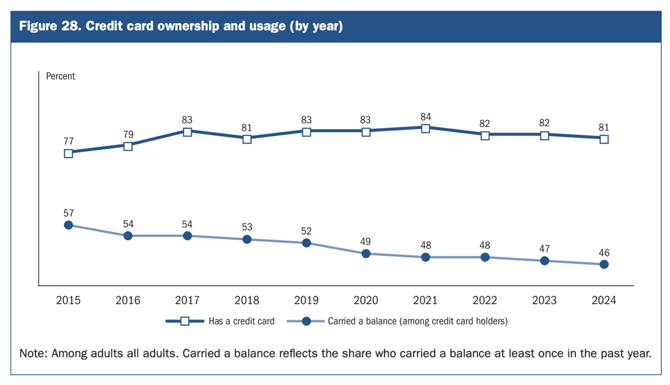
5. Nearly Half (46%) of Credit Card Users Carry a Balance
Credit cards can bring some sweet benefits when you manage them wisely, including cash back, travel rewards, and added layers of purchase and fraud protection.
If you’re one of the lucky ones, just know that the bad habits of other card users pay for your good fortune. The latest data from the Federal Reserve report on the Economic Well-Being of U.S. Households shows that 46% of U.S. credit card holders in effect subsidize the other 54%.5
They do so by paying interest for the privilege of carrying a revolving balance and penalties for delinquencies, defaults, and user violations. Not only are those cardholders squandering their money, it means they aren’t availing themselves of rewards that could positively benefit them.
Interestingly, the trend in the Fed data is downward — fully 57% of cardholders carried a balance in 2015, as the table below shows.
That may seem good, not alarming. But with credit card debt benchmarks straining historical limits and reaching new highs, it means proportionately fewer cardholders are paying to keep the system running. That makes it more vulnerable for all.
6. Credit Card Debt Increases with Income — Up to a Point
A common misconception about high-earning workers is that they have endless wealth. The reality is you can just as easily spend all your money and go into debt, no matter your income. If you aren’t watching how much you’re spending, it’s easy to live beyond your means.
Still, Fed data from 2025 shows income and spending patterns limiting the tendency toward ever-growing card balances. While average credit card balances do increase as lower earners increase their median annual income, the pattern reverses in higher-earning households.6
| Income Percentile | Median Annual Income | Average Credit Card Debt | % with Credit Card Debt |
|---|---|---|---|
| Less than 20% | $20,540 | $3,630 | 33.40% |
| 20% to 39% | $43,240 | $3,840 | 46.40% |
| 40% to 59% | $70,260 | $5,950 | 56.90% |
| 60% to 79% | $115,660 | $7,440 | 54.40% |
| 80% to 89% | $189,160 | $8,900 | 44.60% |
| 90% to 100% | $390,210 | $11,210 | 25.40% |
| All families | $70,260 | $6,120 | 45.20% |
It doesn’t take a genius to understand why: as income increases, there’s less need to carry a revolving balance to make ends meet or pay for wants and needs.
7. Almost 1 in 5 (19%) Lack Savings to Cover a Sudden Emergency Expense
Life happens, and it’s often quite expensive, especially when you’re out of control. That’s what makes sudden emergency expenses so damaging for so many.
Something as innocuous as a flat tire can lead to missed payments and missed opportunities as debt spirals to counterproductive heights.
Bankrate’s annual Emergency Savings Report reinforces those notions with data. As of February 2025, 19% of U.S. adults have absolutely no emergency cash tucked away for a rainy day.7 That makes everything an adventure, because you never know when something that breaks will break the bank.
The survey breaks responses down by generation, putting members of Generation X (born between 1965 and 1980) as the leader in neglecting emergency savings at 24%. Millennials and Baby Boomers came in at 18% without emergency savings.
Meanwhile, millennials, whose average credit card balances are increasing faster than any other generation (see number 3), lack emergency savings at a rate of only 17%. That’s the best of the bunch.
8. Major Medical Debt Contributes to Bankruptcy Filings
Bankruptcy is often the last resort for consumers who are deep in debt. One of the leading causes of unmanageable debt is related to high healthcare costs.
Medical expenses are a driver in 58.5% of consumer bankruptcy filings, according to data cited in a Motley Fool article.8 Bills from healthcare providers, hospitals, and prescriptions not only contribute to debt, they also affect a person’s ability to work and earn income.
Other drivers include work loss, unaffordable mortgages, and student loans.
9. A Majority of Couples (56%) Go into Debt to Tie the Knot
Getting married is an exciting time for couples, but it can also be stressful as more brides and grooms overspend on their big day. A U.S. News survey found that 56% of couples took on debt to get married.9
Most (39%) tapped credit cards as their top financing solution, but 18% turned to bank lenders for personal loans. Unsurprisingly, perhaps, another 18% relied on family. More realistically, borrowers expeditiously pick and choose a combination of solutions according to their individual situations.
Nearly half (48%) of nuptial borrowers reported they initially hadn’t expected to go into debt when they were initially planning their wedding, and 42% regretted spending money they didn’t have.
But only 11% had parents willing to pay for everything. Predictably, larger weddings required more support than smaller ones. For 65%, the combined cost of the venue, catering, travel, flowers, and who knows what else exceeded $10,000.
Ironically, it doesn’t take long for a wedding to recede into memory. Unfortunately, the extra credit card debt and loan payments are hard to forget.
10. Total Student Loan Debt Reaches $1.63 trillion
For many, earning a college degree is a necessary step toward achieving professional status, career stability, and financial independence. But college comes with major upfront costs that can cause ongoing financial hardship.
Those costs include tuition, materials, and often room and board to support students hitting the books rather than working. Naturally, that leads many to invest in student loans to support their education.
Student loan borrowers in 2025 entered a lending landscape transformed under the Trump administration. A full resolution of the changing federal student loan situation remained for the future when this article went live. But Biden-era income-based repayment plans, deferments, and cancellations are a thing of the past.
Meanwhile, total student loan debt in the U.S. reached $1.63 trillion in Q1 2025, up $16 billion from the previous quarter, according to the Federal Reserve.10 The latest Fed data shows that while student loan debt has been the second-highest consumer debt category (behind only mortgage debt), auto loans now rank slightly higher.
| Debt Type | Amount |
|---|---|
| Mortgage | $12.80 trillion |
| Auto loans | $1.642 trillion |
| Student loans | $1.631 trillion |
| Credit cards | $1.182 trillion |
| Retail cards/personal loans | $542 billion |
| HELOCs | $402 billion |
11. 2 in 10 Student Loan Borrowers Are Behind on Payments
Taking out student loans to attend college is a seemingly inevitable rite of passage for many Americans, as data from the 2024 edition of the Federal Reserve report on the Economic Well Being of U.S. Households attests.
The Fed stated that 4 in 10 people seeking higher education (41%) have taken out student loans to support themselves.5 The 41% who have pursued (but not necessarily attained) a higher degree include 24% who have paid off their loans and 17% who still have some work to do.
Borrowers tend to accrue different debt totals depending on the degree they pursue. The latest data shows that 69% of graduate degree earners have student loans higher than $25,000, compared to 47% of bachelor’s degree earners, 34% of associate degree earners, and 23% of folks who attended college or technical school.
For comparative purposes, the most consistent student loan delinquency benchmark is still the Fed, which reports 27% of borrowers in households earning less than $25,000 and between $25,000 and $49,999 as behind on their payments. The figure for borrowers as a whole is 20%.
| Household Income | % Behind on Student Loans |
|---|---|
| < $25,000 | 27% |
| $25,000-$49,999 | 27% |
| $50,000-$99,999 | 21% |
| $100,000+ | 10% |
People often struggle with student loans as they’re simultaneously struggling with other things. Many struggle after taking out loans but failing to attain a degree. Others may have limited outside support or face challenges finding an adequately paying job after graduation.
Missed student loan payments can have a seriously negative impact on your credit score. It’s incumbent on student loan borrowers to stay abreast of the changes in the system, including deferment options and repayment plans that can help them avoid a detrimental hit on their credit report.
12. Parents Owe More Than $114 Billion to Help Adult Children Finance College
We saw in item 8 above that parents of children up to age 18 shell out enough support to negatively impact the credit they have available to them. Well, we’re here to tell you that the costs certainly don’t stop accruing when kids hit some arbitrary age.
Indeed, it may be said that choosing to procreate is a gift that keeps on giving. Because today’s college students and recent grads are burdened with more debt than ever, it’s not just young adults affected by the growing costs of higher education.
More parents are taking out Federal Parent PLUS loans to help cover their adult children’s education, according to the U.S. Department of Education’s Office of Federal Student Aid. In fact, more than 3.6 million recipients have taken out more than $114.3 billion in Parent PLUS loans to help adult children finance their higher education, an all-time high.11
Parent PLUS loans are available to parents of dependent undergraduate students. Considering the rates on these loans are higher than federal student loans for undergraduate students and have higher fees, higher borrowing caps, and narrower repayment options, parents are risking serious financial hardship to assume some of the burden from their kids.
13. The Median Monthly Mortgage Payment is $2,205
Sad as it is to say, none of the expenses we’ve discussed up to this point amount to a hill of beans when compared to a mortgage.
While the markets for auto loans, student loans, and credit card debt are all thriving, with borrowers owing substantially over $1 trillion in each, the mortgage market is beyond the pale. According to the Fed, Americans owed $12.8 trillion in mortgage loans as of Q1 2025, up $199 billion from the previous quarter.10
Elsewhere, the Fed states that about two-thirds of adults who owned their homes had a mortgage in 2024 and that the median monthly mortgage payment was $1,500.68.5
| Year | Average Mortgage Balance |
|---|---|
| 2019 | $204,315 |
| 2020 | $208,185 |
| 2021 | $220,380 |
| 2022 | $236,443 |
| 2023 | $244,498 |
| 2024 | $252,505 |
However, we must turn to the Mortgage Bankers Association for the most current metrics on the average mortgage payment per borrower, which was $2,205 among new loan applicants in January 2025. That’s up 3.7% from $2,127 in December 2024.12
Meanwhile, 2024 data from Experian puts the average mortgage debt at $252,505 in 2024. That’s another all-time high, in case you were wondering.13
14. Slightly More Than Half of Americans (52%) Report Less Charitable Giving Because of the Current Economy
Although Americans say they’re dedicated to helping those in need, financial struggles often get in the way of charitable giving.
According to the Giving USA Foundation, whose annual Giving USA campaign provides comprehensive data and analysis on giving trends, U.S. charitable giving stood at $557.16 billion in 2023 — a 1.9% increase in current dollars but a 2.1% decline in inflation-adjusted terms.14
But a 2024 Ipsos poll on charitable giving habits found that 52% of Americans planned to give less in the coming year due to the unpredictability and challenges of politics and the economy.15
The poll found that while most (58%) reported giving the same amount to charity in 2023 and in 2022, 32% said they felt “torn between paying off their own debt and supporting charitable causes.”
15. Gen X is the Most Indebted Generation
It’s not just preference in music or fashion trends that sets generations apart. Even personal financial issues seem to timestamp each age group.
In keeping with the statistics above showing members of Generation X (born between 1965 and 1980) with the highest average credit card debt, data from Experian marks Gen Xers with the highest total debt balance: $$6.51 trillion in 2024.16
But it’s Gen Z members (those born between 1997 and 2012) who are accumulating new debt at the fastest rate (30.9% year over year):
| Generation | 2023 | 2024 | % Change |
|---|---|---|---|
| Generation Z (18-27) | $0.59T | $0.77T | 30.90% |
| Millennials (28-43) | $4.97T | $5.23T | 5.30% |
| Generation X (44-59) | $6.42T | $6.51T | 1.50% |
| Baby boomers (60-78) | $4.58T | $4.50T | -1.80% |
| Silent Generation (79+) | $0.57T | $0.53T | -6.80% |
Although Gen Xers carry the highest debt load overall, millennials also saw their total increase substantially by 5.3%, signaling their continued role as prime consumers.
Considering each generation experiences a series of life events at different times, expect to see Gen Z members taking on more debt as more of them buy homes and have children. Meanwhile, Gen Xers can expect to wind down paying for college and see their adult children become financially independent.
16. Total Auto Loan Balances and Monthly Payments Continue to Rise
We return to the Federal Reserve to find rising auto loan debt, which stood at $1.64 trillion in Q1 2025. Interestingly, that marked a decline of $13 billion from the previous quarter. But as we established above, U.S. borrowers owe more on autos than in any other category except mortgages.10
In terms of the average car payment, Americans now pay an average of $745 per month for new cars and an equally astonishing $521 for used vehicles. Those big monthly numbers amount to new car loans averaging $41,720, while loans for used cars average $26,144.17
It’s enough to make your hair curl — until you hit the road and see all those giant pickup trucks pushing up the average.
17. More Than Half (58%) of Pet Owners Have Used a Credit Card to Pay for Care
Any pet owner will tell you that dogs and cats are more than animals; they’re family. So, it should come as no surprise that pet parents want to give their dogs and cats the best quality care available.
A 2025 study by Synchrony shows that 15 years’ worth of pet care for a dog now costs between $22,125 and $60,602, an average increase of 11.65%. Cat costs have increased even further to between $20,073 and $47,106 for an average increase of 19.4%.18
Here’s the kicker: While only 20% of pet owners in the survey said they owned some form of pet insurance, 58% reported using a credit card to pay for some of their pet’s care.
Using credit cards excessively for pet care can accumulate costly debt, making it harder to pay off balances for human care (and also impacting your credit score).
Personal Debt Burdens Everyone
We all want to live our best lives, but it’s pretty clear that most consumers are as comfortable with their debt as with a lap cat.
These statistics show the many ways debt claws at consumers, stressing them into shortsighted decision making and saddling them with extra burdens.
Sure, credit and loan products offer convenience and the promise of life improvements — if you use them right. But they can unleash a lot of pain if you use them the wrong way.
Data Sources:
1 https://www.debt.com/research/mental-health-money-survey
2 https://www.achieve.com/about/press/as-household-debt-soars-many-americans-worry-they-cant-keep-up-achieve-survey-finds
3 https://www.experian.com/blogs/ask-experian/state-of-credit-cards
4 https://bestmoneymoves.com/financial-stress-in-2024-revealing-insights-about-americans-and-money
5 https://www.federalreserve.gov/publications/report-economic-well-being-us-households.htm
6 https://www.fool.com/money/research/credit-card-debt-statistics
7 https://www.bankrate.com/banking/savings/emergency-savings-report
8 https://www.fool.com/money/research/personal-bankruptcy-statistics
9 https://money.usnews.com/loans/personal-loans/articles/2024-wedding-debt-survey
10 https://www.newyorkfed.org/microeconomics/hhdc.html
11 https://studentaid.gov/data-center/student/portfolio
12 https://www.mba.org/news-and-research/newsroom/news/2025/02/27/mortgage-application-payments-increased-3.7-percent-to–2-205-in-january
13 https://www.experian.com/blogs/ask-experian/how-much-americans-owe-on-their-mortgages-in-every-state
14 https://www.npr.org/2024/06/25/nx-s1-5017877/inflation-charity-giving-personal-finances
15 https://www.ipsos.com/en-us/most-americans-say-they-are-giving-less-charity-because-economy
16 https://www.experian.com/blogs/ask-experian/research/consumer-debt-study
17 https://www.bankrate.com/loans/auto-loans/average-monthly-car-payment
18 https://investors.synchrony.com/news-events/financial-news/detail/522/new-synchrony-study-finds-nearly-8-out-of-10-pet-owners-underestimate-the-cost-of-care-reaching-up-to-61000-during-a-pets-lifetime


