


Writer: Eric Bank


Editor: Lillian Guevara-Castro


Reviewer: Adam West

Key Takeaways
- Mortgage and vehicle loan defaults are rising fast, and balances are climbing as well — a sign that secured lending remains under escalating pressure.
- Secured credit distress intensifies as greater delinquencies meet fewer recent originations, rendering the market even more difficult for lenders and borrowers.
- The subprime segment continues to grow, now representing 18.7% of the market, redefining lender strategy and risk assessment.
Mortgage and auto loans are being squeezed, the latest VantageScore CreditGauge report reveals. In both market segments, delinquencies are increasing and balances continue to grow — signals of mounting strain on secured lending.
Both early-stage (30–59 days past due) and late-stage (90 days or more) delinquencies are rising, showing that repayment troubles are spreading across borrower segments. The report also indicated that the average VantageScore 4.0 slipped by a single point to 701, a modest weakening.
Originations of auto loans slid, though originations of mortgages were down little from recent months. Fewer new loans are making it to the closing table due to stricter underwriting and anxious borrower demand. Lenders play a delicate balancing act: older portfolios are riskier, yet new secured lending is harder to originate.
Deteriorating Risk on the Horizon
Subprime lenders are familiar with balancing risk, but the report is a signal of something larger: Financial stress is on the rise across every VantageScore level and is no longer exclusively among lower-score borrowers.
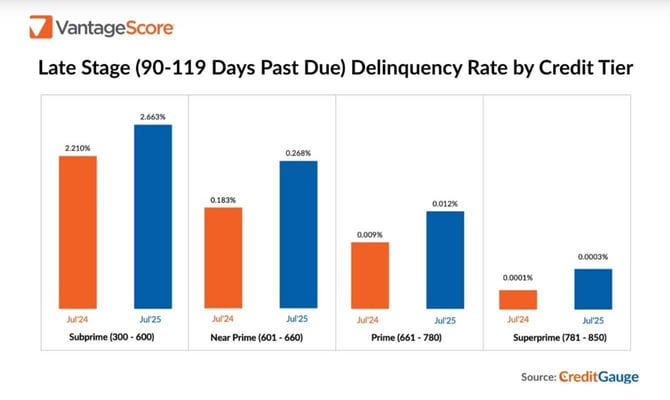
Even the most stable consumers are experiencing the strain, potentially requiring lenders to reevaluate where risk actually exists. That shift suggests volatility isn’t contained anymore — it’s spreading.
Pressure on Secured Lending Products
The report notes that early-stage mortgage delinquencies rose by 0.11 percentage points year-over-year, while auto loan delinquencies increased by 0.05 points. These data points illustrate how strain is building even before borrowers hit late-stage defaults.
Lending Origination Slowdown
Another wrinkle comes from steady-to-decreasing mortgage and auto originations. As fewer secured transactions come to market, growth-hungry lenders may come to depend on unsecured products or other forms of credit.
Differentiation will be especially important to subprime-focused players as competition intensifies among borrowers with increasingly complex risk profiles.
The subprime borrower share hit 18.7%, up from 18.1% a year earlier. That’s more opportunity on paper — but also more exposure to default risk. Lenders operating in this space will need sharper models and better tools to manage expanding risk pools.
The message to credit scorers and lenders alike is clear: Secured credit stress is real, borrower behavior is evolving, and yesterday’s assumptions won’t do. Those who adjust their strategies and reevaluate risk models now will be better positioned to handle what’s coming.
And while subprime dynamics remain the focal point, the report also flagged an unexpected surge in superprime delinquencies. Among superprime consumers (781–850), 90-day delinquencies jumped 109% year over year, and prime borrowers posted a 47% rise.
Stress is rippling across the entire credit landscape. These percentage jumps, though striking, reflect very small starting points. Even so, the direction of change signals a growing strain well beyond traditional risk tiers.


