

Writer: Lucy Lazarony


Editor: Lillian Guevara-Castro


Reviewer: Adam West

Key Takeaways
- One million student loan borrowers had their past due loans moved into default in the Default Resolution Group in the U.S. Department of Education.
- Defaulting on a student loan will lower a borrower’s credit score and hurt access to credit in auto loans, mortgages and credit cards.
- Thirty-two percent of student loan borrowers said paying off their student loans caused them to delay buying a house, according to Fidelity Investments research.
The statistics on student loan balances and delinquencies are sobering. Student loan balances grew by $11 billion to $1.66 trillion in the fourth quarter of 2025, according to the Federal Reserve Bank of New York.
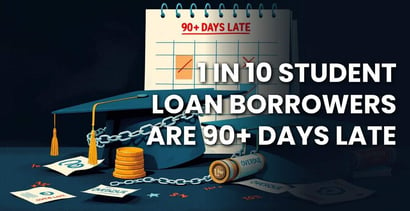
The 90-day delinquency rate on student loans is at 9.6% of balances. So nearly 1 in 10 student loan borrowers are 90 or more days late on their payments.
About 1 million student loan borrowers who were 120 days or more past due on their student loans had those loans transferred to the Default Resolution Group in the U.S. Department of Education.
What It Means To Default on a Student Loan
Loan servicers give federal student loan borrowers 270 days to catch up on payments before a loan balance is considered in default, according to Experian.
Once a student borrower reaches 270 days in missed payments, the total amount becomes due. A borrower could be charged collection fees, be taken to court, and have their wages garnished. In addition, the federal government may withhold a borrower’s tax refunds or federal benefits, Experian reports.
For private student loans, the default process is quicker. A lender may place a private student loan borrower’s account into default after just 90 days of missed payments. Borrowers may be subjected to collection calls and may be sued.
Defaulting on student loans will have a strong impact on a student borrower’s credit score, hurting access to credit cards, auto loans and mortgages. It is something to be avoided whenever possible.
Other Borrowers at Risk
Additional federal student loan borrowers are at risk of tumbling toward delinquency and default. These 9.8 billion in borrowers are in forbearance. When an account is in forbearance, this means a borrower’s student loan payments have been put on pause but the loans continue to accrue interest, NPR reports.
When the forbearance ends and payments begin again, these student borrowers, many of whom are low income, may struggle with staying current on payments, according to NPR.
Rebounding After a Student Loan Default
Defaulting on student loan payments doesn’t have to be the end. Student loan borrowers can rehabilitate or consolidate defaulted student loans.
Under rehabilitation, student borrowers are required to make nine reduced monthly payments over a 10-month period. Doing so will remove the student loan default from the borrower’s credit report, according to Experian.
Another option is consolidating a defaulted student loan into a new consolidation loan. With this option, borrowers get a new loan and as long as the payments are made on time, the loan will be in good standing. But the default from the original loan will remain on a borrower’s credit report for seven years, Experian reports.
Impact of Student Loan Payments on Buying a Home
Student loan debt causes a delay in achieving life milestones such as buying a home, according to Fidelity Investments research. Just how many borrowers are affected?
The research found that 32% of borrowers said paying off student loans caused them to delay buying a home. That number jumps to 37% for Gen Z borrowers and to 36% for millennial borrowers.
“The burden of student debt takes not only a financial toll on borrowers, but an emotional one as well,” said Jesse Moore, Head of Student Debt at Fidelity Investments.
“Across the tens of thousands of U.S. employers Fidelity works with, we’re seeing many borrowers forced to choose between paying down their debt and saving for future milestones.”
The Bottom Line
The delinquency rate on student loans is at 9.6% of balances. This means almost 1 in 10 students are 90 or more days late on their student loan payments. Just as troubling is that about 1 million student loan borrowers had loans transferred to the Default Resolution Group in the U.S. Department of Education.
Having a defaulted student loan will hurt a borrower’s credit score and limit access to mortgages, auto loans, and credit cards.


