


Writer: Lynn Cadet


Editor: Ashley Fricker


Reviewer: Adam West

Key Takeaways
- 3 in 4 Americans (76%) believe everyone should have a personal “GTFO fund,” money set aside in case they need to leave a marriage or long-term relationship.
- Most Americans say it would take thousands of dollars — often five figures — to safely leave, with nearly 60% estimating at least $10,000 is needed.
- Support is even higher among expectant parents, with 88% saying a financial exit fund is necessary.
Most people don’t walk into a relationship thinking it will end. Yet protective measures, such as prenups and pet custody agreements, have been gaining steam lately.
Though breakups can be emotionally taxing, they can also be uniquely financial. Take divorce, for example. An average divorce in the U.S. costs between $8,000 and $11,000, proving how financially draining it can be to exit a long-term relationship.
With the financial stakes surrounding relationships at an all-time high, many Americans are turning to a unique contingency plan in the event of a split.
A recent BadCredit.org study revealed that 3 in 4 Americans surveyed believe everyone should have a personal financial exit plan, or “GTFO fund,” in case they need to leave a marriage or long-term relationship.
While prenups have long been a mainstream protective measure for marriage, a “GTFO fund” just might be its next evolution. Relationship dynamics and the financial climate are changing, and people are now taking proactive steps to protect themselves when entering and exiting long-term commitments.
Young Americans Lead the Shift Toward Financial Exit Planning
There was a time when financial exit planning was viewed as cynical; now, it’s seen as a necessary, tactical tool in modern relationships. And most Americans tend to agree, regardless of their background.
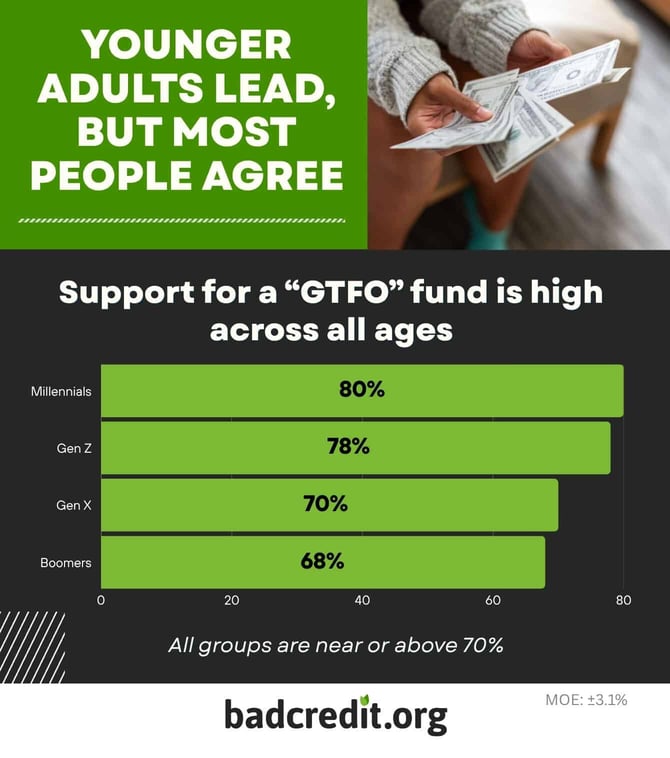
Support for a financial exit plan that included having money saved was overwhelmingly strong, with little difference in opinion between men (75%) and women (77%). There was also little variation among generational demographics.
While younger Americans showed more support for the concept of a “GTFO fund,” older generations weren’t too far behind in their approval. Here is how the data broke down generationally:
- Millennials: 80%
- Gen Z: 78%
- Gen X: 70%
- Boomers: 68%
As our results show, the concept of putting money aside in case of a split isn’t exactly taboo anymore. Rather than a sign of distrust, a financial exit plan reflects a growing desire for financial independence and preparedness, protecting individuals in a time when economic uncertainty is at its highest.
“I fully support a GTFO fund, and I am thrilled that younger Americans are more apt to prepare,” said Erica Sandberg, consumer finance expert at BadCredit.org.
“There is absolutely nothing wrong with setting cash aside for just in case measures. The fact is, some relationships don’t work out. In an ideal world, a lack of funds will never prevent someone from leaving when they should. And if you never use the money, no problem.
Many Say It Takes Thousands — Often Five Figures — to Leave
So what does it take to build a financial safety net in a relationship? According to our results, most Americans say the minimum savings balance should start in the five-figure range.
When we asked our respondents, “How much money do you think someone in your state needs saved to safely leave a marriage or long-term relationship?” this is how they responded:
- Less than $5,000: 8%
- $5,000–$10,000: 33%
- $10,000–$25,000: 32%
- $25,000+: 27%
Leaving a long-term relationship isn’t easy or, frankly, cheap, as our findings show. While 8% of people say they can end a relationship with less than $5,000 in their safety net, the majority of respondents need over $10,000 to leave securely.
These results underscore the seriousness of the preparation involved. While most people can back the idea of an exit fund, it may not be as easily executed as it’s accepted.
Our results reflect the financial burden of a breakup and the splitting of once-shared expenses, including housing costs, legal fees, and everyday needs. This all points to a break-up being more than just an emotional decision; it’s also a financially steep one.
‘GTFO Fund’ Support Rises to 88% Among Expectant Parents
Support for a financial exit plan is even higher among expecting parents.
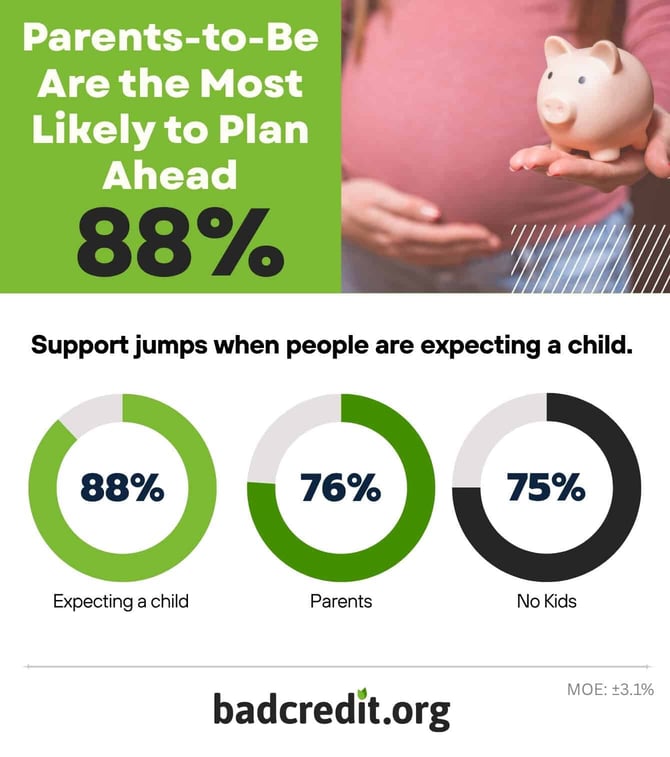
Nearly 9 in 10 (88%) expectant parents say they support the concept of a financial exit plan, compared to 76% of already parents and 75% of people without kids. This reveals a gap of at least 12 percentage points, making them the group with the highest level of agreement.
Expectant parents have a lot on their plates, with bills, preparations, and new responsibilities. So, financial security for them may carry a more heightened sense of urgency than for other respondents.
This trend suggests that as life becomes more complex, the desire for financial independence and a contingency plan only grows stronger.
Sandberg adds, “Pregnancy is such an emotional time. In many ways, it’s when you are least selfish because you must protect a completely vulnerable baby. So it makes sense that people build a ‘just in case fund’ during this time. If you do need to make an exit, that money will be there. It gives peace of mind.”
As wedding season ramps up and couples prepare for their futures, financial conversations surrounding long-term commitments are becoming more nuanced.
Our study shows that commitment and independence don’t have to be at odds. Instead, Americans view a financial exit plan more as a choice informed by wisdom than by cynicism, allowing them to prepare for the stability and uncertainty that lie ahead.
Methodology
This survey was conducted among 1,000 U.S. adults via an online panel. The overall margin of error is approximately ±3.1% at 95% confidence.
All questions were single-selection, and each received 1,000 completes. Crosstabs by demographic group (geography, household income, etc.) are available upon request.
For media inquiries, please contact catherine@badcredit.org.


