My In-Depth Review of Freedom Debt Relief: A Debt Settlement Option for Borrowers Out of Alternatives
I found Freedom Debt Relief to be straightforward and transparent, but the debt settlement process isn't easy.
By: Choncé Maddox
Choncé Maddox
Choncé is a Certified Financial Education Instructor (CFEI) and a nationally recognized personal finance and budgeting expert. She's paid off $50,000+ of personal debt, and her debt story has been highlighted in Essence Magazine and on Good Morning America as part of its 2020 Debt-Free Decade series. Her work has been featured on sites including Business Insider, LendingTree, Credit Sesame, Barclaycard, and The New York Post. Choncé was named one of the top financial experts to follow on Instagram by Black Enterprise.
With more than 15 years of journalism expertise, Jon stays apprised of finance trends, influential companies, and financial literacy resources for subprime consumers. He is most knowledgeable in the areas of budgeting, loans, and responsible credit use, and his articles have appeared in publications produced by The New York Times.
Ashley has managed content strategy for BadCredit since 2015, partnering with major banks, financial institutions, and media outlets to deliver authoritative personal finance content. Her expert credit card commentary has appeared in top national publications, including CNBC, MarketWatch, Investopedia, Yahoo Finance, and Reader's Digest, establishing her as a trusted voice in the industry.
Disclosure: When you apply through links on our site, we often earn referral fees from partners. For more info, see our ad disclosure and review policy.
A mountain of debt often starts as a molehill. You may not even notice how big it’s getting until something bad happens and you find yourself staring up at it, wondering, “How am I going to get through this?”
That sudden realization that a mountain of debt is now far too big to deal with (dare I say, insur-mountain-able) is why many people look for ways to make it more manageable. And those options aren’t always easy.
One option is debt settlement through Freedom Debt Relief, which could significantly reduce the amount you owe. But debt settlement comes with some significant trade-offs, including fees and potentially severe damage to your credit score.
I’ll lay out everything you need to consider before diving in, and tell you how Freedom Debt Relief works, what it might cost, and who stands to benefit the most. So, let’s settle in and learn about debt settlement.
What to Expect With Freedom Debt Relief
Freedom Debt Relief is one of the oldest and largest debt settlement companies in the U.S. It was founded in 2002 and has helped hundreds of thousands of people negotiate unsecured debts like credit cards, personal loans, and medical bills.
Its programs are designed for people dealing with a lot of debt who can’t keep up with their payments. Whether it’s due to lost income, divorce, medical emergencies, or just life, Freedom Debt Relief may be able to help if you have at least $7,500 in unsecured debt.
Now, the program’s first step may sound contrary to everything you’ve heard about monthly payments, but it is a big part of the overall strategy.
Here it is: You will stop making payments to your creditors directly. Sounds like a recipe for disaster, right? It’s actually the first step to ensuring you can pay down the debt in a reasonable time, and potentially for a lot less.
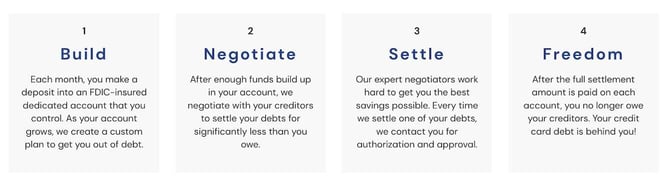
Instead of making payments on your debt, you start making monthly deposits into a savings account managed by a third-party bank. As the account balance grows, Freedom Debt Relief uses those funds to negotiate lump-sum settlements with your creditors for less than the original balance.
This approach relies on financial leverage, something you may lack while your account is in good standing. Creditors may accept less than what you owe rather than risk the chance of receiving nothing from your delinquent account.
Playing this type of hardball can work to reduce what you owe, but this is where those big trade-offs come in. Nothing is THAT easy when it comes to getting rid of debt.
Debt sold to collections agency or other debt buyer
Account reported to the major credit bureaus as late
Accounts later than 90 days considered seriously delinquent
Bank may sue you
Your credit score will start to drop
Account may go to collections
Defaulted account remains on your credit report for seven years
That’s because settlements usually don’t happen immediately. Accounts may go unpaid for several months before negotiations begin, and some creditors may take longer to reach an agreement than others.
Most clients stay in a Freedom Debt Relief program for 24 to 48 months, depending on the amount of debt they enroll and how much they can pay each month.
While Freedom Debt Relief can help with debt settlement, it’s also important to understand what its service CAN’T do. Freedom Debt Relief does not lend money, reduce interest rates, or make payments for you.
Its role is to negotiate with creditors to establish a reasonable payment plan. And the outcome depends heavily on your creditors and your consistency with monthly payments once the plan is in place.
Breaking Down the Costs & Fees
One of the most misunderstood aspects of debt settlement is how much it really costs. Freedom Debt Relief does not charge any upfront fees, as required by federal law.
However, that doesn’t mean the program is cheap. The total cost is spread across service fees and account fees and indirectly extends to other financial consequences that may happen while your debt is still outstanding.
Upfront & Recurring Costs
While there are no upfront fees, Freedom Debt Relief collects a service fee from your dedicated account after a settlement is reached and your first payment is made to the creditor.
This account setup cost is $9.95, and you are also charged a monthly account fee of $9.95, as well. The account provider collects those fees, not Freedom Debt Relief, but it is definitely something to keep in mind.
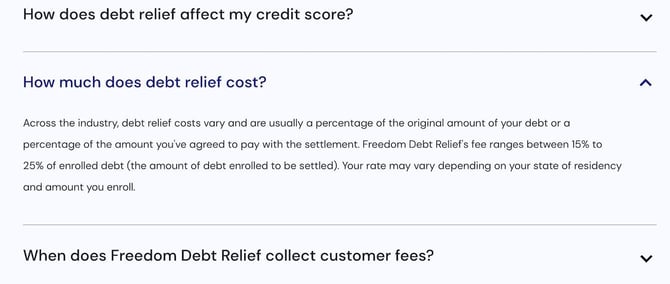
This service fee can be between 15% and 25% of the total enrolled debt. So, any savings you see from a settlement needs to be well over that amount to make it worthwhile
In addition to the service fees, third‑party banks may charge fees for keeping the dedicated savings account. These are usually small monthly charges, but they can still add up, especially if you’re in the program for four years or more.
Interest Rates & Penalties
Sometimes, the biggest financial cost of debt settlement doesn’t appear on a fee schedule. While you’re no longer making monthly payments to creditors, interest on your debt balance continues to accrue, and you’ll likely rack up late fees.
You may also trigger penalty APR by missing payments, which can be upwards of 30%. Many settlement proposals end with a larger outstanding balance than the original amount.
During steps 1 and 2, Freedom Debt Relief clients will be missing payments on their credit cards or loans.
There’s also a tax consideration many people overlook. If a creditor cancels more than $600, the IRS may treat the forgiven amount as taxable income — you could get a Form 1099‑C and, unless you meet the insolvency exemption, owe tax on that amount.
The fees, interest, and tax liability aren’t something that you can calculate at the beginning of the process. You’ll be in the thick of the settlement program before you know all of these costs, but they can chip away at your bottom-line savings.
Total Cost Analysis
To get an idea of what you’re in for, let’s do some easy math (my favorite kind!) with some round numbers.
Imagine you have $20,000 in unsecured debt after all late fees and penalty APRs are taken into account. If Freedom Debt Relief negotiates an average settlement of 50%, you’d pay $10,000 to creditors.
If your service fee is 25%, that adds another $5,000. So, the total you’d pay is around $15,000, which saves you $5,000. If your program takes three years to complete, you’ll also pay $358.20 in settlement account monthly and setup fees.
But it’s not over yet.
The IRS will consider the $10,000 the creditor knocked off as forgiven debt. At that point, what you’ll pay gets a little more complicated since it would be based on your marginal tax rate.
Here’s a list of different marginal tax rates and what you’d pay at each level:
Marginal Tax Rate
Debt Settlement Taxes on $10,000
10%
$1,000
12%
$1,200
22%
$2,200
24%
$2,400
32%
$3,200
35%
$3,500
37%
$3,700
If you’re considering debt settlement, chances are you aren’t at the top end of this scale, so let’s use the 22% rate as an example. You’d owe $2,200, bringing your total savings after settlement to $2,441.80.
That’s a fair amount of money, but not much less than the original $20,000. And when you factor in potential severe credit damage and the lengthy process, you’d be better off with some other option.
Freedom Debt Relief’s Core Value: Principal Reduction
The main appeal of Freedom Debt Relief is that its goal is to reduce the actual amount you owe, not just your monthly payment.
Unlike debt management plans that focus mainly on interest rate reductions, debt settlement aims to significantly reduce what you owe. The company tries to negotiate settlements for roughly 40% to 50% of the outstanding balance.
And once clients enroll, they must route all creditor communications to the company.
Freedom Debt Relief has built relationships with major banks and collection agencies, giving it the inside knowledge and negotiating leverage that individual borrowers can’t match.
While its program doesn’t fully prevent collection activity, having a third party handle negotiations reduces the stress of constant creditor calls and can give you some peace of mind while everything plays out.
No one likes constant creditor or collections calls, and debt settlement can allow you to avoid them without just ignoring the problem (which can be much worse).
Debt Relief vs. Bankruptcy
If you have a large amount of debt and start researching what you’ll save with debt settlement, you may wonder if bankruptcy is a better option. After fees, but before taxes, you may net a savings of about 25% to 30% and impact your credit for a while.
So is that savings and score drop worth staying out of bankruptcy?
Many people choose debt settlement because bankruptcy can be a more damaging process. But for others, bankruptcy may offer a faster and less expensive reset.
Chapter 7 bankruptcy, which can cost more than $1,500 in attorney and filing fees upfront, could quickly discharge eligible unsecured debts, but may also result in the sale of your assets to pay creditors.
A Chapter 7 bankruptcy will also stay on your credit report for 10 years, which can haunt you years after you’ve moved past your debts and are financially healthy again.
Legal Protection Program
One feature that differentiates Freedom Debt Relief is its Legal Partner Network. This program can connect clients with partner attorneys if a creditor takes legal action against them for an enrolled debt.
A lawyer from Freedom Debt Relief‘s network may attempt to negotiate a settlement (but it’s not guaranteed) on your behalf.
This service is free to those currently in a debt settlement program who have made their monthly deposits on time. Another caveat is that this program won’t cover legal actions that started before you enrolled.
While this doesn’t prevent lawsuits or legal actions, it can provide peace of mind knowing that you have a little extra support in your corner.
Availability in the U.S.
Before you get too far along in considering Freedom Debt Relief, I want you to make sure it is available in your state. The company has a handy map on its website that can give you a quick idea — especially if you live in a state that is prominent on the map.
But if you’re not the best with geography or can’t make out your state in that small graphic (shout out, Rhode Island!), here are the breakdowns:
Where Freedom Debt Relief Operates Directly
Alabama
Alaska
Arizona
Arkansas
California
Delaware
Florida
Idaho
Indiana
Iowa
Kentucky
Louisiana
Maryland
Massachusetts
Michigan
Minnesota
Mississippi
Missouri
Montana
Nebraska
Nevada
New Mexico
New York
North Carolina
Oklahoma
Pennsylvania
South Dakota
Tennessee
Texas
Utah
Wisconsin
(Accurate as of February 2026)
Where Freedom Debt Relief Operates Through Legal Partners
Connecticut
Georgia
Illinois
Kansas
Maine
New Hampshire
New Jersey
Ohio
South Carolina
Virginia
Where Freedom Debt Relief Does Not Operate
Colorado
Hawaii
North Dakota
Oregon
Rhode Island
Vermont
Washington
West Virginia
Wyoming
Now, if it’s not available in your state, you aren’t completely out of luck. I mean, you are with Freedom Debt Relief, for now, but you can skip ahead to the “Alternatives Worth Considering” section to see if another service operates where you live.
User Experience & Management Tools
Debt settlement can definitely take some patience, which is why Freedom Debt Relief aims to keep clients informed throughout the process.
Clients can quickly get updates online, through a mobile app, or over the phone while they’re enrolled. The goal is convenience, and many clients state that in online reviews.
Clear communication and transparency also seem to be priorities for the company, and it certainly has some impressive credentials
The Digital Experience (App/Dashboard)
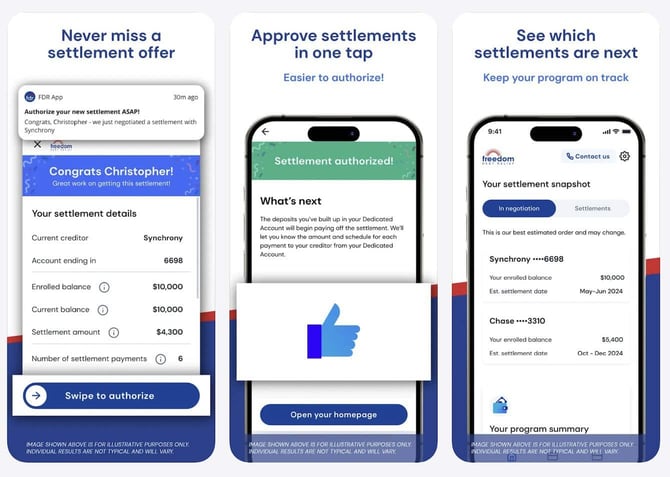
Freedom Debt Relief clients can access a personalized dashboard through a web browser or their dedicated mobile app.
The dashboard is your home base for the entire debt relief program. You can see your plan, check on your progress, or ask the team any questions.
It also shows your enrolled debt, how much money is in your settlement account, and which debts are actively being negotiated.
This is basically your window into everything that Freedom Debt Relief is doing on your behalf.
Settlement offers show up directly in the dashboard, which allows you to review and approve them quickly without phone calls or paperwork delays.
You can also upload documents securely, including any notices you get from creditors or settlement confirmations.
This visibility may reduce some of your anxiety, especially because debt settlement negotiations happen behind the scenes.
Being able to get clarity about where the money is going and which accounts are moving forward is a huge plus
Although I would suggest that you choose a time of day to check it, so you’re not just clicking “refresh” hoping some new information pops up. That will only increase your anxiety.
Customer Support & Service
Service and support are also a big piece of the puzzle because tense collection calls, legal notices, and credit score drops are common during the debt settlement process.
Freedom Debt Relief offers phone and online support through dedicated account representatives called Client Success Specialists.
They handle questions about settlement timing, account status, and any issues you may be experiencing if you’re still getting calls from creditors.
I checked out some third-party reviews about Freedom Debt Relief’s customer service and many people have good things about the level of responsiveness once their accounts are actively being negotiated.
But some clients have also reported being frustrated during the early waiting period and say they wish the process was communicated better at that stage.
Many TrustPilot reviews include clients saying they were relieved to be able to speak to an actual person in a reasonable timeframe.
Transparency & Trust
Transparency is another big concern that consumers have when looking into debt settlement, and it’s also where you need to have realistic expectations.
The dashboard is where you can see all of your updated settlement details goes a long way in that department. And Freedom Debt Relief also has some other bona fides that can put your mind at ease in the trust category.
The company is a member of the Association for Consumer Debt Relief (ACDR), an industry trade group that sets standards for ethical debt settlement practices.
While accreditation isn’t a guarantee of your personal outcome, it is a good sign that Freedom Debt Relief cares about compliance and is actively working to protect your best interests.
And when it comes to fees, I like that Freedom Debt Relief discloses them early in the enrollment process and makes it clear that fees are only charged after a settlement is reached.
And, as I mentioned earlier, Freedom Debt Relief discloses potential tax consequences related to forgiven debt and is upfront about the possibility of a creditor suing you for failure to repay.
Who Qualifies for Freedom Debt Relief
You need to have at least $7,500 in unsecured debt to qualify for debt settlement. This debt is commonly from credit cards, personal loans, or medical bills.
Financial hardship is something else you need to show before moving forward with a debt settlement program. Some common hardships include:
Medical emergencies
Death in the family
Emergency expenses
Divorce
Natural disasters
Job loss or reduced work hours
When negotiators reach out to your creditors, hardship will certainly come up. And instead of saying, “Why don’t you settle on the balance because our client doesn’t want to pay it,” the negotiator can lay out the case for why a settlement is in the best interest of both you and the creditor.
Even though you are facing hardship, you’ll still need enough monthly income to pay back the settlement. Making payments into your dedicated account, even as you stop making them to creditors, is one of the most important parts of the whole process.
And remember, secured debts like mortgages or auto loans are not eligible for settlement. And federal student loans, tax debt, and payments for child support and alimony are excluded, as well.
How to Apply (I’ll Show You Every Step)
I went through the application to see how much information it required and how transparent the steps felt. First things first: It’s not really an application.
You don’t provide all of the same details you would to apply for a credit card or loan; instead, it is mostly contact information and a little about what you owe.
The heavier lifting comes during a personal debt consultation after you hit “Submit”. Debt settlement can feel intimidating, so Freedom Debt Relief has definitely lowered the barrier to entry with this simple form.
Step 1: Total Secured Debt Owed
I started on Freedom Debt Relief’s website and selected the option to check my eligibility. The first thing I did was enter the total amount of secured debt I wanted to address.
I entered a general estimate for the current debt balance, which needed to be over $7,500 to qualify.
Step 2: State, Name, and Contact Details
Next, I entered which state I lived in, and added personal information like my name, email, and phone number before clicking “Click to see my results”.
Step 3: Residential Address
I thought I’d be seeing my results here, but this step carries over all of my information from the last step and asks for my home address. So I enter it, and then click “View my solution”.
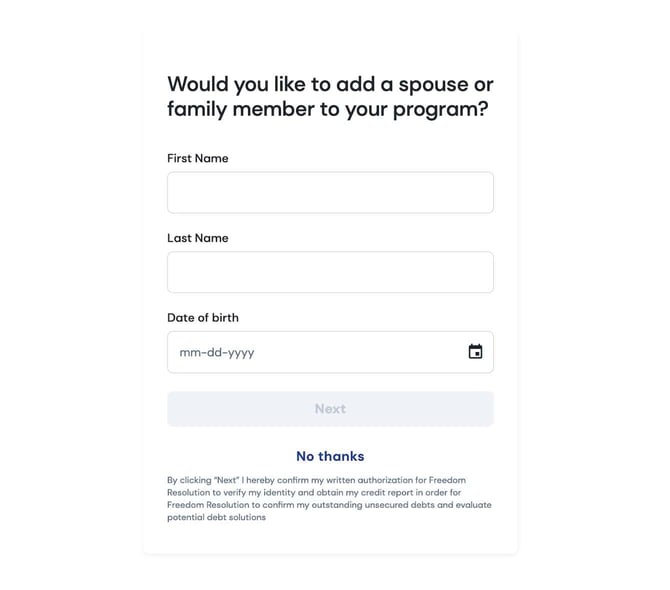
Step 4: Add a Spouse or Family Member
Before I view my solution, I’m asked if I want to add a spouse or family member to my program. I hadn’t thought about it before, but this option could be good for families struggling with a hefty combined debt.
I clicked “No thanks” on this screen, though.
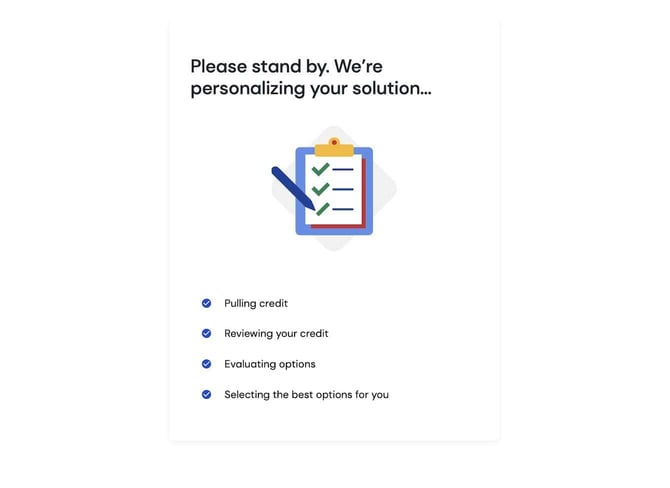
I see a couple of screens asking whether I want to consider debt consolidation loans from some of Freedom Debt Relief’s partner lenders. This could be because I only put $11,000 as my total debt, and I may be better off going the lending route and not with debt settlement.
If I did qualify, a representative from Freedom Debt Relief would contact me to get more details about my finances and work on a debt relief plan.
That’s when I would receive an estimate of what my monthly payment into the savings account could be and how much I could save.
I’d also need to read through all of the disclosures and the debt settlement agreement before deciding if it’s the right service.
This process will take longer than the few fields I filled out on the website, but it is the perfect time to ask questions and get clarity on how everything will work for my situation.
Who Should (and Shouldn’t) Use Freedom Debt Relief
Debt settlement isn’t a solution to take lightly. It’s designed for people who are already near the edge financially and need a way to get out of unsecured debt without filing for bankruptcy.
Freedom Debt Relief tends to work best for people who have a lot of debt, have suffered a hardship, and have few options. If this sounds like you, it is definitely worth a consultation and more research.
On the other hand, Freedom Debt Relief may not be a good fit for people who still have a decent credit score (think 650 or higher) and can access other tools to pay down their debt.
Those options could include consolidating debt with a low-interest personal loan, tapping into their home’s equity with a home equity loan, or possibly qualifying for a balance transfer credit card..
It’s also not even an option for people whose debt is primarily from student loans, taxes, child support, or secured loans, since those don’t qualify for debt settlement with Freedom Debt Relief.
Pros and Cons
When you settle debt, you might pay less, but you’ll hurt your credit and lose short-term flexibility.
Here are some of the biggest benefits and drawbacks to consider before choosing to work with Freedom Debt Relief:
Pros
You may settle debts for significantly less than the original balance.
You don’t pay any fees until a settlement is reached.
Negotiations, paperwork, and timelines are taken care of on your behalf.
Program includes collections assistance and creditor correspondence.
Cons
Your credit scores could drop 100 points or more when you stop making payments to your creditors.
Service charges can eat up a good chunk of your net savings.
Forgiven debt may be taxable income.
Settling with creditors depends on their willingness and the process usually takes two to four years.
Alternatives Worth Considering
Freedom Debt Relief is the oldest and largest debt settlement company, but that doesn’t mean others could be a better option for your debt.
Here are a couple of other reputable debt settlement services, and some details on why you may (or may not) want to consider them instead of Freedom Debt Relief:
National Debt Relief
This is another well-established debt settlement firm that negotiates unsecured debts and charges fees only on settled accounts. National Debt Relief is also available in more states, and it doesn’t have monthly settlement account fees. But it doesn’t offer any type of legal help if your creditor decides to sue you, as Freedom Debt Relief does.
Accredited Debt Relief
This company offers debt settlement along with credit counseling services, which could steer clients to a Debt Management Plan to avoid settlement completely. But Accredited Debt Relief typically has much higher minimum debt thresholds and also cannot help settle lawsuits tied to debt balances.
Would I Recommend Freedom Debt Relief?
Freedom Debt Relief isn’t a shortcut, and it’s not for everyone. I think it’s best for people who are struggling to pay down their debt, suffer a significant hardship event, and have no other option besides bankruptcy.
If you’re considering this option, you should also be prepared to accept any short-term damage to your credit score as you work the plan to settle your debt.
If you’re still managing payments (even barely), it may be worth exploring less aggressive alternatives first.
But for those at a breaking point, debt settlement through Freedom Debt Relief can offer hope if you need direction on moving forward and would prefer to avoid bankruptcy.
Advertiser Disclosure
BadCredit.org is a free online resource that offers valuable content and comparison services to users. To keep this resource 100% free for users, we receive advertising compensation from the financial products listed on this page. Along with key review factors, this compensation may impact how and where products appear on the page (including, for example, the order in which they appear). BadCredit.org does not include listings for all financial products.
Our Editorial Review Policy
Our site is committed to publishing independent, accurate content guided by strict editorial guidelines. Before articles and reviews are published on our site, they undergo a thorough review process performed by a team of independent editors and subject-matter experts to ensure the content’s accuracy, timeliness, and impartiality. Our editorial team is separate and independent of our site’s advertisers, and the opinions they express on our site are their own. To read more about our team members and their editorial backgrounds, please visit our site’s About page.
Freedom Debt Relief
★★★★★3.9/5.0
3.9/5.0
About this rating
BadCredit.org’s debt relief ratings are based on our experts’ evaluation of important key factors including the cost, reputation, and estimated payoff timelines. We also evaluate customer experience, program flexibility, and success rates. Our ratings are unbiased and regularly updated.
Information Warranty & Disclosure: Great efforts are made to maintain reliable data on all offers presented. However, users should check each provider’s official website for updated terms, details and conditions for each offer before applying or signing up. Our site maintains strict terms of service and may accept compensation for paid ads or sponsored placements in accordance with these terms. Users must be at least 18 years of age to be eligible for financial offers as per the terms presented on provider websites.
* FICO scores/credit scores are used to represent the creditworthiness of a person and may be one indicator to the credit type you are eligible for. However, credit score alone does not guarantee or imply approval for any financial product.