



1 in 3 Americans Have Replaced Financial Action with Manifestation — Led by Gen Z


Writer: Lynn Cadet


Editor: Ashley Fricker


Reviewer: Adam West

Key Takeaways
- 73% of Americans believe manifestation practices, such as affirmations or vision boards, can help improve financial outcomes, including credit scores and income.
- 1 in 3 Americans (33%) admits they have relied on manifestation instead of taking concrete financial steps, such as budgeting, credit repair, or paying down debt, when money was tight.
- Gen Z stands out sharply, with 43% saying they have relied on manifestation in place of financial action, nearly three times the rate of baby boomers (16%).
When money gets tight, most financial advice points to budgets, payment plans, and credit checks. But a growing number of Americans are turning elsewhere.
A recent BadCredit.org study reveals that more and more Americans, especially younger adults, are turning to belief-based practices, such as affirmations, visualizations, or vision boards, rather than conventional financial advice to improve their financial outcomes.
This trend highlights a shift in how Americans manage financial stress, raising the question of how replacing traditional financial strategies with optimism can impact personal finances during a time of high economic uncertainty and pressure.
73% of Americans Believe Manifestation Can Improve Financial Outcomes
Post-pandemic, belief-based practices exploded in interest. And America’s infatuation with mindset-based approaches didn’t stop at TikTok vision boards or self-help books. It firmly made its way into their personal finances.
Our survey found that nearly three-quarters (73%) of U.S. adults believe manifestation can help them improve their financial trajectory. Only 27% didn’t agree.

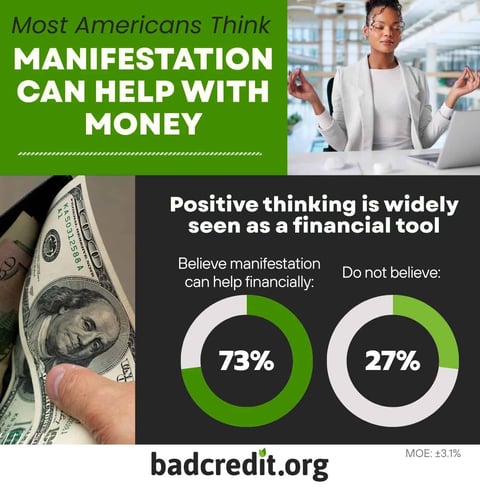
Driven by social media, manifestation is no longer a fringe belief. As these practices gain traction online, they have also firmly established themselves in personal finance behavior.
For many Americans, manifestation isn’t just a positivity gimmick; it’s a tool for achieving tangible financial goals, including outcomes such as improving their credit scores and earning more money.
“Adopting an optimistic attitude about money and credit can definitely work in your favor. After all, if you believe nothing will change for the better, odds are you won’t take the action needed to make it happen,” says Erica Sandberg, consumer finance expert at BadCredit.org.
Evidently, questions still remain: How does manifestation translate into real-world behavior, especially during times of crisis, and what tangible outcomes, if any, does it truly provide?
When Money Was Tight, 33% of Americans Turned to Manifestation
While it’s clear that belief in manifestation is common, some take their faith in the practice further than others. In fact, a significant portion of Americans report substituting practical financial action with these belief-based practices altogether.


One-third (33%) of adults surveyed admitted to relying on manifestation instead of conventional financial strategies when facing financial trouble. This finding highlights a behavioral divide among Americans. It also sparks the debate about relying solely on thought or belief versus taking action to improve one’s finances.
While these results may not assess true financial outcomes, they do reveal how Americans differ in their response when coping with financial stress.
Gen Z Is Nearly 3X More Likely Than Boomers to Rely on Manifestation Over Financial Action
Our study also found key generational differences among those who use or believe in manifestation for financial management.
Belief in manifestation declined modestly with age, but reliance on it over action dropped dramatically. Here is how support broke down across generations:

- Gen Z: 81% believe; 43% rely on manifestation over action
- Millennials: 77% believe; 35% rely on manifestation over action
- Gen X: 65% believe; 27% rely on manifestation over action
- Boomers: 64% believe; 16% rely on manifestation over action
Gen Z’s support stood out significantly. Not only did they lead in belief, but they also led in replacing action with belief-based practices to improve their financial standing. Nearly half (43%) of Gen Z admitted to this behavior, which was almost three times the rate of boomers.
For many young adults, manifesting isn’t just an optimism boost; it’s a go-to resource for getting out of financial binds. In contrast, while older adults believe manifestation can help financially through positive thinking or goal setting, they are less likely to view it as a practical source for financial repair on its own.
According to Sandberg, “I’m not surprised by the study’s results. The younger you are, the more positive you tend to be.”
This generational gap points not just to a shift in financial attitudes among generations, but also to how different generations respond to economic pressure in times of crises.
Sandberg adds, “And the practice of manifestation is especially popular with Gen Z because it’s getting so much attention on social media, but clearly many others are attracted to the ‘if you believe it, you’ll achieve it’ philosophy. But being positive is really just the beginning.”
Following the pandemic, manifestation surged in popularity as people sought hope and a sense of agency in uncertain times. And its appeal still rings true today — boasting more than 304,000 video tags on TikTok, a platform especially popular among young adults — as Americans face new uncertainties.
With record-high debt and lingering inflation affecting finances, we can’t ignore that belief alone may not be enough. Manifestation can’t fill the gap where concrete financial actions, such as budgeting and planning, should be.
“No matter how much you wish cash would drop in your lap, unless you win the lottery or receive an inheritance, it won’t. So take the steps needed to increase your net worth: spend mindfully, borrow conservatively, save assertively, and invest intelligently,” encourages Sandberg.
Instead, consumers who seek to combine optimism with practical financial steps may be better positioned to make real financial progress in the year ahead.
Methodology
This survey was conducted in December 2025 among 1,000 U.S. adults via an online panel. The overall margin of error is approximately ±3.1% at 95% confidence.
All questions were single-selection, and each received 1,000 completes. Crosstabs by demographic group (e.g., gender, generation, U.S. region, etc.) are available upon request.
For media inquiries, please contact catherine@badcredit.org.


