



45% of Americans Would Consider a 50-Year Mortgage


Writer: Lynn Cadet


Editor: Ashley Fricker


Reviewer: Adam West

Key Takeaways
- Millennials are the most open to a 50-year mortgage, with more than half (54%) saying they’d consider it, compared to just 29% of Boomers, who overwhelmingly reject the idea.
- Republicans (54%) are far more supportive of 50-year loans than Democrats or Independents (both 41%), highlighting a partisan divide over how to make housing payments more affordable.
- Men (52%) are more inclined than women (39%) to take on ultra-long mortgages, revealing a gender divide in financial optimism and risk-taking.
In an attempt to make housing payments more affordable for Americans, the Trump administration has introduced a 50-year mortgage plan. Yet, the proposal has received mixed reviews in the media.
As talk of a 50-year mortgage proposal gains traction in Washington, BadCredit.org asked 1,000 Americans if they’d ever consider one themselves. The results? Nearly half (45%) said yes.
The housing market is facing a shakeup: The median age of homebuyers is increasing, and mortgage demand remains low due to high interest rates and costs. And to many, Trump’s controversial invitation to homeownership has appeal, despite its glaring pitfalls.
But our data also reveals sharp divides in American sentiment. While younger buyers view the 50-year mortgage plan as a path to homeownership, older generations view it as a debt trap. Republicans and male respondents also showed more approval than Democrats and female respondents.
While support may be split, the warning is clear: Experts say longer loans may expand access for younger buyers, but they will also deepen household debt, leaving buyers with less financial security and freedom in the long run.
Millennials Most Likely to Take Out a 50-Year Mortgage
Our data reveals key generational differences among respondents. The trend: Support for applying for a 50-year mortgage wanes as age increases.
Of the generations, younger groups were far more likely to say they would consider a 50-year mortgage than their older counterparts. Take a look at the numbers below:

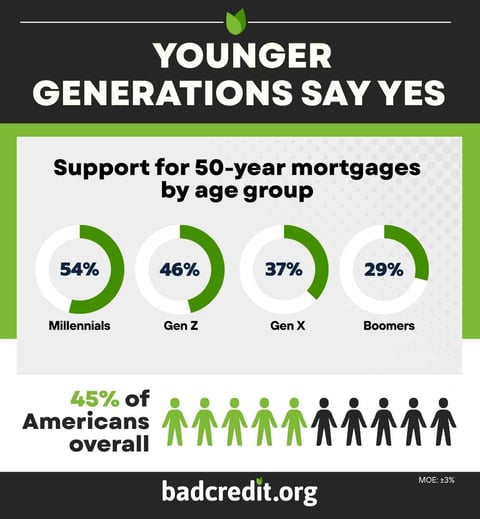
Life stage could explain why millennials outpaced every generation in their support of 50-year mortgage terms. Millennials and Gen Z are at an age where home buying should be the next step; yet, student loan debt and record home prices have made homeownership a distant and unattainable dream for so many young Americans.
Placing this into context, it’s not hard to see why the idea of spreading payments over half a century feels more practical and less reckless for younger generations. It’s a sign of how unaffordable the housing market has become and the unique hardships these generations face.
While younger generations may view this proposal as a path toward homeownership, older generations who may have already experienced fairer terms may view it as a deterrent.
Opponents argue that ultra-long mortgages could trap younger generations in decades of interest and delay true financial freedom, but for many, the alternative is renting indefinitely.
54% of Republicans Back Trump’s Proposed Mortgage Terms
While the Trump administration touts this mortgage proposal as a “complete game changer” for the housing market, experts say the plan is riddled with hidden risks. But how does Trump’s base view this bold proposal?


Not surprisingly, Republicans stood out in their support. More than half of Republicans backed Trump’s plan to introduce 50-year mortgages, the highest among political parties. In contrast, Democrats and Independents showed more skepticism, with only 41% supporting the proposal.
However, their stances may be driven by ideology rather than any other factor.
Support for a 50-year loan aligns with broader political narratives, with conservatives favoring market-based affordability solutions, while liberals tend to prioritize policy interventions such as subsidies or zoning reform.
Men 33% More Likely to Consider a 50-Year Mortgage
Our study also found a stark gender divide. Men (52%) were more likely to say they would consider a 50-year mortgage loan compared to women (39%) — revealing a 13-percentage-point gap.


Yet, these figures align with the current landscape surrounding gender and finances. Existing data shows women often carry more student loan debt and tend to be more risk-averse when making large financial decisions than their male counterparts.
While men may view long-term loans as a rational trade-off for wealth-building through home equity, women, often the more cautious financial decision-makers, see the extended debt horizon as too steep a risk. All of this helps underscore the differing perceptions of financial security among genders.
“In limited situations, a 50-year mortgage can benefit prospective homeowners,” said Erica Sandberg, consumer finance expert at BadCredit.org. “As the study found, millennials are most likely to gravitate toward them. As many in this cohort are raising families, homeownership is appealing, though incomes may not always support 30-year mortgage payments.”
Sandberg adds, “But they must weigh the monthly savings against the long-term costs, and to refinancing or paying more when possible. It can also be a way to build credit. As the buyer establishes better scores, they can refinance at a lower rate.”
As affordability pressures mount, Americans are split on whether innovation or caution will define the next era of home buying. For many, the monthly affordability of a 50-year loan outweighs its lifetime cost. And with nearly half of adults open to a 50-year mortgage, one thing is clear: the appetite for change is growing, even if the risks are, too.
Survey Methodology
This survey was conducted in November 2025 among 1,000 U.S. adults via an online panel. The sample is unweighted but includes a broad cross-section of respondents by age, gender, political affiliation, and geography.
All responses were single-selection, and each question received 1,000 completes. The margin of error for the full sample is approximately ±3% at a 95% confidence level.
For media inquiries, please contact catherine@badcredit.org.


