



51% of Prediction Market Users Borrowed Money to Fund Bets


Writer: Lynn Cadet


Editor: Ashley Fricker


Reviewer: Adam West

Key Takeaways
- 51% of surveyed prediction-market users said they have used a credit card, a personal loan, or other borrowed funds to fund bets.
- 79% of users have lost money in the past year, including 27% who lost more than $500. That total is even higher for people who borrowed money to place bets — 88% of bettors who borrowed said they lost money.
- 53% started using prediction markets to earn income, while 30% of all surveyed adults believe the platforms could improve their finances.
As prediction markets expand across sports, politics, and current events, some Americans are using them for more than entertainment. They are treating the platforms as a potential source of income.
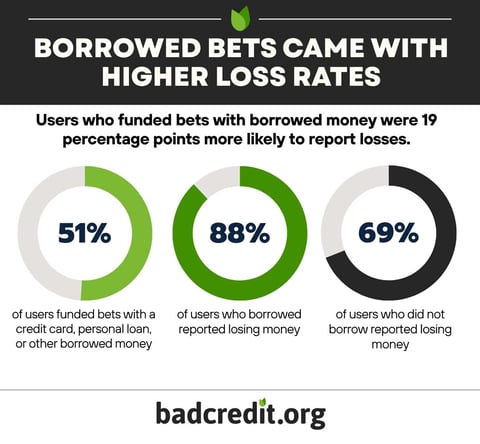
A new BadCredit.org survey found that 15% of U.S. adults have used a prediction-market platform such as Kalshi, Polymarket, or PredictIt. Among users, 51% said they have used a credit card, personal loan, or other borrowed money to fund bets, while 79% reported losing money in the past year.
Income was the most common reason for joining a prediction-market platform: 53% started either to make extra money or because they were financially struggling and needed another income stream. The findings reveal a potentially dangerous collision between financial pressure, borrowed money, and speculative betting.
79% of Prediction Market Users Lost Money — Rising to 88% Among Those Who Borrowed
When it comes to taking a gamble, whether in sports betting, predictions, or just in life, loss is always a real possibility. And prediction market users are seeing this in real time.
Overall, 79% of prediction-market users reported losing money in the past year. More than one-quarter of all users (27%) lost over $500, including 9% who lost more than $1,000. Only 21% said they had not lost money.

“I would recommend that everybody keep this statistic in mind. Our study found that nearly 4 out of five prediction market users lose money, and more than a quarter experience losses of at least $500,” said Erica Sandberg, consumer finance expert at BadCredit.org.
“If you’re like many Americans living within a tight budget, this kind of loss can make paying essential bills very difficult.”
Users who borrowed money to bet were considerably more likely to report losses than those who did not borrow. Among those who said they borrowed, 88% reported losing money, compared with 69% of those who did not borrow.
Sandberg adds, “Although tempting, borrowing money, whether with a credit card or taking out a loan to place a bet, is a universally bad idea. Look at the data. 88% who do so see losses, not gains. Remember that credit products aren’t designed for this purpose. They are to help you finance things you want and need, and are sure that you can handle the payments.”
Borrowed money introduces a whole new level of stakes for users. Unlike with bets funded by personal cash, ones funded with credit or loans can end with more than just a loss — they can also accumulate interest over time, increasing the amount the borrower may ultimately have to repay.
Our data show that losses are the norm, not the exception, in prediction betting activity. For those who participate in prediction markets, the findings reveal a gap between the financial promise some consumers see in them and the losses users report experiencing.
53% Started Using Prediction Markets for Income
When asked why they started to use prediction markets, this is how our respondents answered:
- 44% wanted to make extra income
- 27% joined for entertainment or curiosity
- 10% were influenced by social media
- 9% were financially struggling and needed another income stream
- 7% heard about the platforms from a friend or relative
- 3% felt traditional investing was inaccessible
Income-related motivations topped the list: 44% stated to make extra income, while another 9% said they were financially struggling and needed another income stream. Combined, 53% started using prediction markets for an income-related reason, nearly twice as many as the 27% who joined primarily for entertainment or curiosity.


Among those who use prediction markets, income generation appears to be a more common motivation than entertainment. In fact, 30% of all surveyed said they believe these platforms can realistically improve their financial situation.
Men were more likely than women to believe prediction markets could improve their financial situation, 37% versus 25%. Men were also nearly three times more likely to have used a prediction-market platform, 24% versus 9%.
“There is nothing wrong with using these prediction markets as a form of entertainment,” adds Sandberg. “Only use cash you can afford to lose, and that won’t end up hurting your overall circumstances and end up as debt.”
Prediction markets may be marketed as a way to trade on real-world events, but for many people, it’s more than just risky entertainment — it’s seen as the chance for a potential income stream.
Yet the biggest risk may not be that consumers misunderstand the odds. It may be that they see prediction markets as a financial lifeline rather than a speculative wager.
For media inquiries, please reach out to catherine@badcredit.org.
Methodology
BadCredit.org surveyed 1,000 U.S. adults via an online panel. Results in the study are based on raw, unweighted responses.
Questions about prediction-market losses, borrowing, and motivations were asked only of the respondents who said they had used a platform such as Kalshi, Polymarket, or PredictIt.
The margin of error for the full sample is approximately ±3.1 percentage points at the 95% confidence level. The margin of error for findings among prediction-market users is approximately ±8.0 percentage points.


