



56% of Online-Influenced Home Shoppers Faced Debt or Financial Setbacks


Writer: Andrew Allen


Editor: Ashley Fricker


Reviewer: Adam West

Key Takeaways
- Nearly 1 in 3 consumers who recently spent money beautifying their homes said online content led them to make an unplanned purchase or spend more than intended.
- Among those consumers, 56% took on debt, remained responsible for debt or interest, delayed paying bills or saving, or postponed another financial goal.
- More than half of respondents (54%) spent money on upgrading their houses during the previous year, most commonly to make their homes more comfortable.
- Online content drove an unplanned purchase or additional spending among 55% of Gen Z purchasers, 44% of Millennials, 26% of Gen X, and 6% of Boomers.
- Overall, 38% of home-aesthetic purchasers experienced one or more serious financial setbacks.
Keeping up with the Joneses used to entail making sure one’s home and yard looked more or less in line with those of their neighbors. But that task has gotten significantly more challenging in the internet era.
Homeowners no longer have to worry just about keeping their residences in good-enough shape to keep pace with the properties of their immediate neighbors — some may feel the need to compare their homes with the best of the best they come across online.
New research from BadCredit.org finds that online content led almost one-third (32%) of Americans who recently spent money beautifying their homes to make an unplanned purchase or spend more than they intended.
Among that group, 56% reported taking on debt or experiencing other financial setbacks as a result of their home spending.
Online home content and social media outlets increasingly serve as digital showrooms, giving homeowners a window into how people style their properties around the world.
But in addition to providing inspiration, an influencer recommendation or renovation video may encourage consumers to make a home purchase before considering how it fits their budget. A deeper dive into the research uncovers more about consumers and their approach to spending on home improvements.
54% of Americans Spent Money Beautifying Their Homes in the Last Year
Some people turn to home improvement projects to increase the functionality of their homes or to make them more energy efficient.

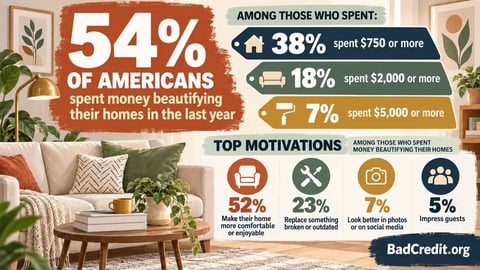
But more than half of the respondents to the BadCredit.org survey spent money on DIY projects, decor, furniture, or renovations simply to make their homes more visually appealing.
Among those people:
- 38% spent at least $750.
- 18% spent at least $2,000.
- 7% spent $5,000 or more.
Although keeping up with their neighbors may have played a role in motivating homeowners to open their wallets, most were driven by a desire to elevate their living experience.
Slightly more than half (52%) aimed to make their residences more comfortable or enjoyable. And 23% just wanted to replace a broken or outdated element of their home.
Only 7% said their main motivation was making their home look better in photos or on social media, while 5% primarily wanted to impress guests.
The bigger point isn’t that most people spruce up their homes just to look good — it’s that what people see on the internet can influence even things they buy for comfort or more practical reasons.
1 in 3 Say Online Content Made Them Buy or Spend More
While social media and online home content may not have inspired many respondents to drastically overhaul their homes, it did cause 32% of them to change their spending on home-oriented purchases.
- 16% made a purchase they hadn’t planned.
- 16% spent more than they planned.
- 20% said it influenced what they bought but not how much they spent.
Altogether, 53% said social media or online home content influenced their purchase in some way.

“In too many cases, home is where the debt is,” says Erica Sandberg, consumer finance expert at BadCredit.org.
“Our study revealed that many people are influenced to overspend by what they see on social media platforms. There is nothing wrong with getting ideas from online influencers and interior design experts, but keep your budget in mind before you buy.”
Who was most influenced by social media and online home content?
It should come as no surprise to parents of teenagers and anyone who regularly spends time with people under the age of 30 that younger respondents were much more likely to say online content motivated them to make an unplanned purchase or ramp up their spending:
- Gen Z: 55%
- Millennials: 44%
- Gen X: 26%
- Boomers: 6%
A similar age pattern emerged for financial setbacks. Among home-aesthetic purchasers, 62% of Gen Z and 48% of Millennials reported debt or another financial setback, compared with 33% of Gen X and 14% of Boomers.
Sandberg continues, “This is particularly common for Gen Zers and Millennials, but I would caution against the assumption that they are less responsible than Gen Xers and Boomers. It’s at least in part because they’re actively creating what their first apartments and houses look and feel like.”
38% Took on Debt or Set Back Their Finances
What one person considers to be a serious financial setback may be just a minor inconvenience to someone else. Among all home-aesthetic purchasers, nearly four in 10 (38%) reported debt or at least one other financial setback. Among that group:
- 16% were still paying debt or interest.
- 13% took on debt.
- 10% reduced or delayed saving.
- 10% delayed paying bills.
- 9% postponed another financial goal or purchase.
In addition, 29% made their purchase with the aid of at least one method of borrowing or financing, such as carrying a credit card balance, using BNPL, or turning to a home equity loan, a personal loan, or retailer financing.
The fallout was more pronounced among the 32% of respondents who said social media and online home content led them to make a purchase they hadn’t planned or to spend more on their project.
If you have to take on debt, Sandberg suggests swiping with eyes wide open: “Use your credit card to pay for the decor only when you have a sensible payoff plan to avoid being the 16% of those who took on debt who are paying interest on those purchases.”
Sandberg continues, “And since some of the items may be expensive – such as a room full of furniture – use the card that will generate the most rewards to reduce the net cost. Charging $5,000 on a card with 2% cash back will drop $100 into your rewards bank.”
Outcomes Following Purchases
| Result | Online-Driven Purchasers | Other Purchasers |
|---|---|---|
| Debt or Financial Setback | 56% | 30% |
| Used Borrowing or Financing | 41% | 24% |
| Still Paying Debt or Interest | 30% | 9% |
| Delayed Paying Bills | 19% | 6% |
These findings suggest a connection between online content and financial consequences without necessarily establishing that online content caused the outcome.
Trying to keep up with the Joneses — whether they live nearby or not — can play a part in a homeowner’s ambition to beautify their residence. But the survey’s findings indicate that trying to make one’s home more comfortable ranks higher than impressing strangers on the internet.
Nevertheless, online sites that provide inspiration for home remodels and decor can boost people’s desire to start a home improvement project of their own.
For respondents who said that social media or online home content led to an unplanned purchase or additional spending beyond what they’d planned, 30% were still on the hook for debt or interest, and 19% had held off on paying bills.
Sandberg adds, “Although beautifying your home can be enticing, keeping your overall finances healthy is essential. If browsing is causing you to borrow too much, log off and consider ways you can improve your living space for cheap or free.”
Inspiration from social media can disappear in the blink of an eye, but home improvement projects — and the bills for them — can stick around much longer.
Methodology
BadCredit.org surveyed 1,013 U.S. adults in August 2026. Of those respondents, 552 said they had spent money during the previous 12 months on home decor, furniture, renovations, or DIY projects primarily intended to improve their home’s appearance.
Results about those purchases are based on that subgroup. The data is raw and unweighted. The margin of error is approximately ±3.1 percentage points for the full sample and ±4.2 percentage points for the purchaser subgroup at the 95% confidence level.
Margins of error are larger for demographic and behavioral subgroups. Percentages may not total 100% because of rounding or because respondents could select more than one answer.
For media inquiries, please email catherine@badcredit.org.


