



Most Affordable College Towns to Watch March Madness in 2026


Writer: Lynn Cadet


Editor: Ashley Fricker


Reviewer: Adam West

As millions of Americans prepare for bracket-breaking excitement next month, many are also trying to avoid breaking something else: the bank. March Madness is as much a social event as a sporting one — bracket pools, watch parties, and bar tabs have become as much a part of the tradition as the games themselves.
But depending on where you live, the cost of that experience can look very different. While some college towns make it easy on the wallet, others can leave fans digging deeper than they’d planned.
To identify the most affordable college towns for watching March Madness out with friends and fellow fans, BadCredit.org analyzed 60 cities anchored by major universities across a range of economic factors, including cost-of-living metrics and game day expenses.
Based on a weighted 100-point scoring system, here’s where your March Madness budget goes the furthest, and where fans might want to think twice before the third round of drinks.
Top 5 Most Affordable College Towns to Watch March Madness:
- West Lafayette, Indiana
- Blacksburg, Virginia
- Morgantown, West Virginia
- Ames, Iowa
- Auburn, Alabama

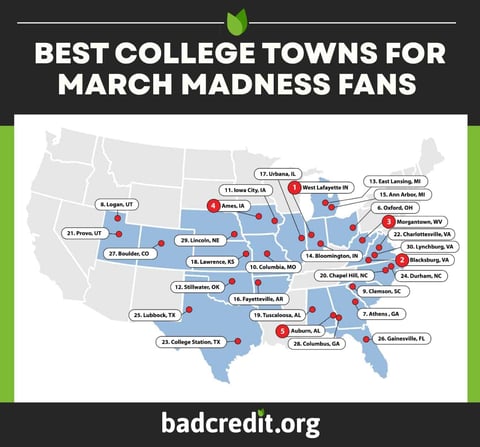
“Affordability isn’t just about cheaper drinks or lower rents, it’s about not feeling stressed out about being able to pay for it all,” said Bobbi Rebell, CFP® at BadCredit.org.
“If everyday costs are under control, people can enjoy social moments like March Madness without turning them into yet another reason to feel extreme financial anxiety,” she added.
Main Findings
March Madness Affordability: 60 College Towns Ranked
March Madness Affordability Index
| Rank | City | State | Total Score | Cost of Living | Housing Affordability | Transportation Costs | Local Entertainment | Job Market Strength | College Student Presence |
|---|---|---|---|---|---|---|---|---|---|
| 1 | West Lafayette | IN | 55.87 | 82.25 | 29.78 | 51.05 | 50 | 49.92 | 72.07 |
| 2 | Blacksburg | VA | 52.51 | 68.5 | 27.9 | 58.32 | 50 | 45.42 | 64.74 |
| 3 | Morgantown | WV | 51.96 | 78.82 | 33.33 | 51.87 | 50 | 46.12 | 46.27 |
| 4 | Ames | IA | 51.07 | 75.21 | 22.47 | 61.02 | 50 | 52.61 | 48.35 |
| 5 | Auburn | AL | 50.72 | 81.29 | 26.22 | 58.34 | 50 | 59.71 | 33.24 |
| 6 | Oxford | OH | 50.48 | 55.58 | 25.84 | 59.99 | 50 | 41.12 | 70.91 |
| 7 | Athens | GA | 50.26 | 99.45 | 23.97 | 42.25 | 50 | 53.19 | 27.19 |
| 8 | Logan | UT | 49.84 | 93.44 | 18.54 | 52.88 | 50 | 52.04 | 29.38 |
| 9 | Clemson | SC | 49.68 | 78.96 | 24.34 | 51.71 | 50 | 41.93 | 44.41 |
| 10 | Columbia | MO | 49.29 | 75.95 | 25.28 | 68.11 | 50 | 58.87 | 22.54 |
| 11 | Iowa City | IA | 49.07 | 75.27 | 22.66 | 59.81 | 50 | 55.36 | 34.94 |
| 12 | Stillwater | OK | 48.82 | 82.48 | 16.67 | 49.88 | 50 | 47.44 | 44.26 |
| 13 | East Lansing | MI | 48.71 | 82.97 | 26.03 | 15.32 | 50 | 39.18 | 67.65 |
| 14 | Bloomington | IN | 48.21 | 68.67 | 25.47 | 50.77 | 50 | 53.59 | 43.89 |
| 15 | Ann Arbor | MI | 47.03 | 57.78 | 23.78 | 65.47 | 50 | 52.32 | 38.57 |
| 16 | Fayetteville | AR | 46.59 | 62.26 | 28.84 | 65.22 | 50 | 56.52 | 21.72 |
| 17 | Urbana | IL | 46.24 | 50.7 | 25.66 | 66.72 | 50 | 45.44 | 41.26 |
| 18 | Lawrence | KS | 46.18 | 69.04 | 23.41 | 57.8 | 50 | 54.69 | 25.23 |
| 19 | Tuscaloosa | AL | 45.75 | 72.6 | 24.16 | 49.63 | 50 | 57.57 | 23.83 |
| 20 | Chapel Hill | NC | 45.45 | 63.46 | 27.72 | 44.89 | 50 | 54.43 | 35.08 |
| 21 | Provo | UT | 45.24 | 67.17 | 20.97 | 44.34 | 50 | 47.6 | 40.57 |
| 22 | Charlottesville | VA | 44.27 | 60.57 | 23.97 | 56.48 | 50 | 60.39 | 22.46 |
| 23 | College Station | TX | 44.26 | 74.8 | 20.04 | 24.54 | 50 | 52.67 | 43.16 |
| 24 | Durham | NC | 44.19 | 71.05 | 24.91 | 55.37 | 50 | 61.84 | 7.33 |
| 25 | Lubbock | TX | 42.71 | 70.22 | 20.22 | 48.93 | 50 | 56.54 | 13.06 |
| 26 | Gainesville | FL | 42.63 | 59.64 | 22.66 | 39.49 | 50 | 42.7 | 37.39 |
| 27 | Boulder | CO | 42.36 | 55.17 | 19.66 | 49.34 | 50 | 54.13 | 31.93 |
| 28 | Lincoln | NE | 41.79 | 66.47 | 23.78 | 45.28 | 50 | 59.49 | 9.8 |
| 29 | Lynchburg | VA | 41.62 | 72.89 | 23.78 | 28.75 | 50 | 48.61 | 20.26 |
| 30 | Fairfax | VA | 41.42 | 62.79 | 21.72 | 51.69 | 50 | 70.23 | 4.99 |
| 31 | Berkeley | CA | 41.11 | 50.46 | 16.48 | 64.25 | 44.44 | 56.75 | 27.62 |
| 32 | Waco | TX | 40.52 | 67.51 | 18.73 | 40.78 | 50 | 51.85 | 13.73 |
| 33 | Columbia | SC | 39.3 | 67.23 | 23.6 | 25.72 | 50 | 45.47 | 16.68 |
| 34 | Spokane | WA | 39.08 | 61.79 | 19.1 | 49.15 | 50 | 49.35 | 3.76 |
| 35 | Santa Clara | CA | 34.98 | 35.82 | 20.04 | 42.48 | 50 | 74.81 | 7.95 |
| 36 | Coral Gables | FL | 34.76 | 48.27 | 12.92 | 23.97 | 50 | 73.21 | 18.46 |
| 37 | Stanford | CA | 34.68 | 41.18 | 22.1 | 31.77 | 50 | 90 | 1.69 |
| 38 | Madison | WI | 34.62 | 63.12 | 22.28 | 43.51 | 20.89 | 63.64 | 17.38 |
| 39 | Lexington | KY | 34.25 | 76.73 | 25.47 | 39.89 | 14.29 | 59.35 | 8.58 |
| 40 | Columbus | OH | 33.9 | 60.6 | 23.6 | 61.17 | 16.83 | 57.34 | 5.39 |
| 41 | Tulsa | OK | 33.28 | 69.97 | 23.6 | 50.44 | 16.11 | 54.95 | 1.49 |
| 42 | Phoenix | AZ | 32.82 | 55.1 | 21.91 | 69.13 | 15.56 | 58.18 | 1.64 |
| 43 | Nashville | TN | 32.82 | 60.3 | 20.97 | 61.2 | 14.74 | 62.35 | 3.86 |
| 44 | Boise | ID | 32.69 | 65.83 | 23.6 | 42.72 | 18.04 | 59.7 | 6 |
| 45 | Raleigh | NC | 32.41 | 60.27 | 25.47 | 46.37 | 16.66 | 62.6 | 6.73 |
| 46 | Albuquerque | NM | 32.28 | 61.19 | 20.79 | 60.74 | 13.52 | 55.56 | 4.1 |
| 47 | Reno | NV | 31.54 | 42.23 | 20.22 | 20.23 | 50 | 55.62 | 4.91 |
| 48 | Fayetteville | NC | 31.42 | 71.73 | 19.1 | 41.29 | 14.57 | 51.07 | 5.76 |
| 49 | Houston | TX | 31.31 | 55.42 | 20.22 | 61.2 | 15.86 | 52.75 | 2.62 |
| 50 | Louisville | KY | 31.28 | 68.62 | 23.78 | 39.6 | 14.6 | 58.41 | 1.95 |
| 51 | Knoxville | TN | 31.23 | 62.54 | 22.47 | 37.22 | 15.81 | 58 | 11.94 |
| 52 | Austin | TX | 30.98 | 53.34 | 20.04 | 53.66 | 17.12 | 63.87 | 5.23 |
| 53 | Fort Worth | TX | 30.16 | 55.92 | 18.91 | 54.18 | 15.23 | 57.86 | 2.44 |
| 54 | Dallas | TX | 30.03 | 52.03 | 18.54 | 60.97 | 15.12 | 56.75 | 1.05 |
| 55 | Tucson | AZ | 28.95 | 60.79 | 20.22 | 36.07 | 14.63 | 51.35 | 7.4 |
| 56 | Orlando | FL | 28.58 | 58.33 | 19.29 | 34.89 | 19.28 | 53.58 | 2.14 |
| 57 | Richmond | VA | 26.89 | 50.44 | 19.66 | 35.22 | 14.18 | 56.4 | 8.17 |
| 58 | San Diego | CA | 24.89 | 36.14 | 14.04 | 45.51 | 16.45 | 57.8 | 6.81 |
| 59 | New York | NY | 24.76 | 18.32 | 10.67 | 79.35 | 15.45 | 54.54 | 3.12 |
| 60 | Los Angeles | CA | 23.86 | 30.34 | 6.74 | 61.3 | 16.18 | 50.36 | 4.55 |
5 College Towns Where March Madness Won’t Break the Bank
Packed bars, passionate fans, and affordable drinks, these five college towns have March Madness covered.


1. West Lafayette, IN
West Lafayette, Indiana, home to Purdue University, takes the top spot for the most affordable March Madness college town. Often cited as the “home” of basketball, Indiana is no doubt passionate about hoops, but West Lafayette is where fandom and affordability meet.
The city ranks high across all economic metrics, and a low cost of living means fans could have more money in their pocket for the things that make March Madness fun: bar tabs, bracket pools, and nights out with fellow Boilermaker faithful.
2. Blacksburg, VA
The second-highest-ranked college town is Blacksburg, Virginia. With a strong college identity and solid affordability metrics, it’s not hard to see why Hokies territory could draw great crowds this year.
The city’s second-place finish is largely driven by its low transportation costs and high student population ratio. These figures translate into a lively watch-party environment for Virginia Tech fans, where students don’t have to pay much to travel and can access viewing venues with ease.
Blacksburg also performs well economically, boasting competitive housing and cost-of-living figures for residents. Together with a lively student atmosphere and clustered nightlife, Blacksburg offers an accessible venue for basketball fans to enjoy the popular tournament without breaking the bank.
3. Morgantown, WV
Morgantown, West Virginia, earns third place largely due to its standout housing affordability and well-balanced cost structure. Data shows that Morgantown scores well for cost of living and transportation expenses. And its housing affordability doesn’t just stand out — it’s the highest ranked among college towns.
With strong rent-to-income ratios and lower dining-out costs, Morgantown allows residents to stretch their dollars and enjoy more discretionary spending. This kind of financial flexibility matters more during tournament season, when basketball devotees may watch several games across a jam-packed March Madness schedule.
Morgantown also benefits from a clustered nightlife scene that helps reduce transportation costs and creates an exciting atmosphere for fans. These factors all contribute to making the city a top-tier destination for watching games throughout the competitive season.
4. Ames, IA
Ames, Iowa, home to Iowa State University, comes in at fourth on the strength of its campus-centered community, low cost of living, and affordable transportation options.
A busy bar scene and strong student presence make it naturally social, and with a healthy job market giving residents genuine financial breathing room, Ames is a place where fans can actually afford to show up, night after night across a long tournament run.
5. Auburn, AL
Auburn, Alabama, rounds out the top five, thanks to its strong affordability profile and well-established college-town culture.
Auburn — one of the largest universities in the South — boasts a rich sports history, drawing in a sizable student population with intense pride. This level of community helps shape a high-energy local atmosphere for fans, especially when tournament games overlap with peak social hours.
The city also has a strong economic standing. Not only does it rank second-highest in the top five for cost of living, but it also scores well for transportation and job market strength. This mix of factors allows residents to stretch their budgets further and support their favorite teams without the stress of financial strain.
The Auburn Tigers have made their stamp in March Madness lore in recent years, and it’s clear that its namesake serves as a great location for watch parties and affordable tournament outings.
Rebell adds, “Big cultural moments like March Madness can quietly put pressure on people to overspend. Cities that rank as more affordable give fans the freedom to participate socially without feeling like they’re sacrificing their financial stability.”
Wherever you’re watching from, fill out your bracket, find your local viewing spot, and set a budget before tip-off. With 67 games spread across three weeks, the costs of socializing through a full tournament run can sneak up fast. The only upset you don’t want this March Madness is the one to your wallet.
Methodology
To determine the Best College Towns for Affordable March Madness in 2026, we compared 60 U.S. cities anchored by major colleges and universities across six key dimensions: Cost of Living, Housing Affordability, Transportation Costs, Local Entertainment, Job Market Strength, and College Student Presence.
Each city was evaluated using a total of 19 metrics. All metrics were standardized to a 0–100 scale, with 100 representing the most favorable conditions for affordability and accessibility during March Madness.
Directionality was applied per metric, and ratio-based metrics were calculated before normalization, where applicable. Section scores were computed as weighted averages of their component metrics.
Final overall scores were calculated as weighted averages of section scores according to the point allocations listed below. All data were collected as of February 2026.
For any media inquiries, contact catherine@badcredit.org.
Cost of Living — Total Points: 20
- Regional Price Parity (Overall) — Full Weight
- Meal at an Inexpensive Restaurant — Double Weight
- Meal for Two at a Mid-Range Restaurant (Three Courses, Without Drinks) — Full Weight
- Domestic Draft Beer (0.5 Liter) — Double Weight
- Imported Beer (0.33 Liter Bottle) — Full Weight
Housing Affordability — Total Points: 20
- Median Gross Rent — Full Weight
- Median Owner Costs as Percentage of Income — Full Weight
- Median Gross Rent as Percentage of Income — Full Weight
Transportation Costs — Total Points: 15
- CPI: Transportation — Full Weight
- Walk Score — Full Weight
- Transit Score — Double Weight
- Taxi Start (Standard Tariff) — Full Weight
Local Entertainment — Total Points: 25
- Events per 100,000 Residents — Full Weight
- Bars per 10,000 People — Double Weight
- Bars per Square Mile — Full Weight
Job Market Strength — Total Points: 5
- Unemployment Rate — Full Weight
- Median Earnings (Workers) — Full Weight
College Student Presence — Total Points: 15
- College Enrollment (as a Percentage of Population) — Full Weight
- College Enrollment Rate — Full Weight
Sources: Data used to create this ranking were collected from the Bureau of Economic Analysis, U.S. Census Bureau, Bureau of Labor Statistics, Numbeo, Walk Score, Eventbrite, and internally compiled bar density data.


