



31 Eye-Opening Global Poverty Statistics (2025)


Writer: Zina Kumok


Editor: Jon McDonald


Reviewer: Ashley Fricker

If you’re living in the U.S., you may be aware of rising poverty levels. However, you may not know the scale of poverty across the world — and how it varies depending on gender, location, and other factors.
Even things that may not seem directly related to poverty — like climate change — can have a huge impact on whether a country makes progress or not.
If you want to feel good about the state of the world, there’s one thing you should know: poverty has decreased a lot since the 1980s.
And researchers are continuing to study other types of poverty beyond just financial, which may indicate that more positive change is coming.
Here are some important — and little-known — facts about global poverty.
1. 808 Million People Live in Extreme Poverty
While general poverty has been decreasing over the past few decades, hundreds of millions of people still live in extreme poverty. In 2025, about 808 million people lived at or below the extreme poverty line, which is about $2.15 per day. This is approximately 1 in 10 people in the world.¹
2. Global Poverty Rates Dropped From 43.6% Since the 1990s
In the 1990s, the global poverty rate hit a high of 43.6%. Today’s rate of 9.9% seems like a huge improvement. Of course, a huge reason for that is that countries like China and India — which represent a huge swath of those living in poverty — have worked extremely hard to eradicate poverty.

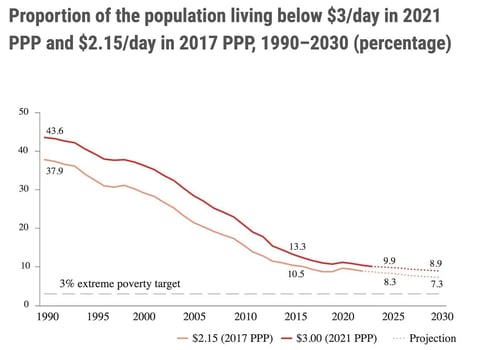
Progress has not happened for all countries equally. According to United Nations data, “small island developing states” actually saw their rates of employed people living in extreme poverty increase from 8.9% in 2015 to 9.5% in 2024.¹
3. Extreme Poverty Rates Predicted to Rise to 8.9% by 2030
If the global situation doesn’t change in the near future, experts estimate that almost 9% of the world’s population will be living in extreme poverty. As I mentioned earlier, in 2025, about 808 million people were already living in extreme poverty.¹
4. Climate Hazards Impact Vulnerable Populations in Over 90 Countries
Major global events, like the COVID-19 pandemic and natural disasters, can cause huge disruptions for people — rich or poor. But the poor are much more acutely affected by these events, and often find it harder to bounce back.
As climate hazards become more common across over 90 vulnerable nations, it may become even harder for those in poverty to escape it.¹
5. Poverty Thresholds Include Daily Spending of Less Than $6.85
When researchers talk about poverty, there are two main metrics they are referring to: poverty and extreme poverty. Poverty has a higher threshold, while extreme poverty is an even lower standard of living.
| Poverty Classification | Daily Income Threshold |
|---|---|
| Extreme Poverty | $2.15 or less |
| Lower-Middle-Income Poverty | $3.65 |
| Upper-Middle-Income Poverty | $6.85 |
Living in poverty means you live on less than either $3.65 or $6.85 a day, while living in extreme poverty means that you live on $2.15 a day or less.²
6. Stagnant Poverty Counts Have Been Tracked Since the 1990s
The poverty rate also varies depending on where you live. Developed countries have higher poverty thresholds than less-developed countries. In upper-middle-income countries, living in poverty means living on $6.85 per day.
This figure includes all the resources a person has to pay for housing, food, transportation, children’s expenses, and more. According to the World Bank Group, the number of people living in poverty has stayed relatively constant since the 1990s due to population growth.³
7. Sub-Saharan Africa Is Home to 67% of the World’s Extremely Poor
Data from the World Bank Group also shows that sub-Saharan Africa is home to around two-thirds of all impoverished people. In 2024, about 67% of people living in extreme poverty worldwide were in sub-Saharan Africa.
| Regional Extreme Poverty Share (2024) | Percentage of Global Total |
|---|---|
| Sub-Saharan Africa | 67% |
| South Asia | 15% |
| Rest of World | 18% |
This area includes countries like Burundi, Malawi, the Democratic Republic of Congo, the Central African Republic, and Mozambique.³
8. 69M People Are Expected to Escape Extreme Poverty by 2030
Research from the World Bank Group found that between 2024 and 2030, about 69 million people will no longer live in extreme poverty. This represents a smaller decline than in previous years.
Between 2013 and 2019, about 150 million people escaped living in extreme poverty. That’s about 50% more people than those who may no longer live in extreme poverty between 2024 and 2030.³
9. Extreme Poverty Could Persist for 100 Years
Based on World Bank Group research and data, extreme poverty isn’t going anywhere anytime soon. It will likely take a century — or even longer — to get people above the $6.85 poverty line, which is mostly used for higher-income countries.³
10. Rural Poverty Rates Are 11% Higher than Urban Rates
The rates of poverty and extreme poverty depend on several factors. One of the most important is location. Almost everywhere around the world, poverty rates are higher in rural areas than in urban areas.
| Global Poverty by Setting | Estimated Poverty Rate |
|---|---|
| Rural Areas | 16% |
| Urban Areas | 5% |
| Global Average (at $2.15 line) | 10% |
According to the World Bank, the poverty rate for rural areas is about 16%, while the rate for urban areas is only 5%.³
11. Higher Poverty Thresholds Affect 44% of the Global Population
It may seem strange, but having a higher poverty threshold only makes the gap between rural and urban areas greater. When using the $6.85 daily poverty rate, about 44% of the world’s total population lives in poverty.³
12. High Income Inequality Persists in 54 African Countries
In general, countries that prioritize income equality may be more likely to have fewer residents living in poverty.
That’s one reason why many African countries struggle to eradicate poverty; they have high rates of income inequality. Sub-Saharan African countries tend to have the worst income inequality in the world.⁴
13. Multidimensional Poverty Affects 18% of the Global Population
The concept of multidimensional poverty refers to factors beyond just financial considerations that are included in poverty. Using this scale, about 18% of the global population lives in multidimensional poverty.
| Multidimensional Poverty (MPI) Indicators | Core Pillars |
|---|---|
| Health | Nutrition, Child Mortality |
| Education | Schooling Years, School Attendance |
| Standard of Living | Fuel, Sanitation, Water, Electricity |
This means that poverty should not be judged solely by how much money you have, but also by other major factors such as nutrition, child mortality, and schooling.⁵
14. 887 Million People in Poverty Face Dangerous Climate Hazards
Research from the United Nations Human Development Report found that about 887 million people living in poverty have to face one of four prevalent climate hazards.
These include air pollution, drought, floods, and high heat. About 34% of all those living in poverty are actually exposed to three of the four climate hazards.⁵
15. Four Main Factors Influence Experiences of Multidimensional Poverty
Sanitation, drinking water, and electricity are other factors that can affect a person’s perception and experience of poverty. This is why it’s important not to just consider money when defining poverty.
For example, without clean drinking water, people may be susceptible to more diseases, which can cost money and limit their ability to work or get an education.⁵
16. China Lifted 875 Million People Out of Extreme Poverty
In the 1980s, China had the largest number of people living in extreme poverty — about 875 million. However, as China’s economy became more robust and modernized, that number slowly decreased.
Now, China doesn’t even crack the top 10 of countries with the largest number of its residents living in extreme poverty. As of 2020, China announced it no longer had any citizens living in extreme poverty.⁶
17. South Sudan Experienced 128% Inflation in 2024
After the COVID-19 pandemic, most people in the U.S. began to experience inflation in a way they never had before. In South Sudan, inflation was 128% in 2024.
That is likely a major reason why poverty has remained so prevalent there. In fact, on the Global Finance list of the poorest countries, South Sudan ranked #1.⁷
18. India Eliminated Extreme Poverty for Its 1.4 Billion People
Research from the Brookings Institution indicates that India can now claim to have eliminated extreme poverty. This may be due to several factors, including more public programs aimed at helping rural people access basic needs, like piped water, electricity, and modern cooking oil.
India has worked hard to turn things around compared to the early 1980s when they had the second highest number of people living in poverty.⁸
19. Poverty Forecasts Show Improved Outcomes Through 2030
Extreme poverty rates are decreasing across the globe. Brookings Institution research indicates that by 2030, only three Asian countries may have substantial populations living in extreme poverty: Afghanistan, Papua New Guinea, and North Korea.⁸
20. South American Poverty Rates Decreased by 2.2% Over One Year
The general decline in poverty is also true for Latin and South American countries. Approximately 25.5% of people in those countries were living in poverty, which is 2.2% less than the year before.⁹
21. The Pandemic Pushed 35 Million People Into Poverty
Just as climate hazards have a huge impact on poverty rates, so do other global issues.
| Impact of COVID-19 | Global Statistic |
|---|---|
| New People in Poverty | 35 Million |
| Poverty Increase in Africa | 11% |
Research from the International Labour Organization found that due to the effects of COVID-19 about 35 million more people fell below the poverty line. During the Pandemic, the rate of poverty in Africa rose 11%.¹⁰
22. Rural Poverty in Sub-Saharan Africa Reaches 46.4%
While poverty rates are typically significantly higher in rural areas, some countries and regions have it worse than others.
The difference is most pronounced in sub-Saharan Africa, where the rural rate is about 46.4%, while the urban rate is 20.2%. However, in some regions, the difference is less pronounced, such as South Asia.¹⁰
23. Sub-Saharan Africa and South Asia Account for 90% of Children in Poverty
About 90% of those living in poverty either live in sub-Saharan Africa or in South Asia (mainly India). According to UNICEF, they are twice as likely to live in poverty as adults.¹¹
24. Northern European Countries Face Persistent 10% Child Poverty Rates
Most people know that the Scandinavian countries have some of the highest rates of happiness in the world. However, not everything is perfect.
About 1 in 10 children in these countries live in poverty, which is still unfortunately high.¹¹
25. EU Average Poverty or Social Exclusion Reaches 21.4%
While Europe has the lowest poverty rate compared to all other continents, not all European countries enjoy the same rich lifestyle. Within Europe, Bulgaria, Romania, Greece, and Spain have the highest poverty rates.
The average rate of poverty or social exclusion is 21.4% in all of the EU, while the rates in Bulgaria and Romania are 32%, and in Greece and Spain they are 26.5%.¹²
26. Denmark and Finland Maintain Poverty Rates Below 7%
While Scandinavian countries have child poverty rates of around 10%, overall, many of the countries maintain lower overall poverty rates.
| Scandinavian Country | Population Below the Poverty Threshold |
|---|---|
| Denmark | 6.3% |
| Finland | 6.8% |
| Norway | 8.0% |
| Sweden | 8.0% |
In the region, Denmark has a 6.3% poverty rate, Finland has a 6.8% poverty rate, and both Norway and Sweden have an 8% poverty rate.¹³
27. 10% of Women Globally Live in Extreme Poverty
All around the world, women are much more likely to live in poverty, with about one in 10 women living under the economic threshold.
The poverty rates for women are higher no matter which country you’re looking at — whether it’s the U.S. or the Democratic Republic of Congo.¹⁴
28. Latin American Poverty Has Dropped by 60% Since the 1990s
While China is largely responsible for the decrease in global poverty in East Asia, other regions have also seen major improvements in recent years.
For example, since the 1990s in Latin America and the Caribbean, poverty declined 60%, while it also decreased 57% in Eastern Europe.¹⁵
29. Poverty Is a Crisis in 39 Conflict-Affected Countries
World Bank research has found that countries affected by violence — specifically, fragility, conflict, and violence (FCV) — tend to also have higher poverty rates. War and other conflicts can disrupt lives, making it harder for economies to stay stable.¹⁶
30. Indigenous People Account for 18.2% of the Extremely Poor
In almost every country, native or indigenous people are more likely to live in poverty than non-indigenous people.
| Indigenous Peoples | Non-Indigenous | |
|---|---|---|
| Total World Population | 6.2% | 93.8% |
| People in Extreme Poverty | 18.2% | 81.8% |
Research from the World Bank found that indigenous people account for 18.2% of all people living in extreme poverty, while only representing 6.2% of the world’s population.¹⁷
31. LGBTQI+ Householders Face a $12,000 Annual Wage Gap
Being part of any disenfranchised group means that you are more likely to live in poverty. According to the Center for American Progress, LGBTQI+ householders earn about $12,000 less each year, or about 85 cents on the dollar earned by straight or cisgender households.
Research also shows that disabled workers are twice as likely to live in poverty.¹⁸ ¹⁹
Global Poverty Is Generally Improving
Humanity has made inroads toward eliminating and reducing poverty, even if the rates remain persistently high in many parts of the world.
Reading through some of these facts and statistics may feel discouraging, but you can help by talking to lawmakers and donating to organizations that promote global health and education.
Data Sources:
¹ https://unstats.un.org/sdgs/report/2025/goal-01/
² https://www.globalcitizen.org/en/content/extreme-poverty-definition-statistics-rate/
³ https://www.worldbank.org/en/publication/poverty-prosperity-and-planet
⁴ https://wid.world/news-article/2023-wid-update-sub-saharan-africa/
⁵ https://hdr.undp.org/content/2025-global-multidimensional-poverty-index-mpi#/indicies/MPI
⁶ https://ourworldindata.org/data-insights/extreme-poverty-in-china-has-been-almost-eliminated-first-in-urban-then-in-rural-regions
⁷ https://gfmag.com/data/economic-data/poorest-country-in-the-world/
⁸ https://www.brookings.edu/articles/the-evolution-of-global-poverty-1990-2030/
⁹ https://www.cepal.org/en/pressreleases/income-concentration-still-extreme-latin-america-wealthiest-10-obtains-342-total
¹⁰ https://ilostat.ilo.org/those-left-behind-the-forgotten-in-the-fight-against-global-poverty/
¹¹ https://www.unicef.org/reports/state-of-worlds-children/2025
¹² https://www.statista.com/chart/30411/share-of-people-at-risk-of-poverty-or-social-exclusion/
¹³ https://www.visualcapitalist.com/mapped-europes-poverty-rates-by-country/
¹⁴ https://www.unwomen.org/en/news-stories/press-release/2024/03/1-in-every-10-women-in-the-world-lives-in-extreme-poverty
¹⁵ https://voxdev.org/topic/methods-measurement/global-poverty-trends-new-lens
¹⁶ https://blogs.worldbank.org/en/opendata/fragility-and-poverty-sub-saharan-africa-two-sides-same-coin
¹⁷ https://www.worldbank.org/en/topic/indigenouspeoples
¹⁸ https://www.americanprogress.org/article/the-2024-lgbtqi-wage-gap/
¹⁹ https://www.ncd.gov/report/2023-progress-report-toward-economic-security-the-impact-of-income-and-asset-limits-on-people-with-disabilities/


