



83% of Parents Say Schools Should Teach Financial Literacy Over Shakespeare


Writer: Lynn Cadet


Editor: Ashley Fricker


Reviewer: Adam West

Key Takeaways
- Parents in the lowest income bracket (<$25K) surveyed were the least likely to support financial literacy taught in schools (74%), while support peaked among high earners (86%).
- Across political party lines, parents agree that money skills matter more than classic literature, with 83% of Republicans, 83% of Democrats, and 84% of Independents in favor of financial literacy classes.
- In the Northeast, 1 in 5 parents (20%) still favor classic literature like Shakespeare over financial literacy, a higher share than in any other region.
As more states join in on mandating financial literacy classes in schools, parents aren’t shying away from expressing their support for the matter.
A new BadCredit.org study reveals that 83% of surveyed parents say they would rather have their children taught financial literacy in school over classic literature such as Shakespeare or The Great Gatsby.
This comes at a time when the debate over education is at its most tense, not only on the state level but also on the federal level.
Education is facing a shakeup: Recent data shows math and reading scores nearing historic lows, while the Trump administration has placed more power in the states’ hands to decide how to educate students. Yet, the demand for real-world education skills may be fueling parents to prioritize financial knowledge over other subjects.
Our survey explored where demand for financial literacy is strongest and weakest among Americans.
High-Income Parents Push Hardest for Money Skills
The Trump administration’s minimizing the role of the Department of Education has led to states and parents getting increased control in shaping educational outcomes for their students. And they’re not losing any time on improving the curriculum.
Our study shows that most parents are in favor of financial education being added to their kids’ courses. However, key demographics have outpaced others in their support. In fact, our survey finds that higher-earning households push the hardest for early financial education.
While higher earners slightly edged out other income brackets in their demand, parents in the lowest income bracket (under $25K) were the least likely to demand money skills over literature. Here is how the support broke down between brackets:

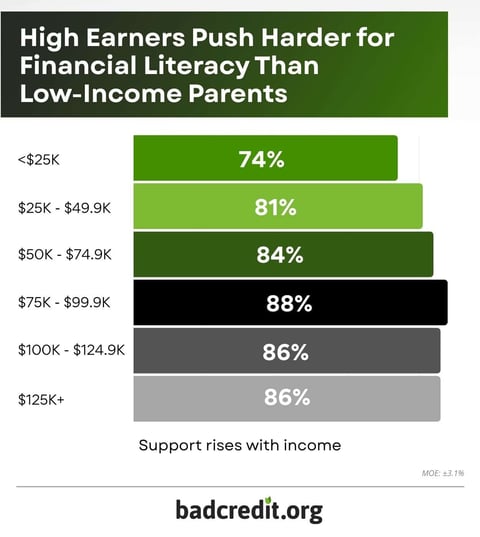
These results set up a surprising and counterintuitive divide among household income groups. While lower-income households may have the most to gain from financial literacy classes, they expressed the least interest.
On the other hand, those who earn the most may have a deeper understanding of the value of financial education for their children, showing why their support outpaced that of other groups.
More Than 80% of Parents Across Party Lines Agree Money Skills Should Be Taught In Classrooms
In today’s polarized world, political parties rarely agree on anything. But early financial education may have parents across the political spectrum finally seeing eye to eye.


Across political affiliations, support for financial literacy classes in schools outpaced opposition. In fact, there was nearly unanimous agreement:
- 83% of Republicans
- 83% of Democrats
- 84% of Independents
Our study finds that financial knowledge is one of the few education priorities where families across party lines agree. While the discourse over lesson plans has been heated in recent years, financial literacy isn’t a subject parents are willing to dispute. Instead, they all view it as valuable and necessary in early and higher education.
1 in 5 Northeastern Parents Still Prefer Classic Literature Over Financial Knowledge
Credit cards and budgeting or Romeo and Juliet? While it seems most parents have agreed on their answer, there lies an interesting gap in opinion in one demographic.
For some parents, classic literature is still a non-negotiable in 2025. We found that 1 in 5 (20%) surveyed parents from the Northeast would rather have Shakespeare or The Great Gatsby taught in schools over financial literacy, the highest among all regions.

Here is how the other regions fared:
- The Midwest: 15%
- The South: 16%
- The West: 15%
While parents nationwide lean heavily toward financial literacy, families in the Northeast are more likely to favor traditional courses such as classic literature over practical and unconventional topics like Roth IRAs and credit cards.
“The near universal support for financial literacy education in schools is heartening,” said Erica Sandberg, consumer finance expert at BadCredit.org. “Personal finance classes are great, but they don’t have to come at the expense of other valuable classes. In addition to dedicated classes, it can be incorporated in a variety of ways.”
“For example, Shakespeare addressed money issues that are relevant today. In Hamlet, he wrote, ‘For loan oft loses both itself and friend, And borrowing dulls the edge of husbandry.’ Students can explore why lending money to friends can be a bad idea.”
Sandberg adds, “Teaching about cash, credit, investing, and consumer decisions is perfectly appropriate in math and government, and yes, even in classic literature! Money is an integral part of our lives and culture. Knowing how to spend, save, and borrow wisely is as important as understanding larger economic concepts such as inflation.”
Despite divisions, one priority stands out: Parents want financial literacy taught to prepare students for real life. It is the opinion of most that money skills have come to matter more in today’s world than reading literary classics. And in the eyes of American parents, financial education is no longer seen as an option; it’s a survival skill.
Methodology
This survey was conducted in July 2025 among 1,000 U.S. parents of school-aged children via an online panel. The sample is unweighted but includes a broad cross-section of respondents by age, gender, household income, and race/ethnicity.
All responses were single-selection, and each question received 1,000 completes. The margin of error is approximately ±3.1% at a 95% confidence level. Crosstabs by demographic group are available upon request.
For media inquiries, please reach out to catherine@badcredit.org.


