



49% of Parents Delay Bills or Sacrifice Necessities for Back-to-School Costs


Writer: Lynn Cadet


Editor: Ashley Fricker


Reviewer: Adam West

Key Takeaways
- Nearly half (49%) of parents surveyed say back-to-school costs have forced them to delay bills or sacrifice necessities such as groceries or medical bills.
- Over half (54%) have either worked overtime or gotten a side job to cover expenses.
- Most parents want to ensure their children are prepared for the new school year, with 74% saying it’s important that their kids have everything, regardless of their budgets.
- 71% say they have tried to hide back-to-school financial stress from their children.
Back-to-school season is here. And while this time is typically filled with excitement of the prospects of a new season and school year ahead, many parents are feeling the weight of something far less positive: financial stress.
A new BadCredit.org survey finds that 49% of parents surveyed have either delayed household bills or sacrificed essentials to cover back-to-school costs. This comes at a time of tense financial pressure for Americans, as families navigate higher costs across groceries, housing, and other expenses.
Our findings show that back-to-school expenses are no longer confined to a seasonal shopping budget. Instead, due to high costs, these expenses have carried over into other areas of life, forcing parents to choose between household necessities and school preparations.
54% Take On Extra Work to Cover Back-to-School Costs
While some parents may be cutting back to cover costs, others are taking on extra work to make it through the back-to-school season.

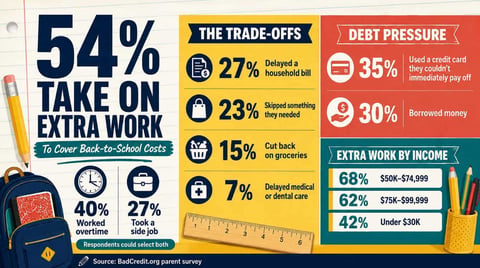
More than half (54%) of surveyed parents say they have either worked overtime or taken on a side hustle to pay for their kids’ school supplies this year. Among those who worked more to make extra income:
- 40% worked overtime
- 27% took on a side job
Since respondents could select both options, the combined result was 54%.
“It’s impressive that so many parents are covering their kids’ upcoming school expenses with extra work or staying longer at their current job,” says Erica Sandberg, consumer finance expert at BadCredit.org. “Although this strategy takes time and effort, the benefit is that additional income won’t result in debt. That’s really empowering.”
Yet, additional work isn’t the only strategy parents have used to pay for their back-to-school shopping. Some parents are managing the pressure by cutting back or skipping bills—49% of parents selected at least one serious household tradeoff.
Here are the specific consequences parents reported:
- 27% delayed another household bill
- 23% skipped paying for something they needed
- 15% cut back on groceries
- 7% delayed medical or dental care
“Rearranging bills can make sense, but it’s important for parents not to put themselves in a worse position, ” says Sandberg. “Putting your health at risk or skimping on nutritious food for a nicer backpack doesn’t make sense. And if you have to delay a payment, make sure there isn’t a late fee or other repercussions first.”
The back-to-school season is fueling an affordability crisis among parents. And debt is increasingly becoming a burden for many, with 35% saying they used a credit card they could not immediately pay off to buy school supplies. Another 30% said they borrowed money to cover costs related to the new school year.
Our survey also found income-based variations among those who decided to take on extra work to cover the costs. Additional work was the most common among middle-class families:
- $50,000–$74,999: 68%
- $75,000–$99,999: 62%
- Under $30,000: 42%
The financial pressure of the new school season has extended well into middle-class households. While lower-income families reported less work, differences in access to overtime, childcare, and credit may explain the gap between middle-income and lower-income parents.
74% Say Having Everything on Day One Matters Even When It Doesn’t Fit the Budget
For many families, the pressure to help children fit in is outweighing concerns about cost. Nearly three-quarters (74%) of parents say it is important for their children to have everything other children have on the first day of school, even when those purchases do not fit the family budget.
Parents want their children to feel seen and fit in while in school. And those emotionally motivated concerns are driving their financial decisions. When asked which concern weighed most heavily, parents said:
- 55%: Their child feeling left out because of what they lack
- 29%: Taking on debt
- 16%: Their child being upset with them
The results suggest that parents are primarily motivated by protecting their children from feeling excluded. But meeting those social and emotional expectations can require serious financial tradeoffs, including spending beyond their budgets.
Clothing is Creating the Greatest Price Pressure
When asked which back-to-school expense has increased the most since last year, here is how parents answered:
- Clothing: 45%
- School supplies: 23%
- Technology: 12%
- Sports/extracurriculars: 9%
- Lunches/food: 6%
- Transportation: 3%
- Childcare: 2%
Clothing was the overwhelming top response among respondents, selected nearly twice as often as school supplies, suggesting that it causes the most price pressure.
“All of these expenses do add up, but there are ways to reduce the costs without sacrificing the way kids feel when they get to school,” says Sandberg. “Even one special item of clothing, like a nice jacket or name-brand sneakers, can go a long way when interspersed with low-priced basics.”
“If your credit card has a partnership with retailers, you may be able to buy a gift card for those stores at a deep discount, such as a $100 value for $75. Pair it with store sales and coupons to stretch your dollar to the maximum.”
71% Hide Back-to-School Financial Stress From Their Children
More than 7 in 10 parents say they have tried to hide their financial stress from their children, highlighting the emotional burden many parents carry during the season.

Among those parents, the most common ways of concealing that stress included:
- Postponing the purchase: 47% suggested waiting until later to buy something.
- Blaming availability: 40% said an item was unavailable rather than admitting they could not afford it.
- Quietly substituting: 40% chose a cheaper version without explaining why.
- Sacrificing something themselves: 31% skipped something for themselves.
- Using credit: 31% used a credit card so their child would not go without.
- Working more: 19% worked extra hours to prevent their child from realizing the family was under financial pressure.
The effort to shield children was also associated with more difficult financial tradeoffs. Among parents who hid their stress, 53% delayed bills or sacrificed household necessities, compared with 39% of those who did not hide it — a 14-percentage-point difference.
The findings reveal a largely unseen side of back-to-school spending. While parents try to make the season feel normal for their children, some are quietly postponing bills, using credit, working additional hours, or going without themselves.
For many families, the cost of preparing children for school extends beyond the checkout line. It also includes the pressure of protecting them from the financial strain happening at home.
Sandberg urges parents to go easy on themselves and to talk to kids about money in positive ways. “Honor your financial parameters. Not only will you be happier when you don’t overspend, but your children won’t see you stressed out when higher-than-desired bills come due.”
While students may arrive at school with all they need, behind all the backpacks, supplies, and clothing could be a parent skipping bills, working extra hours, or making personal sacrifices to make it all happen.
Methodology
BadCredit.org surveyed 1,013 U.S. parents of children between ages 6 and 18 from July 28 through August 2, 2026, about the financial impact of back-to-school shopping. Results are based on raw, unweighted responses. Percentages may not total 100% due to rounding, and multi-select questions may total more than 100%.
The margin of error for the full sample is approximately ±3.1 percentage points at the 95% confidence level. For the subgroup of 718 parents who hid financial stress from their children, it is approximately ±3.7 percentage points.


