



Pay by Bank Could Open New Doors for Subprime Consumers — If Trust Issues Are Solved


Writer: Eric Bank


Editor: Lillian Guevara-Castro


Reviewer: Adam West

Key Takeaways
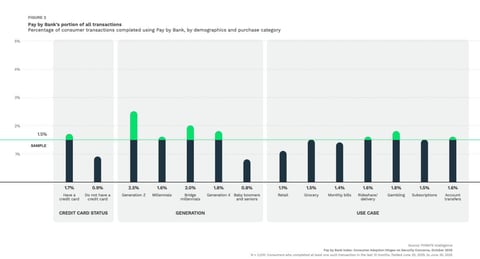
Consumer worries are holding back Pay by Bank, a merchant payment method that doesn’t involve cards or apps. Pay by Bank is fast, cheap, and encrypted. Nonetheless, only 1.5% of all consumer transactions currently use this method, according to a PYMNTS report. In a $5.4 trillion market, that’s peanuts.
Consumer worries appear to be the culprit. Almost half of those who don’t use Pay by Bank worry about entering personal information online. For them, a credit or debit card is way more secure.
In fact, Pay by Bank uses multifactor authentication and hides details from merchants. So ignorance is holding back growth. That’s too bad, especially for debit card users, since they would get the biggest benefit.
Intriguingly, about 60% of surveyed consumers would use Pay by Bank if it came with buyer protections and rewards. The groups showing the most willingness were digital wallet users (72%) and debit card users (61%). That’s not surprising, as these good people are already online savvy.
The percentage of potential users among younger, high-income consumers was 89%, with only 11% saying they would never consider it.
Debit cards are used for $1.6 trillion (30% of $5.4 trillion) of U.S. retail spending each year, according to Federal Reserve and National Retail Federation data cited by PYMNTS. A small move to Pay by Bank could swell sales volume by billions for merchants and fintechs.
Incentives and Buyer Protections Could Tip the Scales
We may be at a tipping point. The reason is that merchants would save money by bypassing the major card networks (Visa, Mastercard, and American Express). Avoiding the networks cuts out the interchange fees.

Think of how the savings could help merchants hand out financial incentives to customers. For example, Pay by Bank could pick up many millions of new transactions if merchants offered customers a 1% discount — and buyer protections — to pay this way.
The numbers tell the story. About 21% pay their monthly bills with Pay by Bank, and 19% transfer money this way. Another 1.6% use it for rideshares and deliveries. But with the right incentives, utilization could surge by double digits. All it would take would be some minor perks.
The biggest winners would be subprime consumers. Pay by Bank is a direct draw on checking accounts. That takes credit checks and interest charges out of the picture. Fintechs might offer instant bank-to-bank transfers safely and cheaply, and consumers could grow to like the speed and transparency.
Lenders who offer the simplicity of Pay by Bank might reduce delinquencies. Subprime consumers get to avoid credit limits or approval requirements. They could join the digital payment revolution at little cost.
Education and Trust Are the Keys to Growth
An educated public could spur the adoption of Pay by Bank. Right now, a mere 12% of debit card users consider Pay by Bank a suitable substitute. Education could weaken those old habits. Generation Z uses Pay by Bank for 2.5% of their transactions, while baby boomers and seniors use it for only 0.8%.
Most consumers don’t know that the digital connections between banks and merchants are secure with Pay by Bank APIs. They don’t have to divulge login details to others.
Additionally, consumers would be doubtlessly pleased to learn of the hidden fees they would avoid. When consumers understand the convenience and safety of Pay by Bank, they might be more willing to leave their cards in their wallets.
Fintechs have a clear opportunity to open Pay by Bank to millions of new users. To succeed, they must demonstrate that Pay by Bank is simple, safe, and rewarding.


