



Opinion: Tariffs Are Coming — Subprime Lenders Must Act or Watch Borrowers Collapse


Writer: Erica Sandberg


Editor: Lillian Guevara-Castro


Reviewer: Adam West

Tariff-driven inflation isn’t just an economic inconvenience — it’s a ticking time bomb for the subprime lending industry.
By saddling low-income families with higher prices on necessities, these policies all but guarantee a surge in missed payments and defaults. Lenders who ignore the warning signs risk being blindsided by a wave of borrower distress.
Higher taxes on imported goods are indeed on the horizon. President Donald Trump has enacted steep tariffs across the board that range from 10% to as high as 50% for several global trade partners.
A 2025 report from the Federal Reserve Bank of San Francisco warns that tariffs are expected to drive up prices on goods and services, increasing overall consumer spending.
When income growth fails to keep pace with inflation, household budgets are strained. This is particularly true — and tough — for financially struggling consumers.
Something has to give. Faced with the choice between buying groceries or paying off debt, many low-income consumers will choose the former.
Any lender serving a financially vulnerable customer base should begin preparing both to mitigate borrower distress and to offset potential charge-offs.
Will Tariff-Driven Inflation Spell Doom for Subprime Lenders?
That may be an exaggeration, but rising inflation certainly doesn’t bode well for indebted consumers.

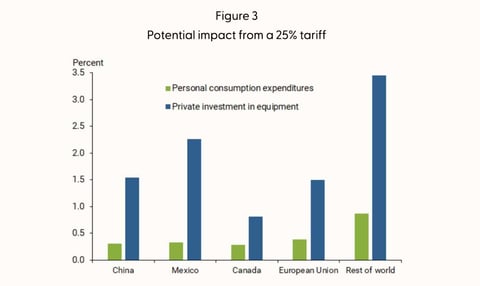
Increased costs could push low-income borrowers with weak credit over the financial edge. These borrowers typically lack sufficient financial buffers and rely more heavily on credit to meet basic needs.
Even a modest increase in expenses can trigger a cascading effect, starting with missed payments, then accumulating fees, followed by growing debt. Eventually, affected borrowers may be unable or unwilling to pay at all.
Encourage Savings
According to the Federal Reserve’s Economic Well-Being of U.S. Households in 2024 to May 2025 report, only 24% of families earning $25,000 or less had emergency savings to cover three months of expenses. Just 40% of families earning between $25,000 and $49,999 reported the same.
This means even minor unexpected costs can result in major hardship for a tremendous number of people. Without a financial cushion, these consumers are highly exposed when prices climb.
Subprime lenders can encourage savings among low-income borrowers by promoting or offering:
- Safe credit products like credit-builder loans and secured credit cards
- Gamified savings challenges
- Automatic savings deposit features
Modify Credit Lines
Under the Fair Credit Reporting Act, lenders may reduce credit limits for a range of reasons, including economic downturns. Lowering lines and loan amounts can help minimize losses and discourage borrowers from overextending themselves when repayment capacity is uncertain.
Conversely, increasing credit lines for subprime borrowers who exhibit responsible financial behavior may be beneficial. Doing so can lower their credit utilization rate, improve their credit score, and provide a buffer for true emergencies.
Intervene Early
As detailed in an August 2025 BadCredit.org report, nonprime and thin-file borrowers are more likely to carry balances month to month, with delinquency rates highest among younger and lower-scoring consumers. These borrowers pose elevated risks to subprime lenders.
Proactive outreach before borrowers fall behind due to inflationary pressures is prudent. Lenders can offer guidance on budgeting and responsible credit use during inflationary events. For borrowers who are up to date on their payments but financially strained, offering an interest rate reduction can provide meaningful relief.
Offset Inflation with Rewards
Credit card rewards — whether cash back, points, or miles — can help offset inflation-related cost increases tied to tariffs.
A recent Electronic Payments Coalition study found many cardholders save their rewards to supplement holiday or back-to-school spending, with rewards covering between 23% and 32% of planned purchases.
For borrowers who pay off their balances before incurring interest, these rewards can ease the burden of rising prices. The study also found rewards have a disproportionately greater financial impact on low- to middle-income cardholders than on higher earners.
Subprime Lenders Can Support Borrowers and Reduce Losses
It’s unclear exactly how severely low-income, credit-challenged consumers will be affected by rising prices, or how far those prices will climb. What is clear is that diminished purchasing power combined with high debt loads will add considerable stress. For many, trying to keep up will become unsustainable.
There’s no need for alarmism about tariffs. They’re here and will likely exert some influence on prices. Increases are expected across a broad spectrum of goods and services, from essentials like food, clothing, transportation, and electronics to more discretionary purchases like travel and dining out.
But subprime lenders can take meaningful action now to limit delinquencies and defaults by helping borrowers navigate the financial impact of inflation.

