



Opinion: Student Loan Crackdown Spells Disaster for Subprime Lenders


Writer: Bobbi Rebell


Editor: Lillian Guevara-Castro


Reviewer: Adam West

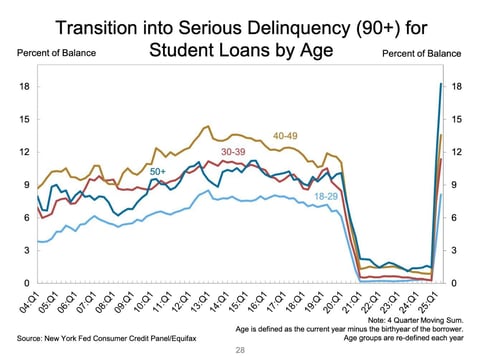
Trouble is lurking for subprime lenders in a place many are probably not even looking: the student loan market. The government is amping up its efforts to get its money back at a time when 1 in 5 older student loan borrowers are already seriously delinquent.
Specifically 18% of student loan borrowers over age 50 are more than 90 days late on their payments, according to the Federal Reserve Bank of New York in its most recent quarterly report. That is close to double what it was just six years ago. It is also significantly higher than among younger generations.
During and after the pandemic, several student loan programs either delayed payments or dangled the promise of forgiveness. That allowed holders of student debt to essentially back-burner payment on these loans and focus their finances on other priorities.
Many loans were taken out by parents for their children’s education. Those loans tend to have fewer guardrails in place to prevent borrowing too much. Now that borrowers are being pushed to resume paying their student loans, a domino effect is starting to kick in.
Getting in Line Behind Uncle Sam
Federal collections can take many forms, including garnishing earnings from paychecks, withholding tax refunds and, yes, even garnishing supposedly sacred Social Security payments.

Older borrowers will have to make peace with the fact that those loans will be paid back and make their plans to pay other debt based on whatever is left afterward.
This may require making some choices at a life stage that is often financially precarious to begin with for many older borrowers. And that’s where it gets really ugly for the subprime market.
Given the choice between paying for food and housing, or paying down debt, many senior borrowers will choose the former. Unsecured debt will be more vulnerable, and the risks could potentially skyrocket.
Offering Borrowers Solutions Before the Problems Escalate
The warning signs are already present even if the emergency lights are not yet flashing. The solutions aren’t ideal, but certain strategies give the subprime industry a better shot at keeping borrowers current.
Ignoring the problem and hoping borrowers find a way to step up their game is likely to be a losing bet, so it makes sense to be proactive.
One thing subprime lenders may want to consider is elevating the conversation with borrowers who may be at risk. For example, lenders can offer modified payment plans along with hardship programs.
Borrowers may welcome, for example, tiered repayment schedules that build up gradually so they can front-load paying down the student debt while still staying current on their other debt repayment.
Strong monitoring of older borrowers may reveal problems they are hesitant to bring up. By offering to involve a financial counselor before a borrower misses payments, subprime lenders may help prevent defaults and create goodwill, as well as strengthen reputational management.
Seeing Things Differently, and for the Better
A reframing of data, and integrating AI, will also be a smart strategy for lenders. For example, it makes sense to incorporate federal student loan repayment status into underwriting criteria. Subprime lenders can also use alternative data to balance that out.
By including other data points, such as borrower income history, their savings and investing patterns and other data points, lenders may get a more accurate sense of how well subprime borrowers can balance the new expectations on student loan repayments.
By the same token, lenders should diversify as much as possible to avoid a concentration of older borrowers who may be facing these new challenges.
Lenders may not be able to turn the horror story into a dream sequence, but by focusing on empathy and managed risk they can better control the narrative and even be the heroes for their clients.


