



The Next Subprime Shock Isn’t Coming from the Poor — It’s Coming from the Middle Class


Writer: Erica Sandberg


Editor: Lillian Guevara-Castro


Reviewer: Adam West

It’s happening. An esteemed researcher at a well-known hospital, a product designer for a large tech firm, and a professor at a private college are all bracing for looming layoffs. I know each of them personally. Until recently, these professionals had little reason to worry about their economic futures. Now they do.
On the other end of the spectrum is my daughter, a recent UC Davis graduate who is struggling to secure any job, from restaurant work to anything even remotely in her field of interest.
Her natural optimism is starting to wane as an increasing number of applicants are fighting for the same jobs. That used car she wanted to finance will need to wait.
These people are smart, hardworking, and responsible. They go to banks and other lenders when they want to improve their lives by applying for loans for cars, homes, and businesses.
They take out and use credit cards to conveniently make purchases they know they can pay back. They represent the stable middle-class borrowers who have historically been your most reliable customers.
Unemployment Data Points to Current and Future Troubles
As a lender, you know that credit history and scores are only part of the qualification picture. Income matters. Yet the employment landscape has changed.
Through July 2025, the United States recorded 806,383 layoffs, representing a 75% increase compared to the same period in 2024. Most alarmingly, layoffs in 2025 are already 6% higher than in all of 2024.

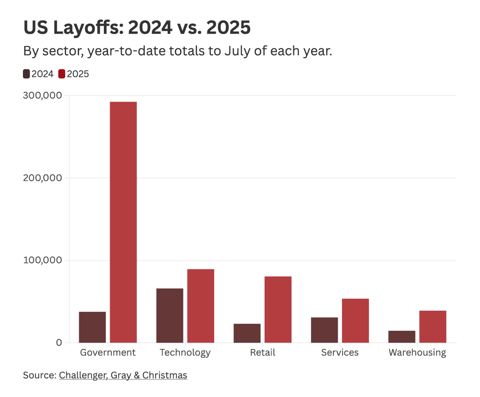
People in the technology world are among those most at risk. The unemployment rate for these workers jumped from 98,000 in December 2024 to 152,000 in January 2025 alone.
At least some of the rising unemployment rate can be blamed on the emergence and acceleration of artificial intelligence. Recent research indicates that nearly 50 million U.S. jobs are at risk from AI-driven automation, with entry-level positions especially vulnerable.
Since 2022, early-career workers have experienced a 13% drop in employment compared to their more experienced counterparts in sectors less impacted by AI advances.
When Once Reliable Borrowers Face Financial Insecurity
There is a world of difference between wealthy individuals who strategically leverage loans and low-income borrowers who may fall behind on bills because they don’t earn enough.
Once-stable professionals, whether just starting out or employed for many years, tend to be reliable borrowers. As their jobs are eliminated and prospects limited, they’re facing financial insecurity. That not only affects them and their families, but lenders working with this demographic.
Where once these consumers could be counted on to use credit products robustly and effectively, now they may either avoid borrowing or over-borrow. Neither scenario benefits a lender’s portfolio.
The credit data already reflects early warning signs. Serious credit card delinquency rates of 90 or more days past due are expected to increase for the fifth consecutive year in 2025 to 2.76%.
Consumer credit quality is deteriorating across most credit categories, with average credit card balances rising to $6,500 in August 2025, up $96 year over year. Credit utilization rates have climbed to 30.77%, suggesting increased consumer reliance on revolving credit amid persistent economic uncertainty.
Balancing Continued Business Against Increased Risk
The challenge for lenders is how to continue to work with people whose jobs are in flux, but who have been excellent customers before. They’re not your typical subprime segment.
These borrowers understand the credit process and have historically used loans and credit cards effectively. To make ends meet with less money coming in, they may have to downsize to avoid getting into excess debt, but their aim is to remain responsible. They’re your bread and butter, and they’re in trouble.
Traditional risk assessment models may no longer capture the full picture. Employment history, a cornerstone of creditworthiness, is becoming less predictive when industry-wide disruptions can eliminate entire job categories within months.
A borrower with a pristine payment history and a decade of stable employment could suddenly represent heightened risk through no fault of their own.
A Message to Lenders
You don’t want to lose these borrowers. To help, you may consider implementing dynamic credit line management that responds to early warning indicators rather than waiting for missed payments.
When a borrower in a high-risk industry requests a credit line increase, you might approve it with enhanced monitoring rather than a blanket approval or denial.
Conversely, for borrowers showing signs of financial stress, such as multiple balance transfers, cash advances, or sudden changes in spending patterns, proactive credit line reductions can protect both parties.
Communication matters more than ever. One of the most striking issues is that people in this demographic are not accustomed to dealing with financial problems. They understand credit, but they may not know how to navigate a sudden loss of income.
It can be extremely tough for them to wonder how they’re going to pay their bills, and humiliating to turn to credit to meet household expenses.
Offering temporary payment modifications or hardship programs before delinquency occurs can preserve the relationship and improve outcomes. Many of these professionals who understand credit and are typically good with money management will bounce back. It would be good to be ready for them.


