

Writer: Lucy Lazarony


Editor: Lillian Guevara-Castro

Key Takeaways
Chapter 12 farm bankruptcies reached 315 filings in 2025, an increase of 46% from 2024, according to the American Farm Bureau.
Farming debt is also on the rise. Farm sector debt is expected to increase 5.2% to reach $624.7 billion in 2026, according to the U.S. Department of Agriculture Economic Research Service.
Rising fertilizer prices and fuel prices also are contributing to tighter financial margins for farmers.
Bankruptcy Not An Option for Some Farms
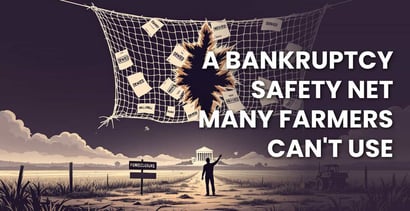
But bankruptcy isn’t an option for every struggling farming family. To qualify for Chapter 12 bankruptcy, families must earn the majority of their income from farming.
As income outside the farm becomes more important, many family farms are not eligible for Chapter 12 bankruptcy and may need to close altogether when debt and the farm’s operating expenses become too much for a family to manage.
The Reasons Behind the Rise in Chap. 12 Bankruptcies
“Most farmers have experienced low yields year after year especially in commodity and specialty crop sectors due to weather-related losses and crop loss challenges,” Jillian Hishaw, a bankruptcy attorney with a legal masters in agricultural law, told us.
She said because of the cost of tariffs, more farmers are forced to take out more loans. Many farmers that borrow have difficulty managing the debt when they take out loans for their farms.
“The problem is in order to keep going as a farmer you often operate in the red. The reality is farming is a debt business, no matter the crop loss you constantly need capital to plant spring and fall crops,” Hishaw told us.
“Due to low yields, decreased market prices of commodities and the constant acceleration of input costs farmers have no choice but to file bankruptcy.”
Which States See the Most Chap. 12 Farm Bankruptcies?
Farmers in the Midwest and Southeast led Chapter 12 bankruptcies in 2025 with 121 in the Midwest and 105 in the Southeast. Arkansas had 33 Chapter 12 bankruptcies, the most in any state.
“Arkansas had the highest filings due to the failing commodities market, particularly the rice sector. Arkansas is a unique state because a large portion of the state revenue is derived from agriculture,” Hishaw told us.
She pointed out that Arkansas was among the top three states for poultry farming and the number one state for rice production. Farmers in the state also have access to legal advice and agricultural lawyers through the National Agricultural Law Center in Fayetteville.
The Bottom Line
Chapter 12 farm bankruptcies are on the rise, reaching 315 bankruptcy filings in 2025. This is a 46% increase from 2024. Low crop yields, weather-related losses, crop losses and tariffs are all reasons why some farmers wind up filing for bankruptcy. Rising fuel and fertilizer prices are other factors making farming more expensive.
But not all farmers are able to file for Chapter 12 bankruptcy. To be eligible for a Chapter 12 bankruptcy a majority of a farmer’s income must come from farming.
Farmers with too much outside income do not have the option of bankruptcy. And they may need to close the farm if debt and the farm’s expenses become too much to handle.
