



Auto Refinancing Surges 70% as Households Struggle With Sky-High Car Payments


Writer: Eric Bank


Editor: Lillian Guevara-Castro


Reviewer: Adam West

Key Takeaways
- Experian's Q2 2025 Automotive Finance Market Report reveals that car refinancing leapt almost 70%, bringing affordability concerns to the forefront.
- Longer-term loans and high monthly payments are driving some borrowers to refinance, not just for lower rates but for reduced monthly obligations.
- Subprime lending patterns show increased risk, with stretched loan terms and affordability stress redefining lender practices.
Auto refinancing is surging. Experian’s Q2 2025 State of the Automotive Finance Market Report pointed to a nearly 70% jump in refi activity over last year. At first glance, that may look like households moving quickly to capture cheaper interest rates.
But the backdrop suggests something more pressing: Rising costs are pushing people to refinance as a way to keep monthly budgets intact.
Car payments topping $1,000 a month are no longer unusual. Seven-year contracts have become a mainstream option, as earlier reporting has shown. Against that reality, the refi surge seems driven less by rate-shopping and more by stretching repayment terms to ease today’s cash flow.
That subtle shift matters. Lenders are now dealing with customers who may be refinancing out of necessity, not strategy.
The Affordability Squeeze
Experian’s data highlights just how challenging affordability has become. Average payments remain close to record levels with growing numbers of loans extending beyond 72 months.
Though a longer repayment period keeps monthly payments low, it raises overall interest and locks borrowers into negative equity for many years. It’s a risk profile that lenders cannot ignore.

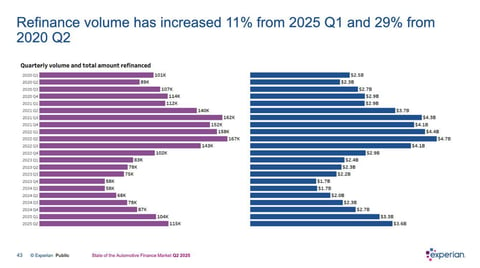
For many families, refinancing isn’t about getting the best deal — it’s about staying afloat. With student loan payments, groceries, and rent all rising, rolling a car loan into a longer repayment schedule can feel like the only viable option.
Concerns are mounting that longer loan terms may not be sustainable, with delinquency rates likely to climb in the quarters ahead.
Subprime Strain
The stress is more severe in subprime where borrowers are more likely to have longer-duration loans. Banks face a balancing act: chasing new refinancing volume while risking higher defaults from financially strained households.
Delinquencies remain a key concern — especially among subprime borrowers, where longer repayment terms only heighten the risk.
Experian data also reveals subprime originations claim a predictable market share, affirming how affordability stress is focused in that group. Throw in inflation and cost of living adjustments, and refinancing shifts from voluntary to mandatory.
Subprime auto loans often end up bundled into asset-backed securities, meaning repayment troubles can quickly spill into investor confidence.
Longer loan terms that mask borrower distress risk dragging down securitization performance. Regulators are watching closely as well; if extended terms and aggressive refinancing start to look like a cover for deeper structural problems, scrutiny is likely to intensify.
Opportunities and Risks for Lenders
The sharp spike in refinancing holds out both opportunity and threat. Refi products that reduce monthly payments can be used to bring in new customers for banks and credit unions. Screening remains important. Competitive positioning enters the picture, too.
Lenders that fine-tune deals to alleviate short-term pressure while holding off on risky overextensions can gain a firmer foothold. Going after volume with a lack of discipline, however, can expose portfolios to still further economic cooling.
Looking Ahead
Experian’s latest report shows auto finance at a crossroads. Refinancing growth tells two stories at once: opportunity for new business and evidence of stress building in household budgets. For lenders, drilling into that 70% surge and distinguishing its drivers will shape results in the year ahead.
With high payments and longer contracts set as the new normal, lenders face a test of resilience that could define the auto finance market well beyond this quarter.


