



Q&A: What is the Difference Between a Charge-Off and a Collection on Your Credit Report?


Writer: John Ulzheimer


Editor: Jon McDonald


Reviewer: Ashley Fricker

Key Takeaways
Charge-offs and collections are both bad for your finances, but they aren’t the same thing. When banks or lenders designate your account as charged-off, they determine that you likely won’t pay, so they take that as a loss on their books.
A collection is an attempt to recover the debt. Sometimes, banks or lenders hire a third-party debt collector to pursue the debt. Other times, they may sell it to a debt buyer that will try to collect it from you.

One thing they have in common is that they both can remain on your credit report for seven years, which will have a devastating impact on your credit score.
Editor’s Note: This answer is from an in-depth video Q&A with John Ulzheimer, one of the leading experts on credit reporting and identity theft. He has more than 33 years of experience in the industry, working for giants like Equifax and FICO, and he brings a unique insider perspective that few others have. You can see the full conversation on our YouTube page.
Why Charge-Offs and Collections
Are Different … But Both Bad
“So there are similarities, and there are differences between a charge-off and a collection. First off, you don’t want either of them on your credit report because neither of them is good, right?
If you had to identify a collection of negative things, then both charge-offs and collections would be part of that list of negative information. There are a lot of other things, but certainly charge-offs and collections are going to be in that bucket of bad things.
So, a charge-off is, for those of you who are accountants, you probably know what a charge-off is because a charge-off is an accounting designation. The longer formal term is ‘charged off to profit and loss.’

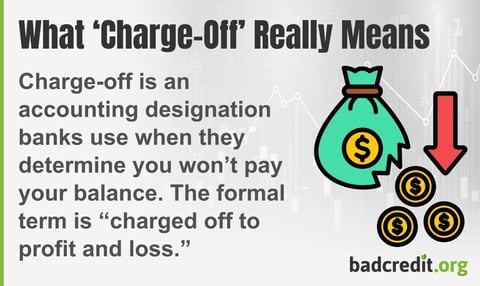
And so, essentially, what it means is that the creditor has concluded that they’re not going to be paid for the obligation, and they are going to take it as a loss; they’re going to write it off on their books as a loss.
The credit reporting industry has long referred to that as simply a charge-off … It’s essentially a message from the creditor to the credit bureaus indicating … we feel that this consumer is unlikely to pay this obligation, so we have charged off the debt on our books essentially as an accounting designation.
A collection is something very different. Normally, when people think of collections, they think of collection agencies, and rightfully so. Because … when they do credit report information, they are reporting collection accounts, or collection segments, as they’re called in my role.
So, a collection is an account on a credit report that has either been consigned by a creditor or, perhaps, the debt collector has purchased that defaulted debt from, for example, a medical service provider or a credit card issuer, and now they’re reporting it as being a collection on the credit report.

A collection indicates that the account has gone into default, and now the creditor is taking escalated steps to attempt to recover their money.
And rather than say, the doctor’s office calling you or the apartment complex calling you, eventually, the credit card issuer is gonna give up calling you, they’re just going to outsource that to a professional that actually is tasked with collecting defaulted debts. And that is the collection agency. And so the collection agency reports collection accounts.
Those are the differences structurally between a charge-off and a collection.
Where they are similar, number one, is that they can both remain on a credit report for seven years. And number two, they’re both considered major derogatory or severe derogatory events in credit scoring systems because they both indicate gross mismanagement of some sort of an obligation, whether it be a credit card account, an auto loan, a medical bill, or an apartment lease, for example.
Certainly, it’s unusual that you have a collection without some sort of a preceding default event, default on an apartment lease, default on a medical obligation, or default on a credit card account.
And then it leads to, assuming that the consumer just flat out refuses to pay the bill, that’s generally when it leads to either the consignment of the debt or the assignment of the debt to a third-party debt collector, where the original creditor still owns the debt.
They’re just basically saying, ‘Hey, look, collection agency, I’ll give you 30% or 40% of whatever you can collect, and that’s my fee that I’m gonna pay you.’
| How Long Negative Items Stay on Your Credit Reports | |
|---|---|
| Item Type | Time on Credit Reports |
| Soft Credit Report Inquiry | No Report Impact |
| Hard Credit Report Inquiry | 2 Years |
| Delinquent Payment (30+ Days) | 7 Years |
| Vehicle Repossession | 7 Years |
| Defaulted Account | 7 Years |
| Collection Account | 7 Years |
| Foreclosure | 7 Years |
| Bankruptcy Discharge | 7-10 Years |
Or they may bundle all those debts together and sell them for 10 cents on the dollar to a debt buyer, and then the debt buyer partners with the collection agency to collect the debt because they’re now the new creditor.
So, it just indicates gross mismanagement of an account. Generally, it also indicates that the original creditor has charged off the debt because they feel like they’re not gonna get paid, and they’re going to wash their hands of it one way or the other.
They’re either going to assign it to a collection agency to try to collect it, or they’re just gonna sell the debt and move.
This should never ever be a surprise, right? Unless you’re just simply not answering your phone, not checking your mail, not checking your email, and ignoring all the notices of default.
Here’s what you can’t ignore, right? Some creditors will assign a debt to a collection attorney.
And the collection attorney, in some scenarios, will sue you. And then the knock at the door is not from somebody delivering something from Amazon Prime. It’s a service, a process server.

The process server is gonna hand you a subpoena or lawsuit paperwork and quote-unquote, ‘you’ve been served,’ letting you know that this creditor has sued you because you have ignored them to the point where you’ve left them no other option other than to sue you.
You can ignore that, but then you’re going to lose by default, and then you’re going to end up with a default judgment. That gives collectors different levels of power to essentially contact your employer and have them garnish your wages.
This is never, ever a surprise. And you should never, ever let it get to the point where people are knocking at your door and handing you legal-type paperwork because you have defaulted on a debt.
The creditor would much, much rather work with you way before it gets to that point than take that last step, which is to sue you. If you feel like you’re getting to that point, call the creditor and let them know.
And then they’re probably going to shut your credit card account. But at the very least, you’ve opened up a line of dialogue with them.
You can discuss things like different types of payment plans, maybe even a settlement-type scenario, and avoid all the nasty stuff that can happen down the road.”


