



18 Surprising Personal Finance Statistics


Writer: Andrea Woroch


Editor: Lillian Guevara-Castro


Reviewer: Jon McDonald

People don’t like talking about money, but the more open we are when it comes to our spending, savings, and debts, the more opportunities we gain to learn from each other, remedy our mistakes, and set ourselves up for a better future.
But if you aren’t ready yet to have these discussions with family or friends, we’ve got your back. Find out how your financial habits stack up to the rest of America and see what you can learn about money by diving into these personal finance statistics.
When you learn how others manage their money, you may even feel better about your own financial situation. Perhaps, you’ll even feel better enough to talk about it.
1. Most Americans (79%) Say There’s a Retirement Crisis
Retirement seems light years away when you’re young, and planning for it is the least of your concerns. But ignoring retirement planning when it seems to matter least can have a major negative impact later.
That’s part of the reason why so many Americans today feel so anxious about retirement. But external factors like inflation and political uncertainty are also significant, according to a 2024 study by the National Institute on Retirement Security.1

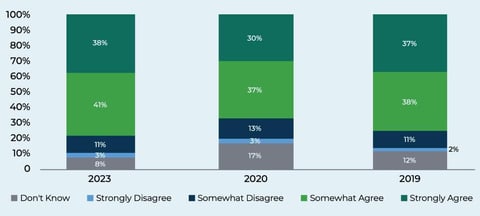
Planning under the pressure of rising day-to-day expenses leads many to deprioritize long-term savings in favor of meeting short-term contingencies, according to the study. The result is that 79% say there’s a retirement crisis in America, 73% say inflation has them feeling more concerned, and 55% worry they won’t save enough to feel secure after they retire.
What’s more, 87% agree that the politicians in Washington, D.C. don’t seem to understand the depth of the problem. That same near-unanimous percentage believes Congress and the president should act now to stabilize Social Security rather than risk damaging the program’s finances beyond repair.
2. Checking Account Fees Have Ticked Downward (After Rising for 10 Years)
With many Americans struggling with personal debt and some effectively living from paycheck to paycheck, bank fees are the last thing financial consumers want to spend their dollars on. But, unfortunately, as banks lose money, they try to make up for it by charging more for monthly maintenance, overdrafts, and ATM use, even if it hits their customers’ wallets harder.
Fortunately, consumers experienced a slight dip in overall checking account fees in the first half of 2025, according to the biannual MoneyRates Checking Account fee survey.2 But that slight bit of relief comes after 10 years of steady rises in bank fees.
The survey puts the average monthly checking account maintenance fee at $13.29, down 3.1% from the previous year. Furthermore, that average has risen only 5% in the past five years when adjusted for inflation.
But that downturn still translates to an annual cost of $167.40 to maintain a checking account, according to the survey. Overdraft fees, down 4% year over year, still amount to $30.82 per occurrence. And ATM fees, down 1.7%, average $4.55 per transaction.
Those fees add up, threatening spending and savings goals because of the pressure to make ends meet and prepare for an uncertain future.
| Fee | Amount | % Change YOY |
|---|---|---|
| Monthly maintenance | $13.95/mo | -3.10% |
| Overdraft | $30.82/occurrence | -4% |
| ATM | $4.55/transaction | -1.70% |
3. Fewer Women (23%) Report Doing Well Financially Compared to Men (34%)
American women are generally more frugal than men, yet they report experiencing greater financial strain, according to a 2024 research and data analysis by LendingTree in which only 23% of females described themselves as doing well financially compared to 34% of men.3
This disparity extends to saving habits, with 37% of women unable to save any money at all, compared to only 22% of men.
The survey indicates more women than men are actively reducing their spending. Men are more prone to enjoying shopping for themselves and more likely to go into debt to pay for nonessentials.
These findings indicate a persistent gender gap in financial well-being, where women’s cautious spending does not necessarily translate into greater feelings of financial security.
Should women learn to be a little more comfortable with irresponsible financial behaviors? We don’t think so, and the survey reflects that, showing that more men than women regret the big purchases they make (51% to 42%).
4. Only 20% of Gen Z Members Are Saving for Retirement
When it comes to planning for old age, the sooner you start saving, the more money you will have accumulated for retirement. However, members of Generation Z (born between 1996 and 2012) have not internalized that lesson in compounding interest.
Evidence comes from a 2024 research study from the TIAA Institute, which found only 20% of Gen Z members are putting money away for their golden years.4
Many say they don’t know where to start. Among the relatively small percentage who are actively considering life after work, 401(k)s are the preferred retirement vehicle. But at this point in their financial lives, almost two-thirds (65%) of Gen Zers say they primarily put the extra money they earn in savings.
Thanks to modern innovations like auto-enrollment, Gen Z is actually outpacing Gen X in retirement savings at this early stage of their careers, indicating evolving dynamics in generational retirement preparedness. But they still have a long way to go.
| Savings Vehicle | % Gen Z Participation |
|---|---|
| Savings account | 65% |
| Retirement account | 17% |
| Money market account | 10% |
| After-tax brokerage | 4% |
| Other | 4% |
5. Reviewing Credit Card Bills Is Stressful For More Than Half (51%) of Americans
Surveys often put concrete numbers behind commonsense notions. Such is the case with the third annual mental health and money survey by Debt.com, which connects stress with credit card bills in ways many will find familiar.5
Debt.com surveys 1,000 Americans each May in recognition of Mental Health Awareness Month, dedicated to raising public awareness and reducing stigma around mental health issues.
This year’s survey comes in the wake of President Donald Trump’s introduction of tariffs into the American economy. Whether they voted for Trump or not, two-thirds of Americans (66%) now say uncertainty over tariffs, inflation, and just the general political climate have negatively impacted their mental health.
And that makes using credit cards stressful. More than four in 10 (43%) report that just the simple act of using a card causes them stress. Ironically, another four in 10 (42%) say the stress of credit card use causes them to take them out again and spend more.
Increasing credit card stress isn’t entirely the president’s fault. In 2022, during the Biden administration, using a credit card led to stress in only 21% of Debt.com survey respondents. It’s been rising ever since.
6. Social Media Messaging Has Led Nearly Half (48%) of Americans to Make an Impulse Purchase
Many seemingly cannot resist the temptation to splurge on the latest shiny new object, even when spending on said object is decidedly not in their budget. But such impulse purchases come at a high cost, according to a survey from Bankrate.6
Unfortunately, our social media-saturated age is at least partly to blame. Nearly half (48%) of social media users in the survey reported they made an impulse purchase after seeing something on social media — behavior that led to an estimated $71 billion in impulse purchasing over the previous year.
Not surprisingly, younger consumers are more likely to fall prey, with 61% of Millennials (born between 1981 and 1996) and 60% of Generation Z members (born between 1996 and 2012) reporting social media spending.
Meanwhile, older folks are apparently wiser, with Gen Xers (1965-80) and Baby Boomers (1946-64) tempted into social media impulse purchases at rates of 42% and 34%, respectively.
Interestingly, however, as the table below shows, consumers seem to regret their impulse purchases at roughly the same rate.
| Generation | % of Impulse Purchasers | % Who Regret at Least One Impulse Purchase |
|---|---|---|
| Gen Z | 60% | 58% |
| Millennials | 61% | 55% |
| Gen X | 42% | 56% |
| Baby Boomers | 34% | 62% |
7. Almost All Gen Z Workers Consider Themselves Underpaid
Speaking of generational differences in the economy, a recent survey from Resume Templates measures the impressive ambitions members of Gen Z have when it comes to success against the unfortunate realities.7
The survey paints a materialistic picture, revealing Gen Zers with a “grass is greener” mentality. Almost nine in 10 (87%) reported feeling underpaid. A majority (60%) said they couldn’t meet their basic needs on their current salary, yet 20% reported spending at least $500 monthly on nonessentials.
Many (20%) felt they should be earning $100,000 or more given their current training and skills, and 19% reported they needed at least that much to truly make ends meet.
Time will tell whether Gen Z’s performance exceeds its aspiration.
8. U.S. Adults Spend an Average of $90 Per Month on Subscription Services
The set-it-and-forget-it subscription model is convenient, but it can be a budget drain if you aren’t paying attention to your bills. Unfortunately, many U.S. consumers may need to develop a closer idea of how much they shell out on subscription services like Netflix and Spotify.
As of 2025, the average American spends $1,080 a year (or $90 per month) on such services, according to CNET’s second annual subscription survey.8
Those numbers are down from the first annual survey. The problem is that consumers may not even realize it, with those who had purchased at least one subscription in the previous year reporting they spent an average of $17 a month — more than $200 per year — on services they didn’t use.
It just goes to show how easy it is to say yes to a purchase but how difficult it can sometimes be to ensure you’re getting your money’s worth.
Here’s a piece of sound advice: Run a sweep of your bank and credit card accounts to pinpoint recurring subscriptions. Then cancel those you don’t need — and find something productive to do with the extra cash.
9. Parents Willingly Go into Debt to Help (Or Please) Their Kids
Raising a family comes with higher living costs, but not everything parents purchase is a necessity. In classic selfless behavior, many parents happily extend themselves to give their children some of the extras they didn’t have growing up.
In fact, there’s apparently not much parents won’t do financially to encourage their children’s education and help them fit in with their peer group at school, according to NerdWallet’s 2024 Back-to-School Shopping Report.9


For example, more than half (53%) of the parents of school- and college-age children surveyed in the report said they were willing to incur debt to pay for their children’s school activities. And 42% said they’d do the same to pay for items with their child’s social success in mind.
The problem is that debt always requires a balancing act. “Going into debt for nonessentials can put your family in a financially precarious position, which can be stressful for everyone, kids included,” the study states.
We couldn’t agree more. It’s natural for parents to sacrifice financially to help their children succeed. But it’s counterproductive to harm your family’s future in the process.
10. Shoppers Racked Up $1,081 in 2024 Holiday Debt
Just as parents seemingly ache to grant material splendor upon their children, so too do American consumers strive to make each end-of-year holiday period more spectacular than the last.
In keeping with that goal, a LendingTree data analysis from 2024 reported that the 36% of American shoppers who incurred debt during the holidays racked up an average of $1,181, up from $1,028 in 2023.10 Sadly, only 44% of those who incurred extra holiday debt had expressly planned to do so.
It’s a matter of competing wants and needs, and certain groups have more needs than others compared to their available spending power.
For example, almost half (48%) of the parents of young children took on holiday debt. That’s probably to be expected, but what about Millennials, who were nearly as likely to take on holiday debt, at 42%?
Regardless of how they got themselves into their holiday debt situation, 60% reported feeling stress about it, and 21% said they expected to carry their debt (and pay interest on it) for five months or longer.
There’s no two ways about it: The holidays are a gift that keeps on giving.
11. Affordability Concerns Prevent 83% of Aspiring Yet Unsuccessful Buyers from Purchasing a Home
However distant, homeownership remains a goal for most as a cornerstone of the American Dream. But it’s not a done deal for many, with 83% of those aspiring to own a home but not yet sealing the deal ascribing their lack of success to affordability concerns, according to Bankrate’s 2025 Home Affordability Report.11


Why? Among many interlocking factors, non-homeowners identified insufficient income (59%), high prices (55%), and high down payment and closing costs (46%) as major barriers to getting a mortgage and building that white picket fence.
Meanwhile, in data from the related 2025 Down Payment Survey, 81% of prospective homebuyers said the expense of the down payment and closing costs stood in their way, with 52% claiming the burden was very significant. One in five believe they’ll never save enough for a down payment.
12. Financial Woes at Home Impact Performance at Work
Unfortunately, personal financial challenges don’t just stay personal. Instead, they follow people into the workplace, significantly impacting productivity and overall job performance. For many, the stress of money worries can surpass stress from work, health, and family issues.
According to a 2025 report by PerkSpot, one in five employees (20%) admits their financial concerns hinder their job performance.12
This translates to substantial lost productivity, with nearly half (46%) of financially stressed employees spending at least three hours weekly dealing with personal finance issues on the clock, costing employers an estimated $3,922 per employee annually.
The study also found that financially strained workers are nine times more likely to experience workplace conflicts and twice as likely to seek new jobs. Perhaps most interesting about the study is the finding that stress even affects high-income earners.
13. More Than One-Third (42%) of Homeowners Regret Their Purchase Due to High Maintenance Costs
When you buy a home, you likely calculate the estimated mortgage cost and feel good about what you can afford. But many new homeowners overlook all the additional costs that go along with mortgage payments, including taxes, insurance, repairs, maintenance, utilities, and other expenses.
That takes a bit out of your budget if you don’t plan properly. The initial excitement of homeownership can sometimes give way to concerns about affordability.
That doesn’t mean your mortgage cost isn’t important. In fact, according to Bankrate’s 2025 Homeowner Regrets Survey, almost one in five (16%) of homeowners expressed regret over their home purchase specifically because their mortgage payment turned out to be too high.13
This suggests that a segment of the homeowner population is experiencing considerable financial pressure from housing costs. But the report also highlights that 42% of homeowners with regrets found maintenance and other hidden costs more expensive than anticipated, adding to the financial strain.
That being said, 70% of homeowners in the survey said they’d buy their current home again if they had the chance. Home is where the heart is.
| Homeowner Regret | % |
|---|---|
| High maintenance and other costs | 42% |
| House is too small | 21% |
| Mortgage payment is too high | 16% |
| Price was too high | 15% |
| Bad location | 14% |
| Other | 12% |
| House is too large | 11% |
| Mortgage rate is poor | 10% |
| Investment potential is poor | 6% |
14. The Average Household Spends About $300,000 to Raise a Child
It’s no surprise that raising kids in America isn’t cheap. But learning just how much parents dish out on their children can be mind-blowing. In fact, above and beyond everyday expenses, parents now spend an average of $297,674 extra to raise a child over the course of 18 years, according to a 2025 study reported in LendingTree.14
Astoundingly, that nearly $300K figure is up 25.3% since LendingTree produced its last analysis of child-rearing costs in 2023. Not surprisingly, it puts a lot of pressure on parents.
For example, the annual costs for raising a small child have surged to $29,419, representing a 35.7% jump from $21,681 in the 2023 findings. A major driver of this increase is daycare, which soared by 51.8%, while food costs rose by nearly 30%.
On average, families now dedicate 22.6% of their income to basic child-rearing expenses, up from 19.0% just two years prior, illustrating the growing financial burden on parents. It’s enough to make your head spin.
15. Half of American Couples (45%) Argue About Money
Therefore, it should mesh with the expectation that disagreements over money are common among couples building households and raising kids. Indeed, financial disagreements are a potent predictor of divorce, according to Fidelity’s 2024 Couples and Money study.15
It’s a serious problem. The study highlights a substantial 25% of couples who identify money as their greatest relationship challenge. And nearly half (45%) of partners admit they argue about money at least occasionally.
Interestingly, however, all this fighting may turn out to be productive for many. Nine in 10 surveyed couples said they have good communication in their relationship.
Although a significant 50% of couples report having different spending behaviors, 79% generally agree on the big financial issues. Couples are giving it all they’ve got, but financial friction underscores how deeply money matters can impact marital harmony and well-being.
Good luck, everyone!
| Top Money Concerns for Couples | % |
|---|---|
| Retirement | 54% |
| Health care | 51% |
| Income | 47% |
| Savings | 42% |
16. One-Third (34%) of Americans Live Paycheck to Paycheck
No matter how you slice and dice it, there’s a growing reality of living paycheck to paycheck in America. In fact, 34% of Americans now live day to day without a significant nest egg, according to survey data from Bankrate.16
It’s a problem that impacts people of all income levels. Sure, 43% of those earning under $50,000 annually report living paycheck to paycheck. But so do 24% of those earning $100,000 or more.
The concern extends to emergency savings, with nearly 6 in 10 Americans (59%) reporting they feel uncomfortable with their current levels. Generationally, Gen X leads at 40%, while Gen Z and Boomers are both at 28%.
Women are also more likely than men to face this challenge (36% versus 32%). The average American believes they need to earn over $186,000 annually to live comfortably, highlighting a significant disconnect between aspiration and reality for many.
17. Over Half (51%) of Americans Have Financial FOMO
A significant portion of Americans are making financial decisions driven by FOMO — the “fear of missing out” on opportunities or experiences. According to new research from Empower, over half of Americans (51%) have made a purchase or investment due to financial FOMO.17
This trend strongly impacts spending, with consumers most likely to spend on dining out and travel due to FOMO (21% and 18%, respectively). Well, more than half (57%) of people have made a financial decision after seeing others’ lifestyles online, and 73% have been inspired to spend, invest, or adjust their saving habits due to FOMO.
Financial FOMO is particularly pronounced among younger generations. Nearly 70% of Gen Z sense it on social media, compared to 57% of Millennials and Gen Xers and 28% of Baby Boomers.
Before you lose all hope, please know that FOMO can also be a positive motivator, with 18% of Americans feeling inspired to succeed financially by watching others win online.
18. Overall Happiness Increases With Income
In these days of wealth and acquisition, the adage that money can’t buy happiness may not hit the mark anymore, according to 2024 research by Matthew Killingsworth of the Wharton School.18 Instead, Killingsworth suggests that happiness continues to increase with income, even well beyond $500,000 annually.
What’s at play here is a striking “happiness gap” across income levels. Wealthy individuals are significantly happier than high earners in the ordinary income group. While low-income participants averaged just above a four on a seven-point life satisfaction scale, the wealthiest scored closer to six.


What’s more, the happiness jump for the wealthy compared to middle-income earners is nearly three times as large as the difference between middle- and low-income groups. You do the math: Where would you want to be?
In Conclusion
There’s no two ways about the fact that money infiltrates every aspect of personal life. From school age to retirement and beyond, money decisions play a pivotal role in how things unfold for people.
No pressure, right? As these 18 surprising personal finance statistics attest, that can mean good and bad things for consumers and households.
But knowledge is power. Learning about the personal financial habits of others through statistical research shines a light on where you are on the financial landscape and what you can do to change your success trajectory.
Then, someday, working with family and friends to achieve common goals may not feel so uncomfortable. When it comes to personal finance, good things happen when people pool their knowledge and skills to achieve something greater than the sum of their parts.
Data Sources:
1 https://www.nirsonline.org/reports/retirementinsecurity2024
2 https://www.moneyrates.com/research-center/bank-fees
3 https://www.lendingtree.com/credit-cards/study/women-men-finances
4 https://www.tiaa.org/public/institute/publication/2024/gap-years-to-golden-years-gen-z-current-thinking-about-retirement
5 https://www.debt.com/research/mental-health-money-survey
6 https://capitaloneshopping.com/research/impulse-buying-statistics
7 https://www.resumetemplates.com/9-in-10-gen-z-workers-say-theyre-underpaid-including-those-making-six-figures
8 https://www.cnet.com/personal-finance/subscription-survey-2025
9 https://www.nerdwallet.com/article/shopping/2024-back-to-school-shopping-report
10 https://www.lendingtree.com/credit-cards/study/holiday-season-debt
11 https://www.bankrate.com/mortgages/home-affordability-report
12 https://www.perkspot.com/blog/the-cost-of-financial-stress-what-employers-need-to-know-in-2025
13 https://www.bankrate.com/mortgages/home-affordability-report
14 https://www.lendingtree.com/debt-consolidation/raising-a-child-study
15 https://newsroom.fidelity.com/pressreleases/love—money–most-couples-give-themselves-high-marks-in-communication–yet-fidelity-study-reveals-h/s/c15df94d-f289-4d2d-bb10-85424c803f8e
16 https://www.bankrate.com/credit-cards/news/living-paycheck-to-paycheck-statistics
17 https://www.empower.com/the-currency/financial-fomo-research
18 https://knowledge.wharton.upenn.edu/article/can-money-buy-happiness-for-millionaires

