



13 Gripping Loan Statistics in the U.S.


Writer: John Ulzheimer


Editor: Jon McDonald


Reviewer: Ashley Fricker

The loan is a long-standing and extremely common form of consumer credit. From homes to businesses to cars to college educations, loans are used to make countless major purchases that, generally, have some form of tangible return on the investment.
But before you set out to apply for a loan, it is important to learn more about the product. Here are 13 key loan statistics to consider as you prepare to fill out an application.
1. Household Debt is Now at $18.2 Trillion
When you choose to take on a new loan, regardless of the variety, you certainly will not be alone. In fact, it is quite a crowded room in that respect.
According to the Federal Reserve Bank of New York,1 as of the first quarter of 2025, the amount of household debt now stands at $18.2 trillion, which is an increase in the amount of debt from the prior quarter.
And before you blame credit card debt for the increase, not so fast. Credit card debt actually decreased by $29 billion from the prior quarter. The primary culprits for the increase in debt are loans, both student loans and mortgages.

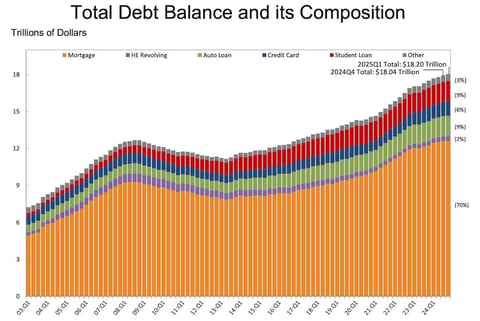
Student loan balances grew by $16 billion and mortgage loan balances grew by $199 billion. Home equity lines of credit (HELOCs), which are a form of loan backed by the value of the equity in your home, contributed to the increase in debt by $6 billion.
Of the $18.2 trillion in outstanding debt, $12.8 trillion of that is mortgage loan debt. So while people tend to blame credit card debt and student loan debt for just about everything, mortgages account for over 70% of the outstanding debt in the United States.
2. The Percentage of Debt that is in Some Form of Delinquency is up to 4.3%
While no consumer takes on debt knowing that they will go delinquent or default, it certainly does happen. That’s why lenders use credit reports and credit scores when you apply for loans and other forms of credit. These tools tell a story about the likelihood that you will go delinquent or default on your credit obligations.
According to the Federal Reserve Bank of New York, as of the first quarter of 2025, 4.3% of outstanding debt is in some form of delinquency.2 Delinquency, as generally defined in the credit industry, is an account that is at least 30 days past the due date.


The credit reporting industry standards do not allow for delinquency of 1-29 days to be credit reported.
This means everyone has a built-in 29-day grace period on their loan payments before they are reported as delinquent to any of the credit bureaus.
Because the Fed’s statistics are based on credit report data, their definition of delinquency would have to be the same. The bottom line is you don’t want to be a part of that 4.3%.
3. Mortgage Loan Interest Rates are Around 6% to 6.85%
Why should you care about mortgage loan interest rates? There are two answers to that question, and they are related. First, the amount of money you borrow to buy a home (aka, a mortgage loan) is likely going to be the largest amount of money you’ll ever borrow as a consumer.
According to the credit reporting agency Experian, the average mortgage loan balance grew to $252,505 in 2024, an increase of $8,000 from 2023.3
The second reason you should care about mortgage loan interest rates is that it is going to determine the cost to service your mortgage loan debt.


At the time of this article the average mortgage loan interest rate was 6.85% for a 30-year fixed rate mortgage and 5.99% for a 15-year fixed rate mortgage, according to the Federal Reserve Bank of St. Louis.
Financial advisors vary in their advice as to whether you should choose a 15 or 30-year mortgage. A 15-year mortgage is going to have a much higher monthly payment than a 30-year mortgage, but you’ll pay much less interest over the life of the loan, and your principal loan balance will reduce much faster.
The monthly payment of a 30-year mortgage is lower, but you can always voluntarily choose to pay more each month, essentially turning your 30-year mortgage into something much less than a 30-year mortgage.
4. You Will Need a FICO Score of 760 or Higher to Earn the Lowest Rates on Loans
It is highly likely that your FICO score will be considered by your lender when you apply for a loan or any other form of credit. The higher your FICO score, the better deal you’ll get from the lender because you pose less credit risk.
According to FICO, in order to earn the best interest rates on mortgage loans, you’ll need a middle numeric FICO score of at least 760.4
So, what does that mean? The way mortgage loans are currently underwritten, the lender or broker will pull all three of your credit reports and three of your FICO credit scores and use the middle numeric score as the basis for their lending decision.
| FICO Score Categories | Score Range |
|---|---|
| Exceptional | 800-850 |
| Very Good | 740-799 |
| Good | 670-739 |
| Fair | 580-669 |
| Poor | Below 580 |
Also, according to FICO, to earn the best interest rates on auto loans, you’ll need a FICO score of at least 720. That’s a little misleading because the FICO score that’s commonly used for auto lending is not the same type of FICO score that’s used for mortgage lending.
Auto lenders commonly use the FICO Auto score,5 which is a semi-customized scoring system tuned to predict auto lending risk.
| FICO Scores Used by the Three Major Credit Bureaus | ||
|---|---|---|
| EXPERIAN | EQUIFAX | TRANSUNION |
| Widely used versions | ||
| FICO® Score 9 FICO® Score 8 | FICO® Score 9 FICO® Score 8 | FICO® Score 9 FICO® Score 8 |
| Versions used in auto lending | ||
| FICO® Auto Score 9 FICO® Auto Score 8 FICO® Auto Score 2 | FICO® Auto Score 9 FICO® Auto Score 8 FICO® Auto Score 5 | FICO® Auto Score 9 FICO® Auto Score 8 FICO® Auto Score 4 |
| Versions used in credit card decisioning | ||
| FICO® Bankcard Score 9 FICO® Bankcard Score 8 FICO® Score 3 FICO® Bankcard Score 2 | FICO® Bankcard Score 9 FICO® Bankcard Score 8 FICO® Bankcard Score 5 | FICO® Bankcard Score 9 FICO® Bankcard Score 8 FICO® Bankcard Score 4 |
| Versions used in mortgage lending | ||
| FICO® Score 2 | FICO® Score 5 | FICO® Score 4 |
| Newly released version | ||
| FICO® Score 10 FICO® Auto Score 10 FICO® Bankcard Score 10 FICO® Score 10T | FICO® Score 10 FICO® Auto Score 10 FICO® Bankcard Score 10 FICO® Score 10T | FICO® Score 10 FICO® Auto Score 10 FICO® Bankcard Score 10 FICO® Score 10T |
If you’ve never seen your FICO Auto score, you’re not alone. The FICO scores that are generally available to consumers on websites and through your lenders are not FICO Auto scores.
You should take comfort in the fact that what makes for a solid FICO score is the same as what makes for a solid FICO Auto score.
5. Auto Loan Interest Rates Remain High, But Don’t Focus So Much on the Averages
To be clear, the amount of interest you pay on a loan is largely based on the quality of your credit reports and credit scores, and how long it takes you to pay off a debt.
For example, if you take out a 48-month auto loan with a 10% interest rate, which is high for an auto loan, but you pay off the loan in 24 months, then you are effectively reducing the overall amount of interest paid on the loan.
Also, most of the statistics you see with respect to average interest rates for auto loans don’t take into account the possibility that an applicant has poor credit, but not poor enough to be denied.
According to Experian’s State of the Automotive Finance Market, as of Q4 2024, the average interest rate for a new auto loan is between 6.35% and 11.62%6 for loans for used cars, which is higher than it was, for example, five years ago.
However, according to FICO there are published interest rates for new and used auto loans that can be well over 16% for consumers who have FICO scores in the 500s.
| Average Auto Loan Financing and Interest Rates | ||
|---|---|---|
| Category | New Cars | Used Cars |
| Monthly payment | $742 | $525 |
| Loan amount | $41,572 | $26,468 |
| Interest rate | 6.35% | 11.62% |
| Loan term | 67.98 months | 67.2 months |
| Credit score | 755 | 691 |
Point being, don’t fall in love with the averages because those averages may not apply to you. It’s always best to check your credit reports and FICO scores before you apply for an auto loan so you have an idea what kind of interest rate to expect from the dealership’s finance manager.
For example, if you have FICO scores consistently above 800, you should expect the lowest rates available. If you have FICO scores consistently in the lower 700s and below, you should not expect the lowest rates possible.
6. 4.86% of Student Loan Debt is Delinquent or in Default
If you have a student loan or plan on taking out student loans, you’re certainly not alone. According to the Education Data Initiative, as of March 2025, there is $1.777 trillion of outstanding student loan debt.7
As of Q4 2024, some 4.86% of federal student loan dollars were in default. And, on May 5, 2025, collection activities on federal student loans resumed after years of payment stoppages due to the COVID-19 pandemic.8
| Total Student Loan Debt | ||
|---|---|---|
| Quarter | Total (in millions) | YoY Change |
| 2024 Q4 | $1,777,101.97 | 2.77% |
| 2024 Q3 | $1,772,891.41 | 2.33% |
| 2024 Q2 | $1,741,137.84 | -1.14% |
| 2024 Q1 | $1,753,333.67 | -1.22% |
| 2023 Q4 | $1,729,139.13 | -1.98% |
| 2023 Q3 | $1,732,575.34 | -1.66% |
| 2023 Q2 | $1,761,243.55 | 0.99% |
| 2023 Q1 | $1,774,909.90 | 1.57% |
| 2022 Q4 | $1,764,067.41 | 1.28% |
| 2022 Q3 | $1,761,742.00 | 1.28% |
| 2022 Q2 | $1,744,007.00 | 1.45% |
| 2022 Q1 | $1,747,455.51 | 1.67% |
| 2021 Q4 | $1,733,415.18 | 2.34% |
| 2021 Q3 | $1,739,443.83 | 2.53% |
| 2021 Q2 | $1,719,067.51 | 2.78% |
| 2021 Q1 | $1,718,706.56 | 2.80% |
What many consumers don’t know is that student loans are credit-reported disbursement by disbursement. That means if you have taken four student loan disbursements, there will be four student loans on your credit reports.
And if the loans remain in default, that will appear on your credit report four times.
Point being, if you choose to take out student loans, be aware that they will report separately for each disbursement. That underscores the importance of paying them all on time so you don’t end up with multiple delinquent and/or defaulted loans on your credit reports.
7. Installment Loans Are Considered in the “30%” Category of FICO Scores, But Are Almost Entirely Benign
Everything on your credit report that is considered by scoring models falls neatly into one of a variety of credit scoring metric categories.
For example, in FICO’s credit scoring systems, the presence (or lack) of negative information is considered in the Payment History category, which is worth 35% of the possible points in your FICO credit score. The same holds true for other information on your credit reports, including loans.
Loans are installment accounts/debt. Meaning, you will have a fixed payment for a fixed number of months. For example, you may have a 48-month auto loan where you will make the same payment of $400 for each of those 48 months.
When you take out your next loan, the payback structure will be something similar, albeit with a different number of months and a different monthly payment amount.
| FICO Score Factor | Percentage of Your Score |
|---|---|
| Payment History | 35% |
| Amounts Owed | 30% |
| Credit History | 15% |
| Credit Mix | 10% |
| New Credit | 10% |
The consideration of installment debt falls in the Amounts Owed category of metrics in FICO’s credit scoring systems. That category, as a whole, is worth 30%9 of the possible points in your FICO credit scores.
And while that sounds like a lot of points, the most important consideration in that category of metrics has to do with credit card debt, not installment debt. In fact, installment debt is practically benign to your FICO credit score as long as it’s being paid on time.
What this means, in practical terms, is you should not choose the size of your loan based on what you think the impact will be on your FICO credit scores. Choose your loan amount, to the extent you can control it, based on your needs.
I’ll give you a real-life example illustrating just how little installment debt influences credit scores. Several years ago, I borrowed about $250,000 to buy a house (a mortgage loan). My credit scores didn’t change at all when the debt hit my credit reports.
When I paid off the loan several years later, an amount of about $240,000, my credit scores went up a whopping four points. And, there’s no guarantee the four-point change had anything to do with paying off the debt.
In sum, there was little to no improvement in my scores because there was little to no reduction caused by the debt.
8. Buy Now, Pay Later (BNPL) Loans Are Becoming More Popular Loan Options
A BNPL loan is a small-dollar, small-term loan generally used to pay for online purchases. For example, you may find a pair of running shoes online that cost you $150. You can make the purchase on a credit card, or you can choose the retailer’s BNPL option, which could be something like three monthly payments of $50.
According to the Consumer Financial Protection Bureau (CFPB), 20% of borrowers financed at least one purchase with a BNPL loan in 2022, and most BNPL borrowers took out multiple BNPL loans.10
The CFPB, which is generally bearish on BNPL loans, also indicates that two-thirds of BNPL loans were taken out by consumers with lower credit scores.
While taking out a BNPL loan is your choice, you should consider the impact on your credit scores. BNPL loans are installment loans, and if you read the prior statistic, you know that installment loans are almost benign to your credit scores.
But, BNPL loans pose a different problem to your credit scores, their age, and frequency.
One of the metrics in FICO credit scoring is the age of your credit reports.11 Two of those metrics are the average age of your accounts and the age of the newest account opening.
Buy now, pay later (BNPL) loans can pose a risk to your credit scores because of their short terms, which can impact the average age of your accounts if they’re reported.
If you are constantly using BNPL loans and the BNPL lender reports those loans to the credit bureaus, they will lower the average age of your credit report. That is a mathematical certainty.
And, if you take out multiple BNPL loans, which the CFPB indicates is common, then you’re going to lower the average age of your credit reports more and for a longer period of time.
This age component is one of the hardest FICO metrics to master because you cannot control your age and how long you have used credit. Someone who is 25 years old simply is not going to have as old of a credit report as someone who is 50 years old.
That’s why younger consumers don’t hit the perfect 850. By constantly adding new loans to your credit reports, you too will not be able to hit the perfect 850 because you will not be able to max out the length/age of your credit reports.
9. Personal Loan Interest Rates Vary Wildly Based on Credit
Another type of loan is the personal loan, sometimes also called a signature loan. Personal loans are installment loans just like mortgages and auto loans, but that’s where the similarities end.
Unlike most installment loans, personal loans do not have any form of tangible collateral, like a house or a car. What secures the loan is only your signature, hence the term signature loan.
Personal loan interest rates vary wildly based on the lender and the credit quality of the applicant. For example, it’s not hard to find personal loans from reputable lenders like Wells Fargo with rates as low as 6.99%. It’s also not hard to find personal loans from reputable lenders like Prosper with rates as high as 35.99%.
Personal loans are generally best used to consolidate other, more expensive, revolving credit card debt. The average interest rate on a credit card is now well over 20%, according to the Federal Reserve Bank of St. Louis.12


To the extent you can pay off credit card debt with a less expensive personal loan, that’s certainly a financial win. You’d also be converting score-damaging credit card debt to score-benign installment debt.
10. Calculate Your DTI Ratio Before Applying for a Loan
One of the key statistics that lenders will calculate when considering your loan applications is your debt-to-income ratio or DTI. Your DTI is calculated by dividing the sum of your scheduled monthly payments by your gross monthly income.
So, if you have to pay $2,000 each month in payments to lenders and you make $7,500 in gross income each month, then your DTI is 26.66% because $2,000 ÷ $7,500 = 26.66%. That means between 26%-27% of each of your monthly earned dollars is already earmarked for servicing your debt.
The reason this statistic is so important is that lenders consider it when determining how much they are willing to let you borrow, or your “capacity.” Generally, a DTI ratio at or below 35% is considered good.
Anything higher than 35% starts getting problematic because it indicates the consumer is experiencing financial stress.
It is not at all uncommon for lenders to deny creditworthy consumers, those with high enough credit scores, because of an elevated and unacceptable DTI ratio.
Generally, the lender will use terms like “Insufficient income relative to loan amount requested” or some derivative of that phrase.
11. 14% of Applicants Are Denied Auto Loans
Whenever you apply for an auto loan, or any loan for that matter, there is a chance your application is going to be denied. According to the Federal Reserve Bank of New York, 14% of auto loan applications are rejected.13
This is the highest rejection rate in at least the last ten years and a massive spike from the 1.4% rejection rate in February 2024.


This is troubling especially considering just how easy it is to get an auto loan. There is literally an auto loan product for almost everyone, even consumers who have FICO scores in the 500s.
And, if you’re willing to put down a large enough down payment on the purchase and buy down the loan amount, almost anyone can find auto financing.
12. 14.2% of New Mortgage Loan Applicants Are Denied
As with auto loans, whenever you apply for a new mortgage loan there is a chance your application is going to be denied. According to the Federal Reserve Bank of New York, 14.2% of mortgage loan applications are rejected, which is about the same percentage as auto loan applications.14
While 14.2% sounds high, that’s the lowest it’s been since October 2023 and a sharp drop from just October 2024 when the rejection rate was 22.6%.


Of course, the best way to ensure the best odds for a mortgage loan approval is to improve your FICO credit scores and eliminate as much credit card debt as possible.
That will indicate to lenders that you are creditworthy, and you have the financial capacity to take on the large monthly payment amount that accompanies a new mortgage loan.
13. The Percentage of Mortgage Refinancing Applicants Who Are Rejected is Staggering
Perhaps the most troubling statistic regarding loan denials is the percentage of mortgage refinance applications that are denied.
A mortgage refinance is just that, an attempted refinancing of an existing mortgage loan. Think of it as a mortgage loan that is replacing an existing mortgage loan.
Brace yourself. According to the Federal Reserve Bank of New York, 41.8% of mortgage refinance applications are rejected as of their February 2025 data point.15 This is almost twice as high as the rejection rate as of October 2024 and easily the highest in at least the last 10 years.


There are really only a few reasons why someone would be denied a mortgage refinance. Lower credit scores, less income, or a drastic drop in the value of your home are reasons why you’d be denied a mortgage refinance. It’s hard to improve any of these things, and certainly it’s hard to improve them quickly.
So, to the extent you can address these things over a long-term horizon of time, you’ll be in a better position for a refinance approval.
Data Sources
1 https://www.newyorkfed.org/microeconomics/hhdc.html
2 https://www.newyorkfed.org/newsevents/news/research/2025/20250513
3 https://www.experian.com/blogs/ask-experian/how-much-americans-owe-on-their-mortgages-in-every-state/
4 https://www.myfico.com/credit-education/calculators/loan-savings-calculator
5 https://www.myfico.com/credit-education/credit-scores/fico-score-versions
6 https://www.experian.com/blogs/ask-experian/auto-loan-rates-financing/
7 https://educationdata.org/student-loan-debt-statistics
8 https://www.ed.gov/about/news/press-release/us-department-of-education-begin-federal-student-loan-collections-other-actions-help-borrowers-get-back-repayment
9 https://www.myfico.com/credit-education/credit-scores/amount-of-debt
10 https://www.consumerfinance.gov/about-us/newsroom/cfpb-research-reveals-heavy-buy-now-pay-later-use-among-borrowers-with-high-credit-balances-and-multiple-pay-in-four-loans/
11 https://www.myfico.com/credit-education/credit-scores/length-of-credit-history
12 https://fred.stlouisfed.org/series/TERMCBCCALLNS
13 https://www.newyorkfed.org/microeconomics/sce/credit-access#/experiences-credit-applications6
14 https://www.newyorkfed.org/microeconomics/sce/credit-access#/experiences-credit-applications15
15 https://www.newyorkfed.org/microeconomics/sce/credit-access#/experiences-credit-applications18


